Dubai to Doha: Fear and Loathing In the Gulf
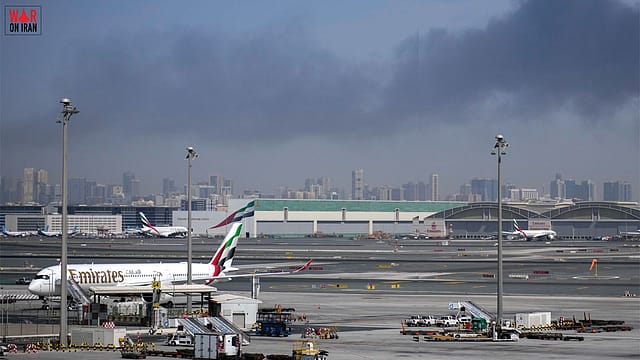
A TOP DUBAI-BASED Indian-origin businessman with investments in India is piqued that Republican Senator Lindsey Graham wants at least one of the Gulf Cooperation Council (GCC) states, especially Saudi Arabia, to join the war against Iran. Launched on February 28 by the US and Israel, even as negotiations with Tehran were underway, the war has killed Ali Khamenei and scores of other key officials of the Islamic Republic.
“It is their war, the second in eight months or so, after the attacks last June in which they claimed to have obliterated Iran’s nuclear enrichment capabilities and its centrifuges. Why this new war unless the intention is to create mayhem, and unless it is guided by a certain messianic mission?” the Indian businessman asks.
He says that he shares the views of Emirati billionaire Khalaf Ahmad Al Habtoor who has hit out at US President Donald Trump and Graham over the war. In a widely shared post on X, Al Habtoor had asked, “Who gave you the authority to drag our region into a war with #Iran?”
Ramesh Kumar, who runs a tea shop not far from Yas Mall in Abu Dhabi, shares similar views about the war. He begins by praising the leadership of the United Arab Emirates (UAE) for allaying the fears of those who live and work in the country, often seen as a stable hub for tourism, HNIs (high-net-worth individuals), and investment, but adds that commodity prices rose almost immediately after the war began.
“We know that Iranians are retaliating, not attacking. It is the US and Israel that are responsible for this war,” he says, emphasising that this is the general sentiment he hears on the street.
Interviews with Indians living across six GCC countries, besides Saudi Arabia and the UAE, such as Qatar, Kuwait, Bahrain, and Oman confirm worries about the future if this war drags on. In many of these countries, tension lingers round the clock as sirens go off and missiles and drones from Iran fly past. Even so, most people insist they do not feel unsafe. Yet, what many of them find difficult to digest are provocative statements by the likes of Pete Hegseth, Graham, Marco Rubio, and Trump himself, who they say appear more interested in war than peace.
Many informed commentators, including businessmen and academics Open spoke to, confide, on condition of anonymity, that they worry about the reputation of their countries, which until recently were known for safety, peace, prosperity, and access to surplus energy supplies. Abu Dhabi-based Jyotsna Mohan Bhargava, author and columnist who was earlier a senior news anchor with NDTV, says that while she appreciates the government’s efforts to appeal for calm and its preparedness not to be provoked, life is far from normal because “you sleep with alerts, wake up with alerts, and the region is in the midst of a war.” Bhargava hastens to add that the UAE government deserves praise. “We just came out of Covid a few years ago and now schools are closed and universities have moved to online classes. It is not normal,” she says.

Others in the UAE that Open spoke to also cited recent comments by Jamal Al Musharakh, UAE’s envoy to the UN office in Geneva, who said: “Our bases are not being used to attack Iran.” Stating that the country was being targeted “in a very unwarranted manner,” he added that the UAE would “not partake in any attacks against Iran.”
Again, most Indians in the region want to remain positive and place their faith in their governments because they had gone there in search of opportunity: to build careers, make the most of what the region offers and, in many cases, strike it rich.
The population of Indians living in GCC countries is upwards of nine million. The UAE hosts about 3.55 million of them, followed by Saudi Arabia (2.64 million) and Kuwait (around one million), while the other GCC countries are also home to large Indian communities. Taken together, these countries host about 62 million people, including roughly 35 million foreign workers—many from India, Pakistan, Bangladesh, Nepal, and the Philippines.
A few entrepreneurs, like Dubai-based Vimal Kumar, CEO of Omnispay, a fintech firm, remain unperturbed by the opinions doing the rounds about the UAE’s future in the wake of this war. Kumar, a former banker-turned-fintech entrepreneur who has worked across India, Southeast Asia, Africa, and the Middle East for years, tells Open, “I live here. I build here. I have staked my business and my future here. So, when people ask me whether the war has damaged the UAE’s reputation as a destination for business, investment and high-net-worth individuals, my answer is not hedged. Reputation is not built in times of calm; it is revealed in times of crisis. And what this crisis revealed was a state of extraordinary institutional depth. The UAE intercepted hundreds of ballistic missiles, drones and cruise missiles, and still kept its supermarket shelves stocked, its hospitals running, and its government communicating with calm authority throughout.”
Kumar goes on, “For the Indian entrepreneur, the HNI family and the real-estate investor sitting in Mumbai or New York asking whether Dubai is still the right bet—I would ask one question in return: Where else would you go? Singapore is tightening. London is raising taxes. Lisbon has curtailed its Golden Visa. US immigration is a mess. The landscape of premium destinations has narrowed, which makes the UAE’s proposition—zero income tax, Golden Visa security, world-class infrastructure, and a 3.5-million-strong Indian community that chose to stay through this conflict, not flee—more valuable, not less.”
Kumar adds that there may be a brief cooling in real estate sentiment and a temporary dip in tourism bookings. “But Dubai has weathered oil collapses, a global financial crisis and a pandemic, and each recovery has reached a higher floor than the last. A city that withstands missile fire with its institutions intact and its governance credible does not permanently lose its allure. It deepens its moat. I believe the UAE will not merely survive this test; it will be validated by it.”
That is great optimism indeed.
Another businessman who has lived in the UAE for decades says GCC countries have not been aggressive towards Iran because that country is grieving the assassination (also viewed as martyrdom) of its Supreme Leader, often a serious matter in Islam. “Although the threat of war involving Iran and Israel was on the horizon, most people, both locals and expatriates, were shocked at the bombing and the killing of several hundred people, including the Ayatollah, especially when negotiations were underway,” he says.
Unlike Kumar, he is cautiously optimistic about the reputational setback for the region, which former Indian Ambassador to Iran Gaddam Dharmendra says has been altered by Tehran since the start of this war. This businessman adds: “The immediate impact on the Gulf countries is the loss of their reputation as a very safe place. They have always maintained a working relationship with Iran. And the attack took them by surprise. The crisis in the Strait of Hormuz could impact these economies badly if it is not resolved quickly.”
WHAT IS MOST worrying, though, is that the crisis seems far from over, with Iran firing missiles and drones at targets across the Gulf, especially US bases in these countries and where Americans stay, in over 40 “waves” of attacks, amid concerns over global energy and fertiliser supplies.
India, among the world’s leading recipients of remittances at $118.7 billion in 2023–24 according to the Reserve Bank of India’s (RBI) latest Remittances Survey 2025, depends significantly on the Gulf. GCC countries such as the UAE, Saudi Arabia, Qatar, Kuwait, and Oman alone account for 36.4 per cent of the total. The US accounts for 27.7 per cent, emerging as the single-largest source.
When Open reached out to Indians living in other GCC nations, Bahrain appeared to be among the most affected countries, while things are gradually returning to normal in Qatar and Kuwait. Of all countries in the region, a greater sense of stability among the public was felt in Oman, possibly owing to its role as a mediator in the recent US-Iran talks, even as authorities in that country were battling a fire in fuel tanks at its Salalah port hit by drones. Iran, reports said, told Oman that it was investigating the attack.
Kuwait-based businessman Suresh KP says things are normal in Kuwait, too, despite early panic and fears of being caught in the crossfire of Iranian retaliation. As he gave Open an interview, Suresh, as secretary of the Indian Business and Professional Council in Kuwait, a non-profit voluntary organisation, was busy multitasking, assisting stranded Indian travellers, offering them stay and food. “We have flown them back to India via Saudi Arabia. They were mostly from Gujarat and Kerala,” he said, noting that Kuwait’s defence capabilities are formidable and that, in sharp contrast with television reports in India, especially in Kerala, people are safe there. The businessman, who is also a member of the Loka Kerala Sabha, a platform for Malayalis across the globe, praised the Indian embassy for responding swiftly to the challenges of the war and to the concerns raised by Indians residing in the country.
Likewise, Saju John, a senior accountant based in Muscat, told Open that Oman appears to be the one country in the region where schools remain open and there are no alerts warning people of attacks. “Many people from nearby GCC countries are travelling to Oman to fly back home,” said John, who has lived in Muscat for 31 years.
Despite such exceptions, the blare of alerts continues to be common in cities like Dubai, Abu Dhabi, Riyadh, and Doha, where public events, tourism activities and large gatherings have been restricted in several areas.
In Bahrain, a person close to the matter told Open that the government had to crush mass protests shortly after the killing of Khamenei. Bahrain was a target for Iranian attacks, after all, because it hosts the US Navy’s Fifth Fleet. Not surprisingly, although Iranian President Masoud Pezeshkian had apologised for attacks on neighbouring “brotherly” countries, pressures from within Iran and provocations from the US meant he later withdrew those statements.
More importantly, migrant workers, who work under the kafala system in which legal status is tied to their employer, cannot leave the country without employers’ permission. In some parts of the Gulf and beyond, there are cases of delayed wages in construction and hospitality. Some analysts fear hiring freezes for new immigrant workers. “This could significantly affect remittances sent to South Asia, which depend heavily on Gulf employment,” a businessman based in Riyadh said.
Meanwhile, in an attempt to goad GCC nations to influence the US, Iran has said that any Arab or European country that expels the ambassadors of Israel and the US from its territory would be granted full authority and freedom to sail their ships through the Strait of Hormuz.
Even so, most people who spoke to Open were careful not to criticise any party openly in this ongoing war. Yet, billionaire Al Habtoor’s X posts criticising Trump and Graham broadly reflect a sentiment gaining ground across the Gulf, including his statement: “We don’t need your protection… all we want from you is to keep your hands off us.”
KP Nayar, a Delhi-based foreign policy columnist and analyst who has worked for years in the Gulf region, says Al Habtoor’s statement comes at a time of glasnost in some Gulf monarchies. “Khalaf Al Habtoor’s open letter is a reflection of that openness,” he says. “This is not the first time he has spoken out. He often writes in the local media and maintains a blog. But most of his past writings were on pan-Arab matters. This is probably the first time he has written about something that affects the soft underbelly of his own country, the UAE.”
Nayar says Al Habtoor is essentially echoing the Arab street. “What he is reflecting is what is being discussed every day during the ongoing iftars and the informal daily majlis in prominent Arab households and in the palaces of rulers during daily gatherings,” he adds. Al Habtoor is not an exception in the current glasnost in the Gulf, Nayar notes. “Even in more restrictive Saudi Arabia, local intellectuals are speaking out and writing in the media and on Arabic news channels. Will this glasnost be permanent? Will it survive the ongoing war? It depends on the final outcome.”
As regards Iran’s strategy in targeting American bases in GCC nations, Nayar says Tehran appears to have decided that if it is going down, it will take others along in the process. “That is why Iran is attacking civilian targets such as the Palm in Dubai, some airports and refineries, in addition to US military bases in GCC countries. In a war like this, military bases are natural targets—no surprise there,” he says.
However, he notes a key difference from last year. “When a US military base in Qatar was attacked, Iran had given prior warning so as not to escalate. This time, Iran’s attacks on US bases are no-holds-barred.” There is also speculation about Iran running out of missiles and drones. “It is entirely possible that the US may run out of interceptors before Iran runs out of missiles,” Nayar says. “The US is overextended, especially with largescale supplies to Ukraine. This was evident during Trump’s meeting with defence industry heads asking them to ramp up production.”
Overall, there is palpable anger and frustration across GCC nations against the coordinated Israeli-American strikes on Iran, attacks that many observers, especially diplomats like Dharmendra who possess deep knowledge of the region, say will have economic and political consequences far beyond the Middle East.
The remarks many in the region appear to resent most came from Senator Lindsey Graham, urging them to get “more involved as this fight is in their backyard”. A Delhi-based official with a GCC country tells Open, “They have miscalculated all their moves and we do not want to pay the price for it any further.” GCC nations, he adds, do not want to trade political stability for anything else.
Iran seems to know this only too well amidst the growing concern that migrant labourers in GCC countries, including many from India, will be the first to bear the brunt as wages are delayed and jobs disappear.