Donald Trump To Increase Tariffs On EU Cars To 25% Next Week, Citing Non-Compliance From Bloc
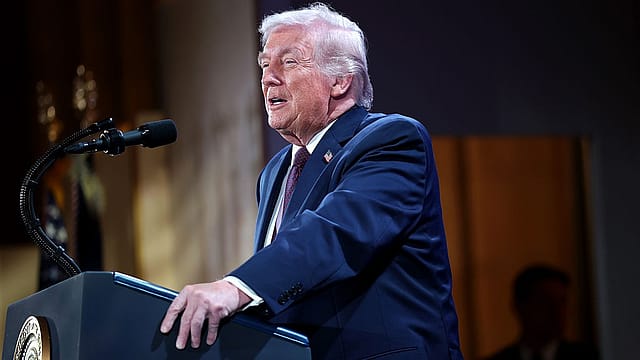
US President Donald Trump on Friday announced that tariffs on cars and trucks imported from the European Union will be increased to 25 per cent starting next week, citing alleged non-compliance by the bloc with a trade agreement.
According to a post on Truth Social, the US President stated that the vehicles manufactured in the United States would not face any such tariffs, encouraging companies to expand domestic production.
"I am pleased to announce that, based on the fact the European Union is not complying with our fully agreed to Trade Deal, next week I will be increasing Tariffs charged to the European Union for Cars and Trucks coming into the United States. The Tariff will be increased to 25 per cent," his post read.
"It is fully understood and agreed that, if they produce Cars and Trucks in U.S.A. Plants, there will be NO TARIFF. Many Automobile and Truck Plants are currently under construction, with over 100 billion dollars being invested, a record in the history of car and truck manufacturing," it added.
The US President also claimed that several new manufacturing facilities are being built in the country, which he said would create jobs for American workers and strengthen the domestic industry.
"These plants, staffed with American workers, will be opening soon -- there has never been anything like what is happening in America today," he added.
The trade deal, announced in July 2025 between the US and the EU, comprising 27 member states, unveiled a bilateral framework agreement aimed at resolving various tariff and trade issues.
Trump and European Commission President Ursula von der Leyen announced the trade agreement during the US president's European visit, under which tariffs on European goods were set at 15 per cent.
The European Union also committed to purchasing USD 750 billion worth of energy from the US.
Earlier in February, the US Supreme Court held that the 1977 International Emergency Economic Powers Act (IEEPA) does not grant the President the authority to levy tariffs.
The Bench of Nine Justices ruled 6-3, with Chief Justice John Roberts authoring the majority opinion. Justices Brett Kavanaugh, Clarence Thomas and Samuel Alito dissented.
The majority ruling held that the US President lacked authority under the 1977 International Emergency Economic Powers Act (IEEPA) to impose sweeping import duties on goods from nearly all US trading partners.
(With inputs from ANI)