Donald Trump has limited capacity to deter Israel, says Michael Kugelman
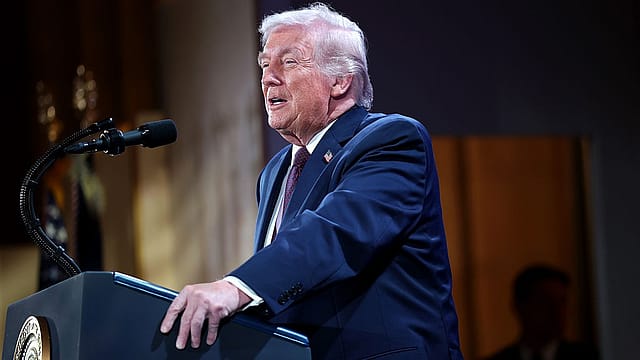
Michael Kugelman, Senior Fellow for South Asia at Atlantic Council, says Donald Trump will inevitably be asked what tangible gains the war delivered for American interests, particularly when Israel appears determined to keep fighting and the prospect of renewed conflict remains very real. Equally significant, he notes, is the absence of any clear pathway in the current negotiations for Iran to formally roll back its nuclear programme.
Kugelman, who previously led South Asia research and programming at the Wilson Center, tells Open: “We've also seen that Trump has had limited capacity to deter Israel from continuing hostilities. And if the US president can't deter the Israelis, it's hard to imagine who can. Perhaps there's an opportunity here for India, given its rapidly expanding partnership with Israel and the strong rapport between Modi and Netanyahu.

Greening the Future
23 Jul 2026 - Vol 05 | Issue 30
Securing a sustainable India
The Fletcher School alumnus also argues that Pakistan has used its role in facilitating contacts between Washington and Tehran to engineer something of an image makeover. “It's had a bad global image for several decades, mainly because of its terrorism problems. But now there are relatively few global capitals that wouldn't describe Pakistan as a peacemaker,” he says.
Edited excerpts from an interview:
The war on Iran has apparently ended with an agreement that many commentators view as a strategic victory of sorts for Tehran and a setback for President Trump. Critics point out that he joined Israel in a campaign widely seen as aimed at regime change in Iran, yet the regime remains firmly in place. What is your assessment of the outcome?
It is the outcome Trump was prepared to accept. Trump himself, during the early part of the war, described the conflict as a regime-change operation. But in reality, he had no interest in being involved in a long, interminable, and expensive war, and especially one that could lead to US casualties. The problem for Trump is that one can now easily ask, what was the point? The outcome essentially marks a return to the status quo ante, with the naval blockade lifted and access restored to the Strait of Hormuz.
Critics can reasonably ask Trump and his government what benefits or positive changes the war brought for US interests—and especially given that Israel's desire to keep fighting could bring on renewed conflict, and given that there are no clear pathways, per the current negotiations, to Iran formally pulling back from its nuclear programme.
How does this new arrangement between Iran and the United States differ from the 2015 Joint Comprehensive Plan of Action (JCPOA) both in substance and in its broader geopolitical implications?
There are similarities in that, in both cases, there were pledges to limit Iran's nuclear programme and ease up on US sanctions against Iran. But the context in the two cases is quite different, because the current arrangement ends a war, while the JCPOA was a diplomatic exercise.
Pakistan has been credited in some quarters for playing a constructive role in facilitating dialogue between Tehran and Washington. Do you think Islamabad has genuinely earned recognition for its efforts to help broker peace?
Oh, absolutely. Islamabad has received widespread acclaim from the international community for its mediation. There's no stronger data point than the US-Iran MOU itself, which has been deemed the "Islamabad" memorandum. And quite frankly the praise is well deserved. Pakistan was in the mediation seat from start to finish—and the start actually stretches back to the Iran conflict last year, when the Pakistanis were first starting to position themselves as Iran mediators and Donald Trump—after hosting Asim Munir for lunch--praised Pakistan for knowing Iran "better than most."
I'd argue the international community's recognition of Pakistan as a mediator is the culmination of a massive image transformation for Pakistan. It's had a bad global image for several decades, mainly because of its terrorism problems. But now there are relatively few global capitals that wouldn't describe Pakistan as a peacemaker. That's a striking turnaround right there. And for a Pakistani civilian and military leadership always looking for ways to soften global perceptions of Pakistan, this is just what the doctor ordered.
What, in your view, were the principal reasons President Trump opted for a deal, despite the risk of alienating influential pro-Israel groups and neoconservative voices at home? Was he primarily responding to sentiment within the MAGA base, or had circumstances left him with little alternative?
It's all political. Trump knows that much of his base voted for him based on his promise not to start new wars. The war is highly unpopular at home. And midterm elections are only months away. This is less consequential for Trump himself, and more so for his party. There was always good reason to believe that he would be looking for an offramp. From a political perspective—given how food inflation and energy prices have continued to go up in recent months—it may have taken him longer to find an offramp than he would have liked. But better later than never, from Trump's perspective.
Israel has faced increasingly sharp criticism, including from some of its traditional allies, over what many see as its fixation on military solutions, particularly in South Lebanon. What does this agreement mean for Benjamin Netanyahu? Do you expect him to continue to seek ways to undermine or derail the deal?
I certainly anticipate Netanyahu looking for ways to reopen the conflict. From Israel's perspective, this is all about a dire national security interest—the need to take kinetic action against a hostile regime in its neighborhood that rejects Israel's existence and is developing a nuclear programme.
We've also seen that Trump has had limited capacity to deter Israel from continuing hostilities. And if the US president can't deter the Israelis, it's hard to imagine who can. Perhaps there's an opportunity here for India, with its fast-growing partnership with Israel and the strong ties between Modi and Netanyahu. Ultimately, however, Israel is unlikely to be deterred if it concludes it needs to continue to embrace military solutions.