Donald Shrunken Trump
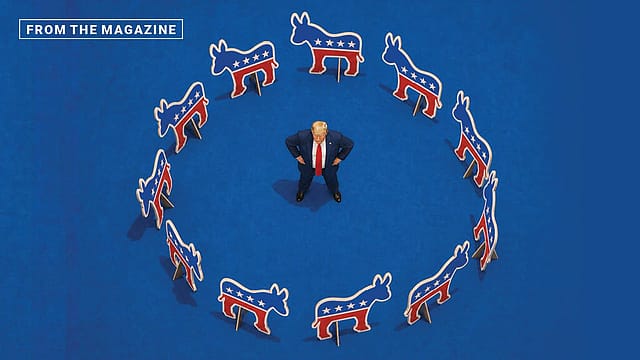
Earthquake doesn’t quite describe the events of November 4 in the US. The Democratic Party regained control of Congress. It did so by sweeping the Republicans out of power in their key strongholds. A Democrat winning in elections to the Senate from Kansas and Texas is almost unheard of. The effects of the US’ war on Iran, the subsequent gallop in inflation and its downstream effects, what Americans call the “affordability crisis”, undid the phalanx Donald Trump had made barely two years ago.
The recriminations began within hours of the results. In a post on X, Vice President JD Vance listed four factors for the erosion of support among Republican voters. These were the war with Iran, cost of living inflation, emphasis or rather dis-emphasis on American nationalism, and the US’ relationship with Israel. The insurgent Trump base—the Make America Great Again (MAGA) voters—chose Trump for a set of reasons, chief among them the focus on the US (MAGA), ending “forever wars”, and ensuring economic benefits for Americans. All these goals were either abandoned by the Trump administration or managed poorly. The rebellion of these voters reflected in the results of the midterms.
Democratic control of Congress will not solve the US’ problems but will further deepen them. Given the extent of political polarisation in the country and the unbridgeable ideological divide between the two parties, it is certain that the newly empowered Democratic establishment will train its guns on Trump. Inquiries and investigations into the president’s allegedly corrupt dealings across the world will consume the rest of his presidency. A deadlock between the legislative branch and the executive branch is certain now. Trump will not let Democrats advance their legislative agenda—he will use the veto liberally—even as Democrats make it impossible for him to appoint anyone. Anything that requires ratification by the Senate will now become very difficult, if not impossible.
This deadlock is not just about unmanageable ideological differences in the US party system but reflects wider divisions in American society. Issues like illegal immigration, racism, economic inequalities and, in general, an era of diminished economic fortunes, have all combined to make a toxic mess. Over time, Democrats have done little to address illegal immigration and looked the other way when people from Latin America entered the US. Trump, for his part, attempted a blunt solution to fix that problem. But what damaged him the most was the war with Iran and its consequences. For a society used to 2 per cent inflation, galloping prices of fuel (such as diesel) and groceries are unbearable. The latest print for Consumer Price Index (CPI) is 3.7 per cent (September). Energy prices have gone up by 5.2 per cent with a 9.1 per cent increase in gasoline prices. Inflation, as any politician knows, is a killer at the hustings.
In the coming days there will be a spate of advice for India, largely from Indians, along the lines of “what New Delhi should do” and, in general, commentary like “implications of the US results for India.” Much of this, though not all, will be speculative or self-serving. If recent events are any measure of bilateral ties, it does not matter who controls Congress or the executive. Ties with India will remain lukewarm at best. The degree of hostility towards India in practically all walks of American life has gone up dramatically in recent years. Trump’s tariffs on Indian exports undid whatever goodwill existed bilaterally. While Indian diplomats will do what is needed to present a correct picture, the political reality of the contemporary US should not be lost sight of.
Two examples highlight the issue very well. When Trump was elected president the first time in 2017, Congress passed the Countering America’s Adversaries through Sanctions Act (CAATSA). That piece of legislation functioned as a potent tool of blackmail against India as it had purchased Russian military hardware (the S-400 missile defence system in particular). Nine years later, during the second Trump presidency, the Lindsey O Graham Sanctioning Russia and Iran Act, 2026 was passed in August this year. The latter law has India as a target for sanctions for purchasing oil from Russia. Both laws enabled the US president to waive sanctions if he chose to do so. Both had a large measure of bipartisan support in Congress. Both are designed to ensure “good behaviour” on India’s part. That the two laws were enacted during the tenure of a president allegedly considered the “best” for Indian interests in a long time tells its own story.
Not that Democrats would bring daylight to bilateral relations either. Given the “progressive” bent in the party’s politics, India is now considered a “competitive autocracy” by many of its leading lights in academia, think-tanks and elsewhere. In this case, the pressure would come from a different angle: India’s alleged “democratic backsliding” and how the US cannot condone such behaviour in the 21st century. The difference between Trump and Democrats is the choice of weapon—a hammer in the hands of one and a sophisticated stiletto for the other. The net effect is the same: punishing India.
This ‘backsliding’ in relations should be taken in its proper perspective. The US is not formally engaged in ‘taming’ India. At the moment, the American political establishment has other priorities. India is nowhere on that list.
For India, the lessons are clear: diversify its trading relationships for safety against depending on one large, unreliable, trading partner. India values its “strategic autonomy”—an expression that raises the hackles of the American establishment and its supporters in India—greatly. If India seeks a closer embrace with the US, there will be severe trade-offs involved in maintaining that autonomy. Almost everything the US offers, or has offered, comes with strings attached.
The midterm results are an opportunity for India to quietly hunker down, expand its economy, develop alternative trading partners and trading strategies, and build relations with other “middle powers”. Rebuilding relations with the US can wait.