Definitions, Dammit!
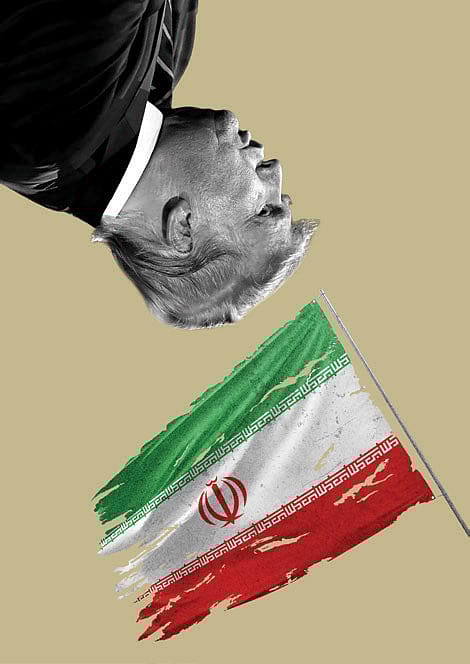
FOR ANYONE WHO WAS COUNTING THE DEAD, dreading the dark fumes over the civilisation the American president was at one point ready to wipe out, sceptical about the free passage of oil vessels through the Strait of Hormuz, doubting the restoration of the Dubai alternative to London and New York, and giving themselves to schadenfreude as Donald Trump displayed his desperation in expletives, semantics alone determined the scale of victory and defeat—or of the hopeful impasse.
Definitions were made and retailed in chatrooms, across newsprint and on airwaves, all reflecting your ideological peeves or inherited hatred towards countries still struggling to overcome bad histories. And that is why victory is better explained through the images of devastation, the list of the assassinated leaders, and the vastly diminished military and nuclear capabilities. These images form the backdrop to an idea that cannot be defeated by a superpower whose military superiority is neutralised by its moral inferiority. In suffering, Iran has enhanced its legitimacy as a victim with a history of overcoming longer wars. In death, its life multiplies.
It is powerful storytelling in which a new Persian mythology is being built around faith and persistence. Victory is redefined in the same phraseology of religious conviction as the one generally associated with repression. What matters when the postcards of dispossession and death from Gaza are replaced by the charred remains of a proud country is the perpetuation of an idea that soothes the liberal mind. An idea under attack, pitted against imperial arrogance, which itself is exacerbated by the Jewish state feeding on paranoia. In the new definition of victory, Iran, powered by God’s own armoury, is an inspirational story of defying Satan’s wrath from the ashes, exhausting the tormentor.
It is a necessary definition, for certain victories, too, are necessary at a time when defeats are not measured by what you have lost—but by what you have not gained. The recurring sight of Trump as a beleaguered Terminator pronouncing the end of Iran is defeat personified in kitschy flamboyance. And the American president did not disappoint the commentator class from the left and the insulated corner of conservatism. He played the part of the deranged imperialist to perfection. Statistics may have supported his claim about a badly mangled Islamic Republic; aesthetics defeated him. The transference of defeat from the Iranian wreckage to the American war room is made easier by the liberal eagerness to create a compatible winner.
In this upheaval of definitions, paradoxes die. Take America, which fought a lonely war, though Israel was there. Then Israel was there always, fighting for its right to be alive. In the most idealistic version of this war, America fought for the sake of freedom. What Trump wanted was a regime change to liberate Iranians from the despotism of the IRGC, and just because it was someone like Trump who said it, it lacked authenticity. The war president not only lacked the Wilsonian sophistication in his internationalism. His character flaws were more glaring than the Middle East’s fault lines he sought to undo. Anti-Americanism coupled with the so-called Trump Derangement Syndrome can turn even partial victory into total defeat.
The revolutionary republic, too, has undergone a moral inversion. As the war intensified and Iran’s defence collapsed, a winner was in the making. Imperial America’s victim would not be allowed to lose; the definition of victory was revised to accommodate Iran. Suddenly the IRGC was not political Islam’s most lethal machine but a popular instrument of resistance. The Iranian youth, periodically brutalised to remain silent, were not the IRGC’s victims but America’s. The Iranian Revolution that created Islam’s Gulag and institutionalised anti-Americanism in the Middle East became a cultural rejoinder to the West’s idea of progress and democracy. The survival of Iran’s fear apparatus was crucial to bringing the American imperium to its knees. As definitions of good and evil, of victory and defeat, turned more surreal, Islamism’s only imperium got a free supply of moral ammunition.
Repurposed definitions, in their narrative ambition, aim at repurposing history itself. As an ideologically polarised world manufactures winners and losers from the rhetorical wares of a half-fought war, is it really the beginning of a new power matrix in which America’s isolation is larger than Trump? Ideologies have a fraught relationship with moral absolutism, and by extension, freedom. The inconclusive war with inverted definitions of winners and losers leaves Iran’s freedom, too, inconclusive. Every war, when seen through the borrowed lenses of ideologies, is a crime against truth.