Defeating the Enemy Within: India had to first curb Naxalism in West Bengal before liberating Bangladesh
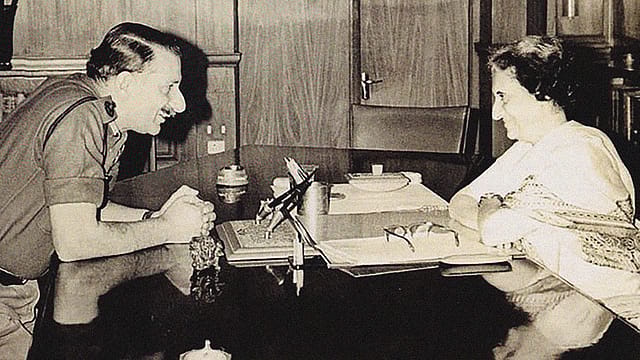
BY OCTOBER 1969, PRIME MINISTER INDIRA GANDHI and Home Minister YB Chavan were a worried lot. The happenings in Midnapore were alarming. The Naxalite-led insurgency made it imperative for the political establishment to address the concerns of the small and middle peasantry against feudal interests. The crisis in East Pakistan also loomed. Indira Gandhi despatched PN Banerjee, a joint secretary in the Research and Analysis Wing (R&AW) and Mujib’s case officer since 1965, to meet with Mujib in London. Mujib wanted to fight the forthcoming general elections in Pakistan scheduled to be held in December 1970.
By 28 July 1969, President Yahya Khan had appointed a Bengali jurist, Abdus Sattar, as chief election commissioner of Pakistan. But before Mujib could sweep the polls in East Pakistan, the radical left in East Bengal manifested in the form of Siraj Sikdar and Mohammed Toaha, and their organization and cadres had to be politically neutralized so that the political space in East Bengal could be completely swallowed up by Mujib’s Awami League. Mujib expected India to deliver on this. And, if Mujib succeeded in making a clean sweep of the polls, it would provide him with international legitimacy, something he still lacked.
Although official papers on the subject are still classified, anecdotal evidence indicates that in 1969 Indira Gandhi cleared a combined army, paramilitary, and police operation to not only ‘wage war’ against the Naxalites and elements of both Sikdar and Toaha’s outfits if they crossed over into West Bengal but also to undertake ‘cross-border hot pursuit’ of fleeing Naxalites into East Pakistan. This was called Operation Steeplechase. It was a ‘three cordon’ operation. A Naxalite hamlet/settlement/force was surrounded by the first or outermost cordon comprising the army, the second or middle cordon comprised the paramilitary, and the third cordon comprised the state police who then proceeded to liquidate the entire force of combatant and non-combatant Naxalites. The operation was launched in the states of West Bengal, Bihar, and Orissa.
Author Rahul Pandita has related in his book that in October 1969 the then chief of the army staff, General Sam Manekshaw, and then Union Home Secretary Govind Narain flew to Calcutta to meet with then chief of staff, Eastern Army Command, Major General JFR Jacob. The first inaccuracy in this narrative is that Narain was not the Union home secretary at that time. He only took over the post on 1 January 1971 from LP Singh who was in the post in October 1969. He was secretary of defence production at that time. It is quite possible that the then Cabinet Secretary B Sivaraman deputed Narain to undertake this task as the then defence secretary, KB Lall, was unable to undertake this journey.

Pandita goes on to narrate that when Manekshaw and Narain revealed their message to Jacob, the latter asked for written instructions, which Manekshaw refused. This was supposedly a ‘black-op’ and off the books. The narrative is pretty much in line with what Jacob has written in his book. However, Jacob does not mention the dates of the start and end of this operation. Jacob added that there were no written orders. He does assert that Manekshaw informed him that the prime minister had instructed him to nominate Jacob to command this operation. Apparently, Manekshaw felt that Jacob’s boss, the Eastern Army Commander Lt General JS Aurora, who was in Darjeeling when this fateful meeting took place, only needed to be ‘informed’.
Jacob was to coordinate and execute this operation with the GOC 33 Corps and the HQ Bengal area. This meant that if both formations were part of Operation Steeplechase, then they had close to 60,000 troops, if not more, at their disposal. In addition, Manekshaw gave Jacob both 9 Infantry Division and 4 Mountain Division; he also threw in 50 Parachute Brigade. This added up to at least another 25,000 troops. A tentative figure of a back-of-the-envelope calculation would place only the army’s force under Operation Steeplechase to be at least 85,000 troops, if not more.
What has not been mentioned by either Jacob or Pandita is that if Steeplechase’s remit was to also extend to Bihar and Orissa, then the army’s Central Command would have to be taken into confidence. In any case, 50 Parachute Brigade was a Central Command formation. The mystery deepens when one investigates other authoritative narratives. One of the most compelling ones is from Atig Ghosh and Anwesha Sengupta in their paper, and I have extracted a quote from it:
For, in 1971, to quash the Naxalbari movement in the district, the police was joined by one battalion of the Fourth Raipur Infantry, five companies of Central Reserve Police Force (CRPF), two companies of State Armed Police, two platoons of Eastern Frontier Rifles, two companies of National Volunteer Force, two companies of Saurashtra Reserve Police, i.e. 8,000 to 10,000 soldiers. This army expedition started on 1 July 1971 and continued till 15 August 1971. Code name: Operation Steeplechase.
Clearly, while Sengupta and Ghosh make a reference to ‘This army expedition’ they omit to mention which army formations took part. Furthermore, the question arises that if Operation Steeplechase was sanctioned in October 1969, why did it only commence after a year-and-a-half in 1971? Are the authors off the mark or are there more pieces to be placed to complete the puzzle?
In retrospect, what probably queered the pitch for the kick-off of Steeplechase in October 1969 was the impending split in the Congress party which took place on 12 November 1969. There was another back story to this. The Naxalite insurgency that started in March 1967 forced the ruling establishment in India to address the concerns of the small and middle peasantry against entrenched feudal interests. Prime Minister Indira Gandhi, faced with this challenge, embarked on a programme of successive populist measures to boost the lower classes among rural and urban areas as well to project her leftist credentials.
If we look at the surrounding political mosaic, further intrigue reveals itself. Ajoy Mukherjee’s second stint as chief minister of West Bengal was from 25 February 1969 to 19 March 1970. It is unlikely that Operation Steeplechase could have been executed under the aegis of his UF government. It would not have permitted such an action to take place under its watch as that involved the state exterminating its own citizens irrespective of the fact that they were ideologically opposed to the Constitution and were practising sedition and were armed insurgents.
During Mukherjee’s first two governments in West Bengal, Governor Dharma Vira had not only failed to develop a good working relationship with Mukherjee but had also failed to combat and eliminate the Naxalite insurgency after the fall of his first government. A tougher no-nonsense governor who could seamlessly work with Jacob was needed. Indira Gandhi’s choice was SS Dhawan, a jurist and diplomat who assumed office on 19 September 1969.
For Dhawan, it was a baptism by fire, and there was no end to the violence unleashed by the gang war between the CPM activists and the Naxalites. This was a war to capture the political space of the left. By the time the second UF government fell on 19 March 1970, the Naxalites were in full stride in places like Calcutta. Cottage industry-produced potassium nitrate bombs were being manufactured and extensively sold by the Naxalites in Calcutta for Rs 2 each. The entire city was a veritable bomb factory. The number of Naxalites in Calcutta and other parts of West Bengal, Bihar, and Orissa mushroomed because of the cult of violence spreading amongst the educated unemployed. With every peak of mounting violence, Naxalite students appeared to be becoming well-armed, reportedly using weapons recently smuggled from China.
Following the collapse of Mukherjee’s government, [Charu] Majumdar released a warning in March 1970: ‘Red Guards should be prepared to meet fascist attacks in the cities.’
The targeted killings of policemen that followed, in broad daylight, on the streets of West Bengal’s towns introduced a new dimension to the CPI(ML) urban terror. The ‘annihilation programme’ was directed against traffic constables, plain-clothes policemen, police officers, and personnel of paramilitary forces like the Border Security Force or the Central Reserve Police. In the process, it unravelled a bloody and brutal circle of violent reprisals. All this impacted life on the streets, and, given the accumulated reservoir of public hostility against the police, there was no public outcry or intervention when Naxalite assaults on policemen began in Calcutta. The assailants could easily escape in broad daylight, as few people cared to protect the police or apprehend the assassins.
IN MAY 1970, the offices of the CPI(ML) journals Liberation and Deshabrati were raided and from then on started the full-fledged government campaign to root out revolutionary activities. On 15-16 May 1970, the ‘Eighth’ Congress of the CPI(ML) was held on the first floor of a house in the Railway Colony of Garden Reach in Calcutta. The work of this ‘Congress’ was conducted in absolute secrecy. A central committee of twenty-one members was formed, of which Charu Majumdar was the general secretary. A nine-member politburo was also formed which, apart from Majumdar, comprised Sushital Roy Chowdhury, Saroj Dutta, Souren Basu (West Bengal), Satyanarayan Singh (Bihar), Shiv Kumar Mishra (Uttar Pradesh), Ram Piara Saraf (Jammu and Kashmir), and Appu (Tamil Nadu).
It was clear that West Bengal had been turned into a battlefield in the real sense of the term, where no civil norms operated. The sole motive was to kill the enemy. Legal procedures like arrests and trials had become outmoded. Charu Majumdar was not wrong when he said in October that year that it was a ‘period of civil war’.
As the ‘enemy’ started the retaliatory ‘pogrom,’ the Naxalites realized that they were now in a phase of a desperate bloody struggle. They responded with amazing fearlessness, and increased defiance of the government and its aggressive extra-constitutional actions. The battle assumed a ‘tit- for-tat’ character. The movement escalated, guerrilla actions erupting in almost every district of West Bengal, throwing the police and the civil administration completely out of gear. The West Bengal inspector general of police, in a circular to all policemen, stressed the need for discipline and courage to face the situation. Asking his men to brace themselves for dangers that face combatants in a battlefield, he likened the situation to the insurgencies prevailing in both Nagaland and the Mizo Hills, as well as China’s challenge along the Indo-Tibetan border.
Calcutta Police Commissioner Ranjit Gupta circulated among his men in the force copies of excerpts from a book on defeating communist insurgency written by Sir Robert Thompson, who headed the British Advisory Mission in Vietnam from 1961 to 1965. The need to train Calcutta’s policemen in counterinsurgency measures suggested by a Vietnam war expert was an indirect recognition of the fact that CPI(ML) urban guerrillas had become a force to reckon with.
With this background of mayhem, Dhawan was forced to get busy as he was now New Delhi’s pro-consul in Calcutta. Using his legal acumen, on 10 September 1970, the West Bengal government declared that the provisions of the Bengal Suppression of Terrorist Outrages Act of 1936—a notorious law used against the Indian revolutionaries during the days of British colonial rule—would be applicable with immediate effect. This was the first time since August 1947 that the law had been invoked. Under the act, the police were empowered to detain persons on suspicion for up to twenty-two hours, and to take possession of arms, premises suspected of being used for terrorist activities, as well as literature propagating such thoughts.
On 22 November 1970, the second in the series of draconian laws was rolled out. This was, ‘The West Bengal (Prevention of Violent Activities) Act, 1970’, that gave wide powers, including arrest without warrant, to the police to curb Naxalite movement and provided them with the legal sanction to do what they had been doing for the last few months. Consequently, armed, and violent encounters with Naxalites in urban areas were indeed spreading. By the end of 1970, despite ruthless terror by paramilitary forces like the Central Reserve Police Force, Eastern Frontier Rifles, and Border Security Force, police were being killed, rifles and ammunition captured, and local gangsters and notorious Congressmen executed in towns in almost every district of West Bengal.
With the situation out of the hands of both the civil police and various paramilitary outfits, did Operation Steeplechase then finally kick off on 10 September 1970 after being conceived in October 1969? What really was Operation Steeplechase? Was it a cover for a legitimate mobilization of the army that had two objectives, namely, to first eliminate the Naxalites and create a safe zone so that any Pakistani counterattack after an Indian invasion would not leave them out-flanked by two enemies and then to invade East Pakistan thereafter? Or was Operation Steeplechase only an operation to eliminate Naxalites, and then as an afterthought, was it used as the primary vehicle to launch an invasion of East Pakistan?
In retrospect, what is clear is that even though Operation Steeplechase was conceived in October 1969, it could only be launched after the fall of the second UF government on 19 March 1970 because New Delhi did not want the left-oriented West Bengal government to raise any uncomfortable questions or make too loud a noise about the means employed in this operation. Clearly, therefore, Operation Steeplechase was increasingly beginning to reveal its dual purpose of both cleaning up the Naxalites and their fellow travellers in both parts of Bengal and also positioning itself as the vanguard force to invade East Pakistan at a propitious moment in time. Did Operation Steeplechase, therefore, alter the parameters of political power in East Pakistan and drastically influence the outcome of the December 1970 elections in Pakistan? Was this a decisive blow by Indira Gandhi to destroy the impact of the two-nation theory and the Partition of India in 1947?
(This is an edited excerpt from Bangladesh: Humiliation, Carnage, Liberation, Chaos by Iqbal Chand Malhotra and Subroto Chattopadhyay)