Creating Fire: Reassessment
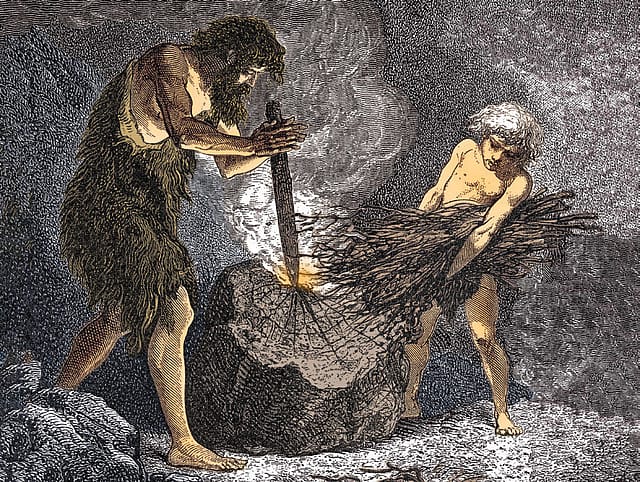
The ability to create fire was a turning point in the history of human evolution. Once humans learnt to make fire, it helped them become more adaptable and it also transformed social life and probably contributed to the development of things like language. We’ve also tended to associate this trait with Homo sapiens. The earliest known evidence we had of humans making fire was from a site in northern France that was dated to about 50,000 years ago, although it was linked to Neanderthals.
A new discovery however completely rewrites our knowledge about humans’ mastering of fire. A paper, just published in Nature, shows that humans were creating fire more than 350,000 years than previously thought.
This discovery was made at a site in Suffolk, Britain, where researchers identified the remains of a repeatedly used campfire, including heated clay, flint tools shattered by intense heat and pieces of a mineral called iron pyrite that sparks when struck against flint. Pyrite is extremely rare in that area, and it is assumed that it was probably carried from a distant location. Our ancestors, Homo sapiens, of course were nowhere near Suffolk around 415,000 years ago (which is what this site has been dated to). They were still evolving and were yet to leave Africa. The inhabitants of this site, the paper says, were most probably early Neanderthals.

2025 In Review
12 Dec 2025 - Vol 04 | Issue 51
Words and scenes in retrospect
This discovery complicates our understanding of human evolution. But it supports the view that Neanderthals, and other species like Denisovans, were far more innovative than what was previously imagined.