Bangladesh: Can Tarique Rahman Be the Redeemer?
BANGLADESH HAS ONCE AGAIN made a fitful start to democracy through the inauguration of a new parliament and the induction of a new cabinet 18 months after the overthrow of Sheikh Hasina’s government. In a country where politics has often been subjected to violent change or unconstitutional removal, one can only hope that this fresh attempt to get Bangladesh’s politics back on democratic rails will have a good chance of deepening its roots.
And yet there are the facts that must not be overlooked. The election which brought the Bangladesh Nationalist Party (BNP) to power 20 years after it went out of government in 2006 cannot properly be referred to as a vote that has satisfied Bangladeshis across the spectrum. For one thing, an arbitrary decision by the just-departed interim administration led by Muhammad Yunus imposed a ban on all activities of the Awami League, Bangladesh’s largest political party that till August 2024 was in government. For quite another, and this is related to the earlier point, the forced absence of the Awami League from the ballot resulted in a non-inclusive election that left anywhere between 35 to 45 per cent of voters from exercising their right of franchise.
The obvious conclusion here is that the credibility of the election remains in doubt and will in fact dog BNP in the weeks and months ahead. The shadow of the Awami League has already begun to loom over the political process through party offices being reopened in different parts of the country. The central leadership of the party has clearly been wanting in the matter of devising a strategy to make a re-entry into the country’s political landscape, but in the past few days, it has been grassroots party activists, those who have borne the brunt of the repression let loose on the organisation by the Yunus outfit who have taken the lead, however tentatively, to reassure supporters that the Awami League is alive and kicking.
The election, despite its non-inclusive nature, has yielded a rather positive note in that voters were unwilling to place the fundamentalist Jamaat-e-Islami to power. In the final days and weeks before campaigning drew to a close, the fear grew among citizens that the Jamaat would squeak through to a victory and go into an implementation of what is correctly considered to be its medieval policies. It was particularly women who were petrified by the possibility of the Jamaat and its Islamist allies taking over the state at the ballot box. BNP’s victory has put paid to that dire possibility.
However, there is in all these developments an element of irony which cannot be missed. It is that the Jamaat, which supported and assisted the Pakistan occupation army in committing genocide in Bangladesh in 1971 and was instrumental in unleashing its goon squads into abducting and killing scores of Bengali intellectuals on the eve of liberation and has never expressed contrition over its acts, will now occupy the opposition benches in parliament. It is for the first time in independent Bangladesh’s history that such a large contingent of lawmakers from a party opposed to Bangladesh’s independence movement has made its way into parliament.
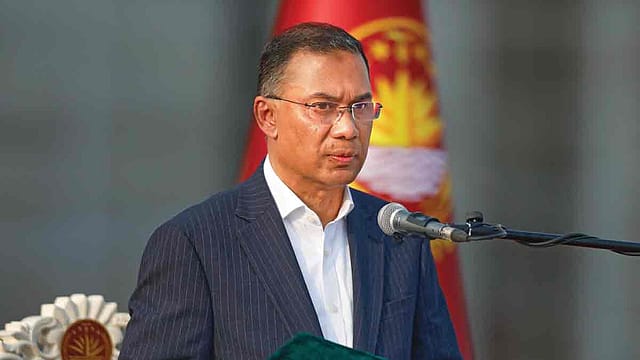
In light of the circumstances which today define Bangladesh, questions will certainly arise about the ability of the BNP government to fulfil public expectations. It will be a difficult task given that the party was out of power for two decades and certainly will be required to relearn the methods of governance. Tarique Rahman, the new prime minister, has cobbled into shape a cabinet where relatively young elements of his party, along with a smattering of individuals from other outfits, have been brought in. The expectation that senior leaders of the party, who served in the government of Begum Khaleda Zia, the new prime minister’s mother, and who during the long period of rule by the Awami League endured persecution and other forms of harassment, has fallen by the wayside. Obviously, Tarique Rahman would like to begin with a clean slate comprising figures beholden to him for according them their present prominence.
The BNP government will not have much of a smooth sailing, though it is early days to predict which way the winds will blow for it. The government has a daunting array of issues it will be required to handle if it means to reassure people that despite taking power in an election that was flawed, it can govern to public satisfaction. One of the first issues that will exercise minds in the new government is that of taking steps to free the Awami League from the arbitrary ban imposed on it by Yunus. Since there are reasons to believe that of the 26 to 28 per cent of the electorate taking part in the vote, a good number of pro-Awami League and indeed secularism-driven voters cast their ballots for BNP as a way of keeping the Jamaat at bay, the government cannot ignore the reality. And the reality is that the elected BNP administration cannot long hold itself back from opening the doors to a rapprochement with the Awami League.
Tarique Rahman and his government will be in an unenviable situation where the economy is concerned. In the 18 months in which the Yunus unconstitutional regime kept Bangladesh in its grip, the economy remained in free fall. Hundreds of garment industries, part of the nation’s economic backbone, were shut down in the anarchy let loose by mobs. Thousands of men and women, especially women, lost their jobs. Besides, prices of essential goods rose exponentially and continuously, forcing the poor and middle classes into near penury. In the field of education, much will be expected of the government in terms of restoring normal conditions all the way from schools to colleges to universities.
Discipline, which broke down in the aftermath of and through the activities of mobs supportive of Yunus, will take a long time to be restored. Teachers have been dismissed, with many of them charged with crimes that have had no basis. Dhaka University, where the students’ union has been taken over by the radical Islami Chhatra Shibir, the students’ union of the Jamaat, has presided over a cult of fear generated among the student community through its attempts to undermine the secular culture the university has historically upheld.

The BNP government, operating on shaky ground owing to the non-inclusive nature of the recent election, will need to tread carefully through the rundown political path in the country. A prime responsibility for it will to be ensure security for citizens through effective measures towards restoring law and order. Under the Yunus dispensation, lawbreakers had a free run of the land. Towards the end of the Awami League government and later, jail breaks saw hardened criminals freed. Besides, following the anarchy let loose in early August 2024, police stations all over the country came under attack, with a very large number of them set afire. Weapons were looted and have never been recovered. Nor have a very significant number of prison escapees been apprehended. Add to all this the scores of policemen lynched by mobs in the days following the overthrow of the Awami League. No investigations were initiated into such criminal acts and no perpetrators of these crimes were taken into custody or produced before the law.
Unless these violent acts are handled efficiently by the government, Bangladesh’s new political leadership will remain vulnerable to conditions that will test its ability to govern. Linked to the lawlessness of the Yunus regime is the arrest of political leaders, journalists, intellectuals, judges, former chief election commissioners, police officers, freedom fighters as well as others, with almost all of them clamped with bogus charges of murder. A number of Awami League politicians, including ministers, have died in prison, raising questions of the role of the Yunus outfit in such tragic happenings. The BNP administration in the interest of national reconciliation will be required to take steps toward freeing all detainees, and at the same time, prosecuting those who in contravention of the law not only placed such individuals into incarceration but also took no step to give them bail or have them freed. The judiciary stayed silent all along in the 18 months of the unconstitutional interim regime.
One of the toughest jobs the new government must do on an immediate basis is to restructure the nation’s diplomacy given that the Yunus regime went out of its way to cause it damage beyond repair. In the past 18 months, relations with India were on a nosedive and indeed hit rock bottom through the injudicious attempts by the Yunus regime to whip up anti-Indian sentiments in the country. The consequences were not hard to foresee, with Indian public opinion reacting to the organised campaign against Delhi in Dhaka.
The new government in Dhaka will certainly walk back from that brink. It will be noted that in the weeks and months leading up to the February 12 election, the BNP leadership carefully stayed away from articulating any anti-India sentiments in their public pronouncements. Senior leaders of BNP have made it clear on various occasions that productive ties between Bangladesh and India are a historical as well as economic necessity. At his press conference following the election, Rahman underscored Bangladesh’s goal of pursuing ties with India on the template of Bangladesh’s interests being upheld. That was a broad hint of BNP’s position in a reshaping of foreign policy badly damaged by the Yunus outfit.
THE WHIRLWIND TRIP to Dhaka by External Affairs Minister S Jaishankar to convey Delhi’s condolences to Rahman on the demise of his mother Khaleda Zia has properly been construed as a move by the Indian government and the incoming Bangladesh government to rebuild the bridges burnt by the Yunus administration. Now that Rahman has taken over as prime minister, Bangladesh will certainly acknowledge the role both Dhaka and Delhi will be expected to play within the ambit of geopolitics as well as bilateral relations. Dhaka would do well to stay away from the issue of Sheikh Hasina’s extradition, for the process applied to her so-called trial went against a full and proper application of legal procedures.
A relationship of trust is an absolute necessity for the governments of the two countries. Rahman will of course be acutely conscious of the anti-India propaganda that extremist and pro-Yunus elements might yet engage in. The government will need to deal with such elements with a firm hand. At the same time, on a bilateral basis, wider trade links between Delhi and Dhaka as well as people-to-people links through tourism will deepen the ties between the two nations. It will also be important to ensure that anti-Bangladesh elements in India and anti-India elements in Bangladesh do not come by any reason to vitiate the atmosphere of friendship, based as it is on historical links, between the peoples of the two countries.
On the question of Pakistan, the new Bangladesh government ought to move away from the embrace into which Muhammad Yunus and Pakistan Prime Minister Shehbaz Sharif have put Dhaka and Islamabad. In recent months, visits by influential Pakistanis, especially Pakistan’s foreign minister and senior military figures, have considerably aroused the ire of Bangladeshis who have never forgotten the genocide unleashed in March 1971 and for which criminal act no Pakistani government has formally or officially offered any apology. BNP, which in earlier times was perceived to be rather close to the Pakistani establishment, would be wise enough to rebrand Dhaka-Islamabad ties in light of the history of 1971.
Since the BNP leadership has claimed, beginning with its founding in the late 1970s, its allegiance to the ideals of Bangladesh’s War of Liberation, in its new avatar it faces the tough job of restoring not only those principles but also the hundreds of monuments and symbols of the war, including the iconic home of Bangabandhu Sheikh Mujibur Rahman, the country’s founder. These monuments were torched or demolished by elements who made little attempt to conceal their anti-Bangladesh psychology. Will BNP be up to the task of asserting itself here?
Finally, one does not expect the new government to last a full five-year term in office owing to the flawed nature of the February 12 election. That is as much as to suggest that the government, in the interest of stability and its survival, will reach a point where it will be expected to reach out to the Awami League. The reopening of Awami League offices has not met with any impediment so far. If that is a sign of the BNP government’s willingness to adopt an accommodative stance in these changed times, it is a hint of the democracy that could become the foundation of meaningful national politics in Bangladesh.