Balendra Shah: Rapper as Nepal's Redeemer
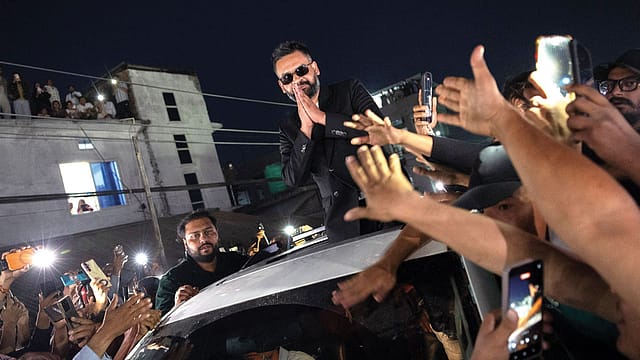
ONE OF THE curiosities of present technology is how much it has shortened the time needed for an outsider to politics to become the leader of a nation. If decades were necessary earlier, if you go by the hoisting of Balendra Shah to the prime ministership of Nepal, 14 years suffice now. Consider that Shah was an unknown in not just politics but any field whatsoever in 2012 when he came out with a rap number on YouTube. The only hint of the future was the social commentary in the single, ‘Sadak Balak’, about a street child's isolation and neglect with lines like, ‘Government officials, foreign businessmen/Don’t just give speeches, look after me with love.’ The song itself hardly made a ripple.
The next year was better when he won a popular YouTube rap battle contest. As his fame grew, it wasn’t a coincidence that this was also the moment when social media was exponentially becoming a part of everyday life. With the reputation of the angry rebel rapper came a burgeoning following among the young and Shah's politics increasingly pushed into the forefront. The tipping point was 2020, when a single, ‘Balidaan’, became a runaway sensation. It has 13 million hits on YouTube. Contrast that with Nepal's population—30 million. It is the kind of reach new technological mediums gave performers like Balen, and if such art has political colour, then politics is a natural progression. ‘Balidaan’ begins with these lyrics: ‘Those supposed to protect the country are all chut*ya/The leaders thieves, looting, eating the country/They urinate on the motherland’s sari, thinking it is underwear/ United in eating, divided when it's time to work.'

Open Minds 2026
26 Jun 2026 - Vol 05 | Issue 26
The power of ideas and arguments in 50 portraits
Shah came from a regular middle-class family. His father was an Ayurveda doctor belonging to a region called Madhesh, abutting India, which has found itself marginalised in Nepal's politics. The family moved to Kathmandu and Shah was born there. He studied and worked in engineering, but music was the calling. A stint studying in India is said to have made Shah interested in political ideas. His appeal comes from Madheshi roots while also, as someone in the capital, identifying with the country’s political degradation. There is a certain mythmaking in all this because Shah himself has rarely given interviews, and much of the stringing together of his life comes from others or social media.
After ‘Balidaan’s massive resonance, Shah began mulling an entry into politics. The next year, 2021, he announced on Facebook that he would contest for Kathmandu’s mayoral elections set to happen in 2022. He remained an anti-establishment figure and contested as an independent winning easily with a little over 60,000 votes, a lead of 23,000. As mayor, his functioning was as someone refusing to still accept the system. A famous story around his tenure is that, exasperated by the delay of a road construction that had led to dust and debris, he got a garbage truck to dump its contents outside the office of the roads department.
Nepal has had a problematic tryst with democracy swinging in numerous directions, from the monarchy to a Maoist insurgency that eventually came to office through an election. In 2015, it found some stability with a new constitution, but ruling has been a revolving door. Since 2015, there have been seven governments. KP Oli, who Shah replaces, had been prime minister using various political machinations four times for varying spells. In September 2025, he found himself facing an entirely unexpected agitation. An ill-advised ban on September 4 on social media triggered youths to band together online and launch an agitation. Underpinning it was anger over corruption and a feeling that the children of the privileged were the only ones leading a good life in Nepal. Soon, the protests spilled over to the real world and people started coming onto the streets. On September 8, Oli sealed his fate when police firing killed 19 protesters, leading to even more protests and a total breakdown of order. Government buildings were set on fire and even the prime minister’s hose was ransacked.
Shah, as Kathmandu mayor, aligned himself with the protesters. A song that he had written a decade ago, ‘Nepal Haseko (Nepal is Laughing)’, began to be a calling anthem for the movement, getting millions of views on YouTube. As an icon for the youth and a product of social media, the mechanism through which this upheaval had been triggered, he was perfectly placed to position himself as the alternative. And he did so, shedding his independent status and becoming a member of the Rastriya Swatantra Party (RSP). In January 2026, he resigned as mayor and went on to lead RSP to victory in the general elections. He continued to make use of symbolism, contesting in the very seat of Oli and defeating him.
At just 35 years old, Shah has a long runway left to shape a country in disarray. His rise, while extraordinary, is not an aberration. Modern political history has many examples of entertainers leading nations and consolidating themselves. In Ukraine, for instance, Volodymyr Zelensky was a television actor who, like Shah, rode on an anti-corruption plank that propelled him to be president and was faced with a Russian invasion. He has managed to successfully mount a defence that few anticipated. In the US, there is the example of Donald Trump himself, a businessman who was also a television reality star. He contested the presidential primaries for the Republican Party as an outsider out to clean the system. The party and country revolve around him now.
Shah has many characteristics that define such mercurial new leaders. He talks directly with his followers through social media and has given almost no interviews to the mainstream media. The cultivated image is of one who clearly sees how rotten the system is, knows it cannot be fixed through existing systems and alone has the ability to do so. The promise is of radical overhaul and authenticity. But once in power, the exigencies of running a country take over. It is easy as a mayor to teach the roads department a lesson, but there are limits to how disruptive a prime minister can be. The election promises of his party include doubling per capita income of Nepalis to US$3,000, doubling the GDP, and creating 1.2 million jobs. They might sound simple on paper but need massive reforms, which are often not measures voters like. His legacy could depend on how a populist politician manages unpopular decisions.