Art in Lisbon: Kitsch Is Cool
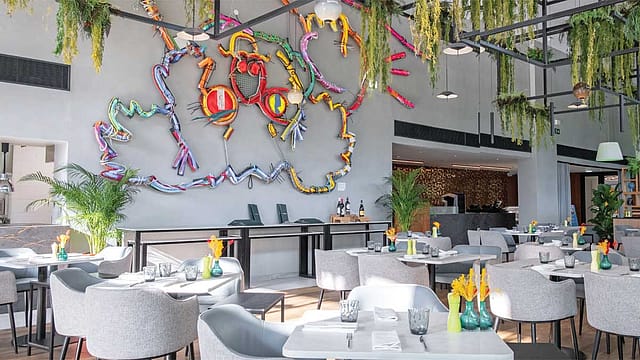
IN PARTS OF LISBON, art shows up in the most unexpected of places. Not hanging on pristine white walls under dim lighting or guarded behind ropes. Instead, picture artworks above breakfast buffets, across corridors and adorning hotel lobbies as you wait for your turn to be checked in.
There is a certain sense of respite in stumbling upon museum-worthy art without having to wait in serpentine queues, pre-booking tickets months in advance or feeling pressured into commenting on art correctly while flanked by connoisseurs. What if you happened upon Portuguese street artist Bordalo II’s works displayed casually in your hotel lobby? Or found yourself admiring artist Graca Paz’s geometric abstract forms while waiting for the elevator? It was in Lisbon that it dawned on me that galleries weren’t the only places where contemporary art thrived. During my travels, it was becoming increasingly evident that art lived almost non-ceremonially, woven into the everyday rhythm of spaces that travellers occupied.
As my airport cab dropped me off at my hotel, Martinhal Lisbon Oriente in Lisbon’s Parque das Nações, it wasn’t the reinvented waterfront landscape or fountains with conical chimneys that first grabbed my attention. It was a giant dragonfly.
As I wheeled my suitcase through the cobbled entryway, I didn’t anticipate that in this exhausted moment of transit, I would pause to look at something that did not scream ‘museum art’. Rather, it stood almost nonchalantly, blending with the hotel’s architectural landscape.
Yet, to the mindful traveller, it spoke volumes, signalling the quiet anxieties of modern-day Lisbon life—sustainability, consumption and rapid urban growth.
Created by Bordalo II, the oversized insect, Plastic Dragonfly, stood outside the main lobby like a playful mythical creature, made to attract children. But on closer inspection, there is something unsettling about it. A kind staff member explained that the dragonfly was made using bumpers, fishing nets, hoses, and construction site helmets—everything discarded. Its yellow hind legs made from materials from wastelands and abandoned factories shimmered brighter under the afternoon Lisbon sun.
The art walk did not end there.
Next stop: the restaurant. As I helped myself to some yogurt and oatmeal, suspended dramatically above the breakfast platter was another Bordalo II creation–this time, a giant koala—assembled from repurposed hoses, rescued ropes, fishing nets, and plastics. Lighted Koala would transform into a flickering neon spectacle at night.
There was something almost ironic about its positioning. As the aroma of warm baguettes filled the room and guests returned for more servings of the unlimited buffet, excessiveness defined the space. In contrast, the koala stood as a subtle reminder of the waste generated by exaggerated consumption lifestyles.

As days passed in Lisbon, I realised I was encountering the city’s contemporary art in stark informal settings. Sometimes while taking a bite of pastel de nata and sipping coffee, an artwork would stare back from cafes, restaurants, and hotels, transforming them into spaces of Lisbon’s cultural storytelling.
This approach mirrors Portugal itself, where art is rarely restricted to institutions and exists in public, visible across promenades, buildings, bookstores and tiled streets. A hand-painted signage over a bus stop here, a political graffiti adorning a government building there, creativity shows up as accidental exhibits.
Yet, modern-day Lisbon, especially neighbourhoods like Parque das Nações, where Martinhal Lisbon Oriente is located, has become a symbol of urban renewal and contemporary living, grappling with excessive tourism and cultural preservation. “Street art here is not peripheral. It is central to how the city expresses itself today,” says Chitra Stern, founder and CEO, Martinhal Family Hotels and Resorts.
It is this philosophy that inspired the founders to work with artists such as Bordalo II whose use of recycled materials and bold urban forms speaks directly to the realities of modern city living, “not in an abstract way, but in a way that feels immediate and tangible.” Though his work is visually appealing, it is embedded in environmental commentary. “Lisbon is more global and dynamic, but also more aware of the environmental and social pressures that come with that growth,” Stern says. “Bordalo’s work captures this tension beautifully.”
It is not just the artwork that counts, but also the way guests engage with it. “Rather than presenting art in a formal or detached way, we integrate it into the everyday rhythm of our spaces, allowing guests to encounter it naturally,” adds Stern. “This feels very aligned with how creativity actually exists in Portugal today: present, accessible and part of daily life.”
THE FACT THAT all the artists whose exhibits are at the hotel are based in or working in close proximity to Lisbon creates a direct connection with the city itself. Even subconsciously, Lisbon and its culture are reflected in the works.
Take Lisbon-based artist Pedro Batista. He feels that when an artwork is placed in a different setting like a hotel, the experience changes significantly. “The encounter with the artwork becomes much less ‘scheduled’ or intentional,” Batista says. He points out that in a gallery, people arrive already prepared to observe, analyse, and spend time with art. “In a hotel, the artwork becomes part of everyday life, almost like an unexpected discovery. That creates a more intuitive and emotional relationship.”
He feels that such settings facilitate a more intimate relationship between the art and the guest. When artworks are placed within a lived-in setting, whether alongside design objects or within spaces inhabited by people, the reading of the work changes compared to a traditional exhibition, Batista adds.
Bordalo II’s extravagant voice is juxtaposed with softer tones of artists such as Kruella D’Enfer, who transformed all floors of the hotel into one enormous internal mural. “Our selection of contemporary artists reflects this balance quite consciously,” Stern adds. “On one hand, there is a strong connection to Portugal’s vibrant street and urban art culture— raw, immediate and deeply rooted in the country’s contemporary expression.” At the same time, they work with artists such as Graça Paz from Porto, whose practice brings a more narrative depth.
For Paz, installing art in hospitality places holds a democratic standpoint. “Finding art outside the usual spaces where we are accustomed to seeing it, gives it a democratic dimension,” she says.
Paz believes that art encountered in such spaces encourages intimacy. “The relationship between art and daily Lisbon life mirrored through such spaces encourages reflection and stillness. Museums and galleries may not always offer that level of intentional aesthetics or connection in the presence of crowds and noise.” She explains guests are invited to inhabit the artwork rather than simply glance through it.
Art, once perceived as an elite indulgence is now transitioning into spaces where people live and work. The multidisciplinary artist Jenny Bhatt sees a practical purpose in such encounters. “It becomes an exposure for people who otherwise may not be visiting galleries and museums,” she says. “It may spark curiosity in them to engage more seriously with art in galleries, museums and institutions. This could lead to long-term engagement with art.”
To her, this reframes memory and how we reminisce about art. “When travellers visit a city, they always identify it with the visuals they carry back,” Bhatt says. “Whether it’s monuments, public spaces, their engagement with art is immediate and intuitive, irrespective of personal preferences or knowledge of art.”
The immediacy lingers differently from traditional museum experiences where hurried selfies and queues dominate. A gallery visit can become another one of the items on one’s to-do list. But artwork encountered within lived spaces hit differently: the quiet presence of art on a hotel room wall or at a restaurant creates a more intimate connection with the city itself.
Portuguese artist Vasco Águas shares, “The fact that my work is displayed in public spaces, and in a way accessible to everyone, creates a completely different relationship between the audience and the work.” When exhibited in these kinds of spaces, the relationship becomes more democratic, he feels. Artists such as him believe that there is a greater sense of proximity, where the more intricate details of each piece and the craftsmanship involved can be appreciated up close—something that cannot be fully conveyed through images on social media or in digital portfolios.”
When creating work for hotel settings, Águas’ approach is different from that of a gallery exhibition–in terms of scale, narrative, or how it will be experienced by viewers. “I always try to build a narrative and draw inspiration from the space itself—its history and surroundings.”
In that sense, it can reflect certain aspects of Lisbon and even Portugal–its artists, its materials, its atmosphere, its way of life–but in a more subtle and personal way. “This does not mean museums pale in comparison, but rather this offers a different kind of experience, one that is more spontaneous and open to interpretation,” he says.
In Bordalo II’s ‘The Lionesses’ that adorns Martinhal’s lobby, discarded objects such as toys, shutters, and abandoned materials are repurposed to create a captivating portrait of a lioness and her cub. And perhaps that is exactly what I carried back while departing Lisbon— not just the spectacle of art but how they inhabited it quietly. The dragonfly at the entrance, the neon koala at the restaurant and the Lionesses at the lobby were all made using debris. Yet, to me, what stood out was how art intersects with everyday life in spaces that travellers inhabit.