Are Humanoid Robots the Future of Warfare or Just Expensive Science Fiction?
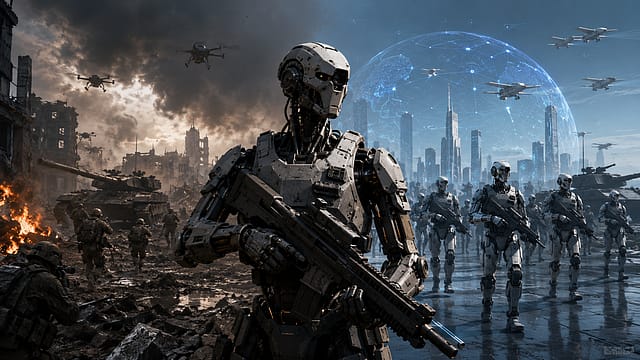
The idea of a humanoid robot soldier has long belonged to Hollywood. That line is blurring fast.
A San Francisco-based startup is actively developing an armed humanoid robot for defence use, with units already being tested by the US military and undergoing pilot logistics testing in Ukraine.
The technology is raw, the ethical debate is fierce, and the timeline is shorter than most people realise.
Who Is Building the Humanoid Robot Soldier and Why?
Foundation Robotics, a two-year-old US startup, is developing a humanoid robot called Phantom specifically for defence applications.
According to BBC, its CEO Sankaet Pathak argues that since the world is built for humans, humanoid robots can use existing tools and weapons without redesigning infrastructure.

The Modi Years
02 Oct 2026 - Vol 05 | Issue 40
A Nation Rebuilt
The company reportedly holds 24 million dollars in US military research contracts.
What Can It Do on the Battlefield?
Foundation envisions Phantom handling supply pickup, reconnaissance, casualty recovery, and hazard inspection.
More controversially, it is also being developed for what a BBC report highlights as potential “frontline weaponization,” while Pathak maintains that humans must always control lethal force decisions, the argument is that arming humanoid robots keeps soldiers out of lethal chokepoints and could reduce collateral damage compared to aerial strikes.
Is the Technology Ready for Combat?
Not yet. The current Phantom MK-1 has no battery, is not weatherproof, cannot stand back up after falling, and lacks the hand strength needed to fire a weapon.
A second-generation model is in development, reportedly targeting six hours of runtime and wrists capable of handling firearms. Foundation aims to produce 40,000 units annually by the end of 2027 at under 20,000 dollars each.
What Do Independent Experts Think?
Scepticism runs deep. Dean Fankhauser of robotics advisory firm Robozaps told the BBC that today's humanoid robots struggle with basic warehouse tasks, let alone battlefield conditions.
Robert Griffin of the Florida Institute for Human and Machine Cognition warns these systems cannot handle open-ended uncertainty, and that human soldiers have already outsmarted AI systems with simple unpredictable behaviour.
Should the World Be Worried About Autonomous Weapons?
Lethal autonomous weapons lower the barrier to warfare, dehumanise conflict, and blur accountability.
The humanoid form is particularly concerning as civilian familiarity with human-like machines could cause people to misread danger in a military context.
(With inputs from yMedia)