An Islamic NATO: The Mecca Mirage
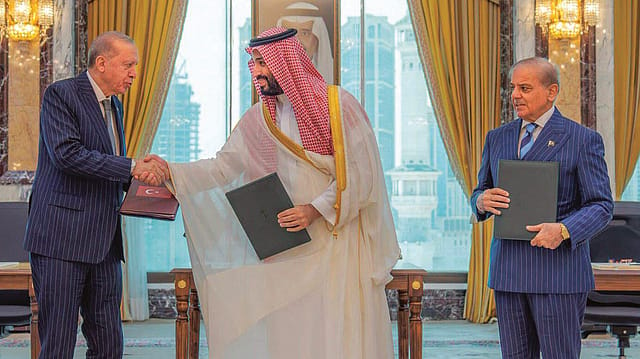
DESERT LANDS EVOKE TWO INSTANT IMAGES: an oasis, real but rare; and a mirage, the continual delusion on the road to nowhere.
Is the Mecca pact an oasis or a mirage? A mirage offers hope of life to those gasping for water because it mirrors an oasis, but illusion inevitably fails the reality check.
A military alliance is ephemeral without a clearly defined enemy. You might advertise it as a defence pact but that does not change the focal question: Who is the enemy? It is a military pact, not a trade partnership. The Three Musketeers, bound by the oath of one-for-all-and-all-for-one, are coy about the visceral threat which has brought three geographically non-contiguous and historically disparate nations into a compact signed in the presence of God.
Are Saudi Arabia, Pakistan, and Turkey, each a long-term ally of the US, now united in a life-or-death Sunni-against-the-now-formidable-Shia-power Iran? That would be the perfect scenario in the Washington playbook as America, wounded by Iran, limps out of the Gulf and seeks to strengthen mobilisation in the Pacific against China.
Reality check: If Pakistan sends a single soldier to fight the Islamic Revolutionary Guard Corps (IRGC) of Iran, Karachi will burn on the first day of battle and Islamabad might topple by the third day. The people of Pakistan have not surrendered half their national wealth to their defence forces to fight a Muslim nation which has effectively ended the unipolar domination of America over the richest combination of oil and water on the planet. The Musketeers are already taking cover behind a fog. Voices have risen that Iran should become the fourth Musketeer, a D’Artagnan perhaps. In which case, who is the enemy of the Mecca pact? America? An idea which has not been thought through can easily slip into the absurd.
There will be much support on the Muslim street if the less-than-compact pact threatens Israel. In which case, America will blow it apart. America is Israel’s guardian angel. Its strategic interests are deeply linked to Israel’s survival. Amidst the headlines blaring on both social and anti-social media, no one seems to have heard the studied silence of Israel. Israel, whose survival depends on a careful sift of reality from illusion, knows that America will never permit its dependents to invade Israel. America has bases in Pakistan, Saudi Arabia, and Turkey. Bases mean crowbar leverage over the hosts.
The biggest danger to any military alliance is confusion. NATO succeeded because it had geopolitical cohesion, enemy clarity and a demarcated battle zone: the Soviet Union in Europe. NATO was not against communism. It was not designed to defeat China, the second communist behemoth.
In the absence of a known antagonist, each member of the Mecca pact will use this porous fortress against an individually preferred enemy or to expand its security space. Turkey will treat it as implicit Saudi support for strategic control of Syria, further expansion of its already formidable naval heft across the Mediterranean, and control of the Kurds. Islamabad’s garrulous ministers are telling Pakistanis that Saudi Arabia and Turkey have become formal allies in its war against India. Saudis have already persuaded Pakistan to sign a defence agreement with Somalia, signed on August 4, 2026 between Defence Ministers Ahmed Moallim Fiqi and Khawaja Muhammad Asif. Pakistan troops might already be engaged in the swamp wars of the Horn of Africa.
US President Donald Trump, never short of a phrase, has described the Mecca pact as big, bold and an important first step. If this is the big first step, what is the second? Is there a third? What is the pace, direction and destination? Has Trump given his blessings to Pakistan’s drumbeat pursuit of an Islamic NATO on the assumption that a mélange of Sunni nations would always take its cue from Washington? That would be naïve.
An Islamic NATO is one of those silly-season concepts which the Pakistan military-civilian establishment uses to sell expensive snake-oil to its own people. It is a good headline for local media, and rather less impressive in Jakarta or Borneo or Sudan or Cairo or Morocco. Egypt’s army, which had to rescue the country from the Muslim Brotherhood, is wary of any project bracketed by ambiguous Islamism. Indonesia, with the largest Muslim population in the world, is buying BrahMos missiles from India.
For Washington, the Mecca Musketeers only make sense as a regional compact against the Iran which emerged after the fall of Mohammad Reza Pahlavi, an American protégé, in 1979 and the subsequent consolidation of the present Islamic movement, created by Imam Khomeini. America and Saudi Arabia allied to destroy the new Iranian dispensation before it could acquire deep roots.
In 1980 Riyadh, never shy of cheque-book security, financed Iraq’s Sunni dictator Saddam Hussein’s invasion of Iran. Iran’s formal army had disintegrated and the Saudi-Saddam- Washington axis believed that Tehran would fall within a week or weeks; eight years later they were still waiting. Ayatollah Khomeini famously described the Saudis as “camel grazers of Riyadh” and “barbarians of Najd”, while Iran’s IRGC matured into a fighting force. A humiliated Saddam tried to replenish his impoverished coffers by invading Kuwait, and another dangerous chapter was scripted.
Two Mecca Musketeers have chosen to camouflage deep contradictions within the echo chamber of their history. A century ago, Arabs abandoned the Ottoman Caliphate to join the Allies in World War I and defeat the Ottoman Empire. Turkey was saved from partition only by the leadership of Mustafa Kemal and the heroism of its people. Even if Ankara can elide past 1918, memories of October 2018 are unlikely to disappear easily into Riyadh’s amnesia bin. In 2018, Recep Tayyip Erdogan led a campaign, supported by the US, to frame the young Saudi Crown Prince Mohammed bin Salman, or MBS, for nothing less than the murder of the journalist Jamal Khashoggi in the Saudi embassy in Ankara. MBS might smile in 2026 but can he forget?
A mystery question awaits an answer. Why has the UAE been excluded from the piety of a Mecca signature?
The Arab Gulf nations are divided between passive states, Kuwait and Bahrain; Egypt and Qatar, which take an independent course; and proactive Saudi Arabia and Abu Dhabi, who are joined at the hip in foreign and security policy, working in cool and careful coordination through the repeated havoc of continual turbulence.
The only rational explanation for the seeming divergence is a calculation that the Mecca pact is one-dimensional. Pakistan is useful only as a mercenary force whose all-weather capacity is yet to be tested. The broader canvas of geostrategic comfort requires an economic bridge with India. The relationship with Delhi has been outsourced to the UAE while the Saudis take charge of the security dimension.

The most significant development in American policy under Trump has been his consistent effort to delink India from the security and stability architecture of the Indian Ocean Region, from West Asia to the Malacca Strait. Trump dropped Indo from ‘Indo-Pacific’, a decision which his ambassador to India Sergio Gor tried to brush away with a feeble non-sequitur. This might also explain the covert American support for Jamaat-e-Islami in the Bangladesh elections, and the continued effort to ring-fence India in South Asia.
India has emerged as a major power of the Indian Ocean, particularly after Prime Minister Narendra Modi strengthened its base in the Andaman and Nicobar Islands and moved towards a 200-ship navy, facts which have led to discomfort rather than accommodation in the present White House. Trump has been disconcerted by India’s determination to protect the independence of its foreign policy. He prefers the sound of obedience.
American presidents since Bill Clinton have respected India’s gradual rise from a beleaguered question mark in 1990 to a credible democratic, economic and nuclear power. There was fresh interest in India in the immediate aftermath of 9/11, the terrorist attack engineered by Osama bin Laden. America made its boldest effort to draw India into its strategic fold.
The concept of a second NATO is not original. After 9/11, the US offered India a lead role in a project labelled Eastern NATO. The public initiative was led by an India-friendly diplomat, Nicholas Burns. It was a cross-party offer to become a military ally in the international coalition against Islamic terrorism as defined by Washington, the Pentagon and Langley. America wanted India to put boots on the ground in its war against Saddam Hussein in 2003. Senior Cabinet ministers like Jaswant Singh were willing, but Prime Minister Atal Bihari Vajpayee stayed within the traditional parameters of foreign policy. America’s goodwill run continued into the Manmohan Singh administration but India was still not ready to be part of any external engagement. That goodwill run has slowed to a trot, if it is moving at all.
Gor’s recent statement on Jammu & Kashmir being an integral part of India was welcome, but it was no more than the distribution of Trump crumbs while the main meal was being served elsewhere. Such an assertion would be more useful in Islamabad. Indians know that Kashmir is an integral part of India; Pakistanis do not. Surface comfort might be better than no comfort, but it remains peripheral.
Kashmir is Pakistan’s fixation. It would like every Muslim country’s support in its permanent war against India. In South Asia, the Mecca pact has already become a useful ploy for India-baiters, not least in Dhaka where a powerful lobby threw a spanner into Prime Minister Tarique Rahman’s proposed visit to Delhi. The lobby is actively trying to improve cooperation with Pakistan. On August 15 this year, a six-member delegation of Bangladesh’s Directorate General of Forces Intelligence (DGFI) travelled to Pakistan, led by Colonel Magfuz-ul-Bari, along with Wing Commander Imrul Kais, Mohiuddin Asif, Murad Hossain Tushar, Khandokar Ariful Islam, and Squadron Leader Raihan Mohammad Chowdhury.
THE TRUMP SYNDROME
There is a pattern in Trump’s approach to the world: it is shaped by leaders, not nations. If they have a few medals strung on their chests, no harm done. He believes in decisions which affect policy rather than policy which affects decisions. It can become random. He has the advantage of being supremely indifferent to the past. He is unfazed by contradictions. The latest order is the operative policy, until the next one.
On current form, Pakistan’s Asim Munir is his favourite Field Marshal, although one wonders how many he had to choose from. Munir is an expert at ego-massage which the American president values. He needs it from his subordinates as much as from leaders. He removed an effective press secretary, Karoline Leavitt, because she preferred her recently born child to 80-year-old Trump. He is besotted by the devotion of another aide, Natalie Harp, who called him guardian and protector in a letter written in 2023, adding, “You are all that matters to me”, which was signed “With all my heart”. It was not a love affair; it was an admiration affair.
Trump shifts from sledge to hedge before those who do not genuflect, like China’s Xi Jinping or Russia’s Vladimir Putin. When India’s Prime Minister Modi and Canada’s Mark Carney refused to bend the knee, his policy towards India and Canada sank into a sulk. The relationship with Canada is threatened by serious rupture. On a milder scale, Trump has become punitive towards Britain and South Korea because they refused to send troops for his Iran war.
Power is very personal. That is in his nature. His world is divided between ‘winners’ and ‘losers’ and he cannot bear the thought that history might write him off as a loser, despite the obvious fact that we are witnessing a distinct retreat of America from the Gulf war, while Iran continues its game, first articulated by Mao Zedong, of alternately loosening the noose and tightening the noose. It will never be a complete American withdrawal, but the era of unilateralism is over.
Trump has relapsed from bombing Iran into the Stone Age after decapitating its moral and executive leadership to “unprecedented” sanctions dressed up as some ultimate weapon to strangle Iran. The threat imploded at the edges within 48 hours when China’s spokesman coolly told media that China did not take instructions from the White House. Neither Russia nor China shows the slightest inclination to accept the decisions of a president who can be mercurial.
A former foreign minister of Iran once told me that it was impossible to sanction a country with seven neighbours. He meant Iran’s seven land neighbours. Iran has another six maritime neighbours. Trump has no Marines to impose his will on Afghanistan, or indeed Turkmenistan or Armenia or Azerbaijan. Is Turkey going to stop buying aluminium, zinc, natural gas from Iran or embargo the export of its machines, chemicals and plastics? Iran supplies Turkey with nearly 20 per cent of its gas imports.
The strongman theorist believed Iran would change if its Supreme Leader was changed. He does not quite understand institutional depth. The price of miscalculation is heavy. When the facts are against him, he turns to bluster. He promised to bomb the excrement out of Oman if they partnered with Iran on Hormuz control. Oman kept quiet. Nothing happened.
America’s defeat is being measured by Western commentators. Mark Urban wrote in the August 16 edition of Britain’s Sunday Times that America’s stock of Patriot missiles was down from 2,300 before the war to less than 800; THAAD missiles from 600 in 2023 to 250; half of Tomahawk cruise missiles had been fired in 18 months; all 350 land-based precision missiles available in February 2026 were gone. Iran was still not in the Stone Age. The publisher and the editor of the Pentagon’s official armed forces publication were sacked for exposing the woeful condition of aircraft carrier USS Abraham Lincoln. The Pentagon is shutting bases; the official casualty figures acknowledge 18 dead and 770 wounded. In July, the Pentagon signed a contract with Lockheed Martin worth nearly $60 billion for Patriot missiles which would be available by 2030 at the earliest. Trump will not be president in 2030 even if he tweaks the law and gets a third term.
In the meantime, China has 1,200 ballistic missiles ready for use in the Pacific region.
In the strategic calculus, America has shifted from dominance over the Gulf to a quiet reassertion of the 2025 National Security Strategy document which insists that allies “must assume primary responsibility for their regions and contribute far more to our collective defense”. This was primarily intended for Western Europe, which began to transfer its defence budget to social welfare after 1990. In Washington’s view, the Mecca pact shifts the burden of security to allies in the region. Will they be more effective than the American hegemon? No. But they might redefine the threat, which will put them at odds with American interests.
Trump’s Iran invasion has drained the Arab Gulf, in the immediate term, of economic promise, stalled Saudi reform, depreciated confidence in the petro infrastructure, interrupted supply lines for energy, and left America as a fading power in the region. There is a decade’s work ahead in reconstruction, reorganisation and revitalisation if war pauses, a big if.
PAKISTAN’S OVERSTRETCH
War, said Churchill, is God’s way of teaching Americans geography. Iran and Beijing have taught Washington its limitations. The lessons continue.
The biggest lesson for Pakistan might be the ultimate paradox: Has Pakistan been weakened by overstretch in its military commitments after the Mecca pact?
Pakistan watchers estimated that till recently 80 per cent of the country’s deployable capacity, from a standing army of 600,000, was concentrated on the line between Kargil and Kutch on the Indian front. The dispersal began with rising needs in the Baloch, Khyber-Pakhtunkhwa, and Afghan operations. The Mecca pact forces Pakistan into another sector that extends from the Houthis to the south of Saudi Arabia to Somalia and perhaps farther south to Sudan later. Pakistan’s strength on the Indian border has been depleted.
Pakistan is believed to have sent 13,000 troops and 20 combat jets already for its new commitments. Any upscale against the Houthis will require more troops. Each additional soldier, each additional jet there means that much less on the Indian front. Pakistan has a good defence industry, and drones are arriving from Turkey. But every commander knows that the danger zone lies in the space between stretch and overstretch.
Pakistan’s military establishment has extorted public funds with the argument that it is essential to save Pakistan from India’s secret desire to reverse Partition. No Indian in the 21st century has the slightest desire to do so, but facts do not determine the military budget of a jelly-state like Pakistan. There is evidence that people are beginning to understand. Kashmiris in Pakistan Occupied Kashmir (PoK) are no longer fooled into subservience by finger-wagging or threat-mongering: they are enraged because Pakistan has treated them as colonised subjects.
Pakistan is a dependent state. It cannot be a partner state. It has been reduced to rolling over its economic crisis on a hand-to-mouth basis. This August Riyadh sent another $3 billion to the State Bank of Pakistan as blood transfusion, making the total debt $8 billion in addition to $1.2 billion in deferred payment for oil supply facility. Islamabad is waiting for America to ease the pressure of $10 billion from the International Monetary Fund (IMF). The total external debt of Pakistan is nearly $140 billion, of which $70 billion is to China. Its total internal and external debt of near $300 billion adds up to nearly 70 per cent of GDP. Pakistan is saved by a Saudi drip feed.
On August 18, within less than a fortnight of the Mecca pact, Yemen’s Information Minister Moammar Al-Eryani told French news agency AFP that the Houthi militia “is working to create the conditions for seizing control of the Bab el-Mandeb Strait by expanding its presence along the western coast and attempting to control strategic Yemeni islands in the Red Sea”. In the second week of August, the Houthis hit eight Saudi tankers and sank two military vessels.
The Houthis have begun targeting the Yemeni port of Mokha, as well as Yemen’s military sites. On August 17, AP released pictures of Pakistani crew members of the cargo ship Tihama killed by the Houthis. Iran has hit ADNOC tankers. The Houthis have become Iran’s arm’s-length allies in the long-term war of attrition. Anyone who expects peace in the region has not read the Bible, or indeed checked the last eight decades.
The Saudis must protect the strait. They have no option. They need infantry in addition to effective air power. They need Pakistani troops against a Houthi Shia army which has displayed surprising resilience. How will the people react if Pakistani blood is shed against fellow Muslims? What will Iran do? The temptation to respond on the Baloch front must exist, if nowhere else then on some think-tank’s paper. Will the Afghan Taliban use the dispersal of Pakistan’s armed forces to force the issue over the Durand Line? Will India see a strategic opportunity in the widening war? One matchstick can light a bonfire.
An Islamic NATO may be fanciful, but one game-changing idea has been floating below the radar ever since the true father of the Pakistani nuclear bomb, Zulfikar Ali Bhutto, brought it into the public discourse: the Islamic bomb as a theoretical shield of the Muslim world. The man in charge of Pakistan’s nuclear programme, AQ Khan, a muhajir from Bhopal, became the world’s most successful nuclear proliferator, turning the illegal export of nuclear material into a lucrative side business for his family. He was dismissed by a reluctant Pervez Musharraf only in January 2004 under pressure from George W Bush, who sent evidence of the clandestine transfer of nuclear secrets. Khan was honoured with a state funeral after his death on October 10, 2021.
Will there be clandestine transfer of enriched uranium under cover of a military pact? We do not know. There is no evidence of such a process. But it is not a state secret that the Saudis believe that with Iran going nuclear, they need nuclear weapons capability. The Saudi National Atomic Energy Project seeks peaceful energy, but that cannot be a high priority for a country floating on oil.
The conflicts that have ravaged the region are endemic, virulent, and volatile. Peace pacts are diffused long-term assets; war pacts work only with a focal point. Henry Kissinger, paraphrasing Churchill, noted that to be America’s enemy was dangerous, but to be America’s friend was fatal. The American security umbrella has been punctured by the shower of missiles. But any effective alternative architecture cannot be built on sand. Time then to ferret out another Churchill quotation which might be at least half-relevant: Truth is so precious in war that it must always be accompanied by a bodyguard of lies.