American Imperialism: Rule Americana
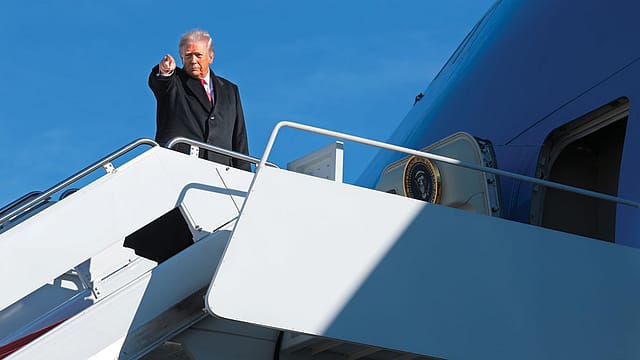
IN THIS WORLD OF MULTIPOLAR DISORDER, US President Donald Trump is an open book. He doesn’t signal, he broadcasts, giving the world a blow-by-blow account of the fervent activity inside his head. Ignore his verbal torrents at your peril, tedious as they can be. Dismiss him as mere bluster and find your country gone.
Trump means business as Venezuela’s former President Nicolás Maduro recently found out. But does the operation signal a new arrangement or will it just get added to the list of more than 40 US interventions in Latin America over the last century? On the other side of the globe, Iran is in tumult with nationwide protests against the regime sparked by sky-high inflation and extreme economic distress.
Thousands have been shot dead by the authorities. Trump told the Iranian people on Tuesday (January 13) to continue filling the streets, assured them that help was “on its way”, and told the regime to stand down. It seems to have done so. On Wednesday (January 14), Trump said he had been told that killings and executions in Iran had “stopped” but said he was “going to watch” the situation.
Tehran tried to open talks on its nuclear programme as a way to divert Trump’s attention but he cancelled all planned meetings between US and Iranian officials as the situation deteriorated and the death toll rose. The White House is said to be weighing various options, including military strikes. But there is no clarity yet.
It begs the question: Does Trump have a real plan or a bunch of random ideas demanding attention? Can he intelligently divide his time between geopolitical games and gazing at the new ballroom in the White House? These questions will continue to plague world leaders as they try to discern and decipher the unprecedented scope of the great unravelling.
Is there a clue in the dollar bill which carries the Latin phrase: Novus Ordo Seclorum (a new order of the ages), which in turn comes from the official US seal designed a few years after American independence? Whether the order is new or old, it seems that only the strong have a say. That much is written on the wall. Interestingly, this July 4 will mark the 250th anniversary of American independence with Trump presiding over a year of festivities. Indications are that he wants a bonus and add new territory to the US ledger. Greenland is on notice with a volley of threats, sending European leaders into a tailspin.
In an interview to the New York Times, Trump was candid when asked if there were any checks on his power. “My own morality. My own mind. It’s the only thing that can stop me,” he said. Not international law, not past agreements, and certainly not old think. Past US presidents have been too cautious about the use of American power, according to Trump. A declaration of this magnitude from the world’s most powerful leader is worrisome at several levels, not least because the Republicans live in fear, the judiciary is underperforming, and the people are fighting too many daily battles. They may curtail him in the November midterms but that remains to be seen.

Trump’s MAGA anti-interventionist base, interestingly, seemed to go along with him for the ride to Venezuela. No resistance came from major influencers like Steve Bannon and Tucker Carlson in contrast to the outcry when the administration bombed Iranian nuclear sites to aid Israel’s campaign. How did the MAGA faithful square ‘America First’ with Trump’s appetite for foreign adventures? They seem to have bought the logic that any military action in these parts by definition serves the America First agenda because the US is the pre-eminent power in the region. Or one could argue MAGA is what Trump says it is.
The Vanishing Old Order
What’s not in doubt is the near-total collapse of the post-World War II order with its (selective) rules, common understandings (for some), and (unmet) expectations. The old idea of spheres of influence is rearing its head or so it seems with Trump’s dramatic entry as a hemispheric hegemon determined to exercise control on his near abroad. Apart from Greenland, he has explicitly threatened Cuba, long a thorn for the Americans and signalled missile strikes against Mexican drug cartels. On the other side, Russia continues its determined war against Ukraine to avenge interference in its sphere. China continues militarisation of the South China Sea and the border with India while flexing its muscles against Taiwan. The big ones are busy grabbing what they can by whatever means necessary.
But the major powers haven’t sat down and negotiated boundaries as they did back in the day at Yalta when the US, Britain, and the Soviet Union discussed the fate of Germany and the rest of Europe after World War II to divide and rule their realms. The Cold War followed as smaller countries got jostled between the two poles. Today’s scenario doesn’t boast of rules or an agreed agenda but reeks of opportunism and resource grabbing. Trump’s hunt for oil and critical minerals is well known. China has been securing strategic assets from Africa to Latin America for decades while Russia is trying to return to the big league in different ways. Trump, Xi Jinping, and Vladimir Putin have a kind of selective admiration for each other but whether that is enough to set mutually acceptable rules of the game is unclear.
China’s power is growing as it invests heavily in the technologies of tomorrow and outpaces the US in building its national power. Is Trump’s focus on the Americas an admission of loss in the larger game? Not necessarily, say some experts, because the US is still an Asia-Pacific power and asserts its pre-eminence in Asia in formal policy articulations. The question is whether Asian countries take those assertions as seriously as they once did when Trump’s adversarial policies are designed to hurt them, be it tariffs or technology flows. Other experts agree that Trump is signalling the start of an age of empires, indeed coexistence with the other two. While the three may not clash with one another, the future for the rest may not be as sanguine. They will have to scurry for shelter wherever they find it.
Nothing is certain except, perhaps, a long period of volatility and disruption. The United Nations (UN) is a non-functioning asset, a stage reduced to performance art where the weak rail, the strong ignore, and the middling score debating points. On January 7, the US announced it was withdrawing from 66 international organisations because they were “wasteful”, “ineffective”, and part of the “multilateral NGO-plex” in conflict with US interests. The same day, Trump announced that the US military budget for 2027 should be raised from $1 trillion to $1.5 trillion in these “very troubled and dangerous times.”
A larger defence budget for an expansive doctrine? The Monroe Doctrine and the ‘Trump Corollary’ (dubbed as the ‘Donroe Doctrine’) as stated in the National Security Strategy (NSS) assesses threats to US security differently and on a narrower, regional basis. The original 1823 doctrine developed by then President James Monroe declared the Western Hemisphere as an area of US influence where European powers were not welcome. In 1904, Theodore Roosevelt expanded it to give the US carte blanche to interfere in Latin American countries found to be on the wrong side of Washington. US national interests overrode international law. Trump has built on the idea to justify whatever comes next after Venezuela.
The audacious capture of Maduro, his wife Cilia Flores and the country’s oil by the US military as everyone was getting over their New Year’s hangovers was forecast in Trump’s NSS. The document unveiled in December talked boldly about restoring “American
preeminence in the Western Hemisphere” and denying “non- Hemispheric competitors” the ability to position forces or control strategically vital assets in the region. The finger pointed squarely at China and Russia and their expanding footprint in the region.
The Venezuela Operation
The White House called the Venezuela raid involving all branches of the US military and 150 aircraft a mere “law-enforcement operation” against the leader of a “narco-terrorist” drug cartel. It was perhaps to avoid the need to seek Congressional approval. Euphemisms apart, the message was delivered in Beijing and Moscow. The US then seized an oil tanker, Marinera, sailing under the Russian flag with no apparent pushback. A Russian destroyer and a submarine were nearby but sailed away. It was the third seizure by the US military in recent weeks against what officials call the sanctions-evading “ghost fleet” of ships carrying Venezuelan oil.
Recall that the US spent the last year building a massive naval presence in the Caribbean Sea, deploying an aircraft carrier strike group and several destroyers carrying thousands of troops off the shores of Venezuela. Trump gave Maduro an ultimatum in November to step down but the Venezuelan president apparently countered with a proposal for a slow departure—in three years. The White House rejected the offer, captured him and put him in a Brooklyn detention centre.
The swift takeover sent chills down the collective spine of Cuba, Colombia, Mexico, and others. Their leaders are on high alert, issuing statements but also seeking accommodation. Trump warned Cuba to “make a deal before it’s too late” after cutting off oil supplies to the island battered by decades of an American embargo. Cuba’s President Miguel Díaz-Canel was defiant: “No one tells us what to do.” For years Maduro depended on Cuba for his personal security detail and sent the island oil in exchange. At least 32 Cubans died in the US operation while defending Maduro.
Secretary of State Marco Rubio has played a starring role in the US scheme to establish hemispheric dominance, obscuring Vice President JD Vance in the process. The two are seen as future presidential candidates. As a Cuban American and son of Cuban exiles, Rubio must find Project Western Hemisphere much more engaging than, say, the Quad where there is no action or a promise of any in the near future.
Cuba or Greenland?
Rubio has repeatedly denounced Cuba over the years as a dictatorship and a failed state. Sensing the moment is near, he was explicit when he said, “If I lived in Havana, and I was in the government, I’d be concerned—at least a little bit.” He clearly wants to go down in history as the man who tamed Cuba. Trump jokingly endorsed a suggestion on X that Rubio will be Cuba’s next president, responding with, “Sounds good to me!”
How does it sound to Greenland on which Trump’s eyes seem firmly set for a takeover? The train has been in motion for a while—the acquisitive president talked about owning the semi-autonomous island in his first term. But the rhetoric is serious and persistent this time round and laced with strategic justifications. If the Venezuela op is any indication, various options on Greenland must already be on the table. Few noticed that last June the Pentagon shifted military jurisdiction for Greenland from European Command to Northern Command in a bit of bureaucratic magic. The idea was to cleave the island from Denmark in terms of policy discussions and notionally bring it into the American “backyard” since Northern Command’s area of responsibility includes the continental US, Alaska, Canada, Mexico, and surrounding waters.
Trump is convinced that “possession” of Greenland is important for US security interests. If he doesn’t take Greenland, Russia or China will, is the logic. He has openly said Denmark and Greenland could do it “the easy way” or “the hard way”, referring to a potential sale or a military takeover. The sparsely populated island has emerged as the latest spot for geopolitical contestation—it is ideally located to detect incoming missiles and monitoring Chinese and Russian vessels roaming the icy waters. Currently, the US operates only the Pituffik Space Base but ran several more during the Cold War which were shut down over time.
What about the 1951 agreement the US has with Denmark which grants Washington rights to open and operate as many bases as it deems fit? It’s not enough for Trump—he wants ownership because in his real estate mind, the US won’t defend a lease, only a place it owns. A flustered Danish Prime Minister Mette Frederiksen predicted the end of NATO in the case of a forcible takeover since one member would be attacking another. Greenland is part of the Western alliance through Denmark. Rubio and Vance met the foreign ministers of both on Wednesday, January 14, but failed to make headway. Instead, they established a high-level working group to discuss their “fundamental disagreement” on the question of the US acquiring Greenland. While Greenlanders support independence from Denmark in polls, they overwhelmingly oppose US control.
Where Does It Go from Here?
The short answer: no one knows. Expect things to continue messily on. An imperious president, an evolving doctrine, weakened institutions, and polarised people seem bent on taking America to a place where others fear to follow.