America Regains Its Hemisphere
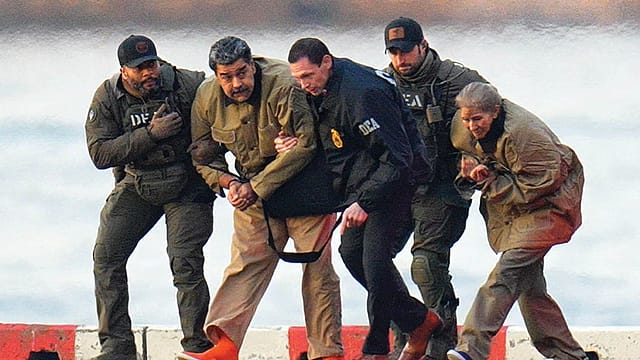
THE CAPTURE of Venezuela’s former President Nicolás Maduro and his wife Cilia Flores by American soldiers in the dead of night followed by their dispatch to the US on “drug charges” is an unprecedented event in recent history. That single act has taken the world in an unpredictable direction. The danger that powerful countries will now do what they please is real.
In Donald Trump’s second term as US president, the rules of how countries behave with each other and conduct business are being rewritten in a manner not seen since the end of World War II. One obvious risk is that the Western alliance— one of the lynchpins of global order—is now under threat.
Opinion on the subject is divided, given the series of actions being undertaken by the Trump administration. On the one hand is conservative opinion in the US that thinks action against authoritarian governments—and the Maduro regime fell in that class—is justified. On the other are liberals who worry about the adverse consequences of recklessness in engagement with allies.
The first thing to be noted is that Trump clearly wants to have primacy over the entire Western Hemisphere. This includes not just rewriting the rules of engagement between the US and countries in the West but the near-total diminishment of sovereignty for these countries. The US now wants to “acquire” territories such as Greenland and primacy in the Western Hemisphere.

I.N.D.I.A. Falling
12 Jun 2026 - Vol 04 | Issue 75
The Unravelling of an Alliance
Signs of this impending change were noted almost a year ago when Trump began threatening Canada. Writing in the Financial Times in January last year, Michael Ignatieff—a scholar and former leader of the Liberal Party of Canada— said, “Trump may not be recycling 19th century war cries. He may be looking to the future, to a world where the writ of ‘the rules-based international order’ no longer runs, and where power over the global economy has devolved to three zones of influence: the Chinese in east Asia, the Russians in Eurasia, and the Americans, with an exclusive sphere of influence in the western hemisphere, stretching from Greenland in the Arctic to Chile at the Southern tip of Latin America.”
Ignatieff, who is of Russian/ Ukrainian descent, went on to sketch what Trump is trying: critical minerals mined from Greenland; a single North American economy drawing in Canadian oil and gas, uranium and critical minerals; a wall to keep Latin Americans out and Mexico as a cheap labour platform for US manufacturers; privileged access to the Panama Canal excluding China; and a Trumpian version of the Monroe Doctrine defining North and South America as America’s exclusive zone of power and protection.
While this vision may seem rooted in a variant of American nationalism, it also threatens the already shaky foundations of global economic integration that has proceeded since the end of World War II. There is also an element of defeatism in it. It is an admission that the US can no longer compete with China. To many, the ‘China threat’ is overblown. From 1979, when its GDP was roughly 10 per cent of the US GDP, China peaked to nearly 60-70 per cent of America’s GDP in 2022, depending on how you make the calculation. From then on, this fraction has begun to fall. It is unlikely that China will catch up, or exceed, US GDP in the near future. From that perspective, it is nowhere near ‘beating’ the US.
But empires and nation-states cannot be assessed properly by a single economic aggregate. In terms of military strength, however measured, China is a near-peer to the US and the latter cannot defeat it in open war. Similarly, China’s ability to innovate in key technology sectors is now at par with the US, if not ahead. The goal to contain China openly depended on a global coalition of likeminded countries and liberal democracies. But given the daunting nature of that task—it would be almost unachievable even if it were tried—the US under Trump has given it up. There are many domestic and global factors that have led Trump to conclude that this cannot be done.
The “hemispheric thinking” that Ignatieff alluded to is Trump’s strategy of retreating behind a moat and rebuilding American strength, something he feels was deliberately eroded by a liberal elite. For the time being, as America regains strength, there is no option but to let the world be divided into spheres of influence, an old 19th-century idea of European provenance. China and Russia can do what they please in their domains of influence even as the US will do what it needs to in its region. Doing this requires a singleminded, ruthless elimination of any opposition from the Lincoln Sea to the Oglander Bay. Sovereignty of nation-states is just a distraction in this quest.
This is evident from the open threats being issued to Denmark, a treaty partner in NATO, to saying the US will “run” Venezuela and “manage” its natural resources at Trump’s “discretion”. Since the end of World War II, when it became the dominant political pole in the world, the US has practised statecraft that resembled indirect rule of the kind the British put in place in princely India—on a global scale—but its colonial adventures were limited to brief interludes in Cuba and the Philippines. That is changing now.
For now, the calculation behind Trump’s actions has a plausible chance of success. In Europe, the leading powers want the US to help counter Russia in Ukraine even as they speak in unison about keeping him out of Greenland. In Latin America, countries like Cuba and Venezuela have been hollowed out by regimes that dreamt of ushering in socialism but ended up destroying freedom and liberty.
The populations in these countries are unlikely to shed tears for their old rulers even if they do not like the new ones. Confusion in one part of the realm and resignation in the other is unlikely to breed resistance.
There is, however, much that can go wrong. Even the best laid adventures in the global arena go wrong. The miscalculations the US made in Iraq and Afghanistan earlier this century can repeat. For one, China’s response to these developments is not known. It owes its spectacular success to a world that was open to trading, financial flows and exchange of technology. Trump is rapidly shutting down all that. Had China been a normal country where domestic economic adjustments could be made quickly, it would not care for what Trump does. But for an export-led miracle economy to quickly turn into one powered by consumption is a tough task. China has tried that option but it remains a manufacturing and trading power. For another, there is a set of middling powers, India and Brazil among others, that are now being grinded by Trump. It is not that these countries lack agency but they cannot take on the US. In a dog-eat-dog world, short-run survival clouds long-term options.
For the moment, Trump knows that and he is doing what he wants to.