A Quiet Consolidation: The evolution of the Quad as an instrument of order
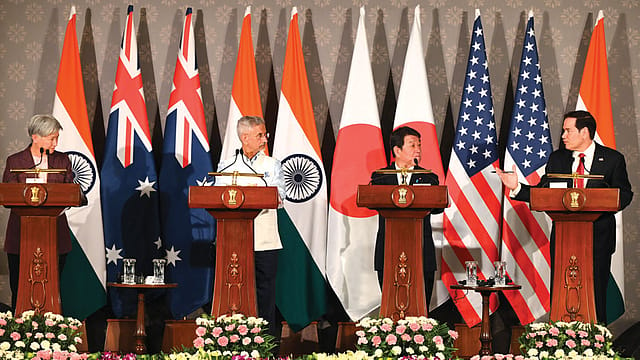
US SECRETARY OF State Marco Rubio’s visit to India last month was significant not merely for what it revealed about contemporary US-India relations, but more importantly, for what it suggested about the future trajectory of the Quadrilateral Security Dialogue (Quad). At a time when questions persist regarding the durability of American commitment to the Indo-Pacific under a second Trump administration, and when the Quad itself faces scrutiny over its relevance and effectiveness, Rubio’s presence in New Delhi served as an important political signal. The visit sought to reassure regional partners that despite shifting global priorities, Washington remains invested in the Quad as a key pillar of its Indo-Pacific strategy.
The future of the Quad has often been viewed through the lens of high-level summits and grand strategic declarations. However, Rubio’s visit suggests that the grouping’s evolution is increasingly likely to be driven by functional cooperation. The outcomes of the 11th Quad Foreign Ministers’ Meeting in New Delhi reinforced this trend, highlighting a model of pragmatic collaboration focused on specific deliverables.
This evolution reflects the strategic realities confronting all four Quad members. The grouping has matured beyond debates about whether it should become an Asian equivalent of NATO.
Instead, it is gradually positioning itself as a platform for addressing practical challenges in maritime security, supply-chain resilience, critical technologies, and energy security. The launch of the Indo-Pacific Maritime Surveillance Collaboration (IPMSC), the expansion of maritime domain awareness initiatives, and the introduction of a Critical Minerals Initiative Framework illustrate how the Quad is increasingly defining itself through operational outcomes.
From this perspective, Rubio’s visit can be seen as an effort to sustain the Quad’s momentum at a time when external and internal pressures threaten to slow its progress. The most important message emerging from New Delhi was that the Quad remains alive not because of ideological alignment among its members, but because of converging strategic interests. The four countries continue to share concerns regarding China’s growing influence across the Indo-Pacific, particularly in maritime spaces, critical supply chains, and emerging technologies. While they may differ in their approaches towards Beijing, they increasingly recognise the need for mechanisms that enhance resilience and reduce strategic vulnerabilities. Yet, the visit also highlighted the limits of the Quad’s future evolution.
One of the central challenges facing the grouping remains the divergence in national priorities among its members. India continues to view the Quad as one element of a broader multialignment strategy rather than the cornerstone of its foreign policy. New Delhi values the Quad’s utility in balancing China’s growing influence, but it remains reluctant to support any initiative that resembles a formal military alliance. India’s continued engagement with Russia, participation in BRICS, and emphasis on strategic autonomy reflect this broader approach.
Rubio’s visit did little to alter this reality. Indeed, the discussions between Indian and American leadersunderscoredthatwhilestrategicconvergence exists, important differences remain. Trade disputes, immigration concerns, and differing approaches towards certain global issues continue to shape bilateral interactions. The future of the Quad will therefore depend not on complete alignment among its members but on their ability to compartmentalise disagreements and focus on areas of practical cooperation. The Trump administration’s role in shaping the Quad’s future is equally important. With Rubio’s visit, Washington has sought to signal continuity in its Indo-Pacific engagement. However, questions remain about the depth of that commitment. The absence of a confirmed leaders’ summit following the ministerial meeting is noteworthy.
Without sustained leadership engagement, there is a risk that the Quad could become increasingly bureaucratic.
This challenge is particularly relevant because the Quad’s future credibility will be determined less by the number of initiatives it launches and more by its ability to deliver tangible outcomes. The history of multilateral cooperation is filled with examples of ambitious declarations that failed to produce meaningful results. Maritime surveillance networks, critical minerals partnerships, and energy-security frameworks all require long-term investments, institutional coordination, and political commitment. Rubio’s visit generated momentum, but sustaining that momentum will require continued followthrough from all four members.
The emphasis on critical minerals during the visit offers an instructive example of where the Quad may be headed. Competition over supply chains has emerged as one of the defining features of contemporary geopolitics. China’s dominance in rare-earth processing and critical-mineral production has exposed vulnerabilities across advanced economies. The Quad’s decision to prioritise supply-chain resilience indicates a recognition that strategic competition is increasingly being fought through economic and technological ecosystems rather than traditional military balances alone.
Similarly, the focus on maritime domain awareness reflects an understanding that the Indo-Pacific’s future stability depends on the ability ofregionalstatestomonitorandrespondtoemerging challenges at sea. Illegal fishing, grey-zone coercion, and disruptions to commercial shipping routes have become pressing concerns. By investing in maritime surveillance capabilities, the Quad is positioning itself as a provider of regional public goods rather than simply an anti-China coalition. This distinction may prove crucial to the grouping’s long-term sustainability.
Humanitarian assistance, disaster relief, infrastructure development, health security, and technology cooperation have become integral components of its activities. Rubio’s visit reinforced this trend by highlighting initiatives that offer practical benefits to a wider range of regional stakeholders.
Nevertheless, the shadow of China continues to loom over every discussion about the Quad’s future. Although the joint statement avoided direct references to Beijing, many of the initiatives announced were clearly designed to address challenges arising from China’s growing regional influence. This deliberate ambiguity remains both a strength and a weakness. It enables consensus among members with differing threat perceptions, but it also limits the grouping’s ability to articulate a more coherent strategic vision. The future trajectory of the Quad will therefore depend on whether it can successfully balance flexibility with purpose. If it attempts to evolve into a formal alliance, it is likely to encounter resistance from India and potentially other members. If, however, it continues to focus on functional cooperation and practical problemsolving, it may emerge as one of the most durable mini-lateral arrangements in the Indo-Pacific.
For India, this outcome would be particularly advantageous. The Quad allows New Delhi to strengthen partnerships with major democracies while preserving the strategic autonomy that remains central to its foreign policy. It enhances India’s influence in the Indo-Pacific without forcing it into rigid alliance structures. Rubio’s visit reaffirmed that the US recognises and accommodates this preference, even as it seeks deeper cooperation in areas such as defence, technology, criticalminerals, andmaritimesecurity. Ultimately, the most important implication of Rubio’s visit is that the Quad’s future is likely to be characterised by consolidation rather than transformation. The grouping is evolving into a pragmatic mechanism for managing shared challenges in an increasingly contested Indo-Pacific.
The visit demonstrated that despite periodic doubts about American commitment, persistent differencesamongmembers, andChina’scontinued criticism, the Quad retains strategic relevance. Its success will depend not on grand declarations or institutional expansion but on its ability to deliver concrete outcomes that address the region’s most pressing challenges. In that sense, Rubio’s visit was less about celebrating the Quad’s achievements than about ensuring its continued evolution as a functional instrument of Indo-Pacific order.