A Friendless Continent: Europe caught between Trump and Putin
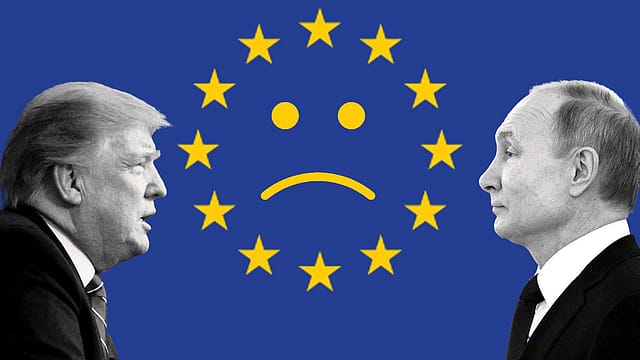
WE ARE FACING MORE UNPREDICTABILITY in global affairs than at any time since 1939, but one thing has become clear. Europe is the new Nepal—a yam crushed between two boulders, the US and Russia.
Europeans have been taken aback by the realisation that our longtime friend, the United States, appears to be making common cause with our longtime enemy, Russia. What exactly this might mean in either domestic or foreign affairs is still emerging, and it is hard to say what event might bring more clarity to the situation. Will Russia abandon its ambition to expand westwards? Will a change of occupant in the White House mend longstanding links that have suffered so much damage lately?
It has astonished many Europeans that a core element of Donald Trump’s MAGA movement seems sincerely to believe that Europe is now a hellhole of repression, where no one dares speak freely, where Muslims dominate the cultural and legal agenda, and where the foundational principles that shaped America have been abandoned.
What is especially sinister about this new transatlantic view is that it coincides perfectly with that of Vladimir Putin, who shares MAGA’s taste for traditional values, sexual normativity, and the Christian faith, not to mention a brigand style of crony capitalism.
Since 2016 a great many powerful people in America have come to see Russia as an ally in a crusade against ‘woke’ and have wanted to copy the oligarchic autocracy they see in Moscow—the kind of society in which rich people can do what they want. They believed a version of this was working well in Hungary, and the 900-page manifesto known as Project 2025, widely circulated before the 2024 presidential election, was based largely on the ‘illiberal democracy’ built in Hungary since 2010 by Viktor Orbán.
This, it seemed to them, was a way forward to a world in which there was nothing to argue about with Russia, where corporate regulation would not restrict profits, and where activist judges could not restrain the powers of government. Trump has called Orbán “a fantastic leader” and actively backed him in the Hungarian general election held two weeks ago.
Orbán consciously styled himself on Putin, who has closely supported him for years, not only for his conservative cultural values but also because of his opposition to further European integration. Orbán has long been known in Brussels as ‘the great obstructor’ and has played a pivotal role in denying Ukraine financial support from the European Union (EU).
But despite this coterie of powerful friends, Hungarians turned decisively against Orbán, and he was soundly defeated on April 12, 2026.
Hungary has been a kind of test case for the clear alignment of interests between Washington and Moscow, and this combined approach was what underlay the recent US National Security Strategy (NSS), published in late 2025, which cast doubt on the utility of NATO, and advocated support for ‘patriotic parties’ in Europe, meaning parties like Giorgia Meloni’s Brothers of Italy, which is currently in government, and viable contenders such as the Alternative für Deutschland (AfD) in Germany, the Freedom Party in Austria (FPÖ), the Freedom Party (PVV) in the Netherlands, and Orbán’s own Fidesz in Hungary. All take a hard line on immigration and cultural issues, and most, with the notable exception of Marine Le Pen’s Rassemblement National (RN) in France, wish to hamstring, if not leave the EU.
So where can Europeans now look for friends, and how can the unity and security of Europe be preserved if outsiders bear it such ill will, and there are so many insurgent parties determined to break up whatever institutional solidarity the continent still possesses?
Europeans are now facing the reversal of around three centuries of history. In the late 16th century, Asia and Europe were on a roughly equal footing in terms of technology and wealth creation but, for good or ill, Europeans then dominated the world from roughly 1650 to 1950, using industrialisation and military technology. That domination is gone; so what role can Europe now play in the world?
European countries together comprise a rich market, of some 500 million souls, but in terms of ability or willingness to project military power or cultural influence, Europe lags far behind in South America, Africa, or Asia. The one thing that Europeans can still cling to is our system of liberal institutions, which has never held sway in either Russia or China and is rapidly falling out of favour in the US; the Democracy Index, published by the Economist Intelligence Unit (EIU), has ranked the US as a ‘flawed democracy’ since 2016.
Europe is still the heartland of the idea that governments should regulate corporate business, that the rule of law should constrain the capabilities of governments to determine the scope and nature of public debate, that citizens should be protected from their rulers as much as from the depredations of fellow citizens, and that politicians should stand down when defeated in free and fair elections—Orbán, for instance, has just done exactly that.

On all these points, President Trump could take serious issue with the culture of institutional regulation that Europe maintains. His determination to acquire Greenland, which is an autonomous province of the Kingdom of Denmark, makes more sense when viewed with reference to its regulatory framework. He could put military bases there under existing defence agreements, and American companies could freely extract resources on the island, whose government is friendly towards foreign investment. But Trump’s insistence that he must ‘take’ the place, whether by negotiation or by force, is, quite simply, because Greenland is part of the EU, and the EU regulatory structure is not friendly towards uninhibited fossil fuel extraction, environmental destruction, or the sidelining of minority rights.
Greenlanders, by an enormous majority, oppose the idea of being annexed by the US, and European leaders managed to band together and push back strongly when, in early 2026, Trump mounted a serious bid to take possession of the island, and it may well be that when Trump has finished dealing with Iran and Cuba, he will turn his attention once more to taking possession of a block of ice that he has described as ‘badly run’.
The US fought two World Wars to uphold the principle of national self-determination, but this has not deterred Trump in the slightest. His supporters still loudly insist that sovereignty relies on the ability to defend territory. If you can’t defend it, and we can take it, that makes us sovereign is the argument, as delivered by White House Deputy Chief of Staff Stephen Miller.
The one thing that seemed to restrain Trump over Greenland was the unanimous opposition of all other members of NATO— some 30 countries at the time. He has repeatedly threatened to leave the alliance, but behind closed doors it may have been explained to him what countermeasures Europeans could take if either he withdrew from the alliance or if US troops ever invaded Greenland. He might have been told that if American bases in Europe were removed, it would seriously hamper the ability to mount operations in the Middle East, or that a massive European disinvestment in US Treasury bonds might inconvenience his government, which is currently carrying a huge burden of debt. Or it may have been suggested that European countries would never buy armaments from US firms again.
No one on the European side has leaked details of the back-and-forth, but the result was that Trump stood down and, at least for now, Greenland remains part of Denmark.
SO, WE IN EUROPE must now live with the idea of invasion not only from the east but also from the west. The long-term disunity of Europe, which seemed finally to have been addressed by the formation of the EU, no longer seems to be enough. Nor can we rely for our defence upon the continued existence of NATO, which was intended “to keep the Americans in, the Russians out, and the Germans down.”
Until now, the threat of Russia was always the main consideration, and after the collapse of the Warsaw Pact in the late 1980s, Europeans outside of the Balkans enjoyed something of a golden era of security, leading to the negotiation of the Maastricht Treaty of 1992, which accelerated European integration, and the Schengen Agreement of 1995, which effectively removed internal borders between over 20 European states.
But American politicians are now openly hostile to the EU, pointing out its fondness for regulation and its slow economic growth, while condemning its liberal attitudes to traditional cultural values and its long-term unwillingness or inability to take its own defence seriously. Within American politics, the EU stands as a dreadful warning of what ‘civilisational collapse’ looks like.
Yet to anyone who is not a free-market fundamentalist, the European model is not so bad. Having voted to leave the EU in 2016, around 60 per cent of Brits are now in favour of rejoining. In an extraordinary twist, it turns out that the same proportion of Canadians is also in favour of joining the EU, a more attractive prospect than becoming the 51st state of the Union.
Americans seem to be asking Europeans to change their societies not for their own benefit but in America’s interests, for which we can expect to get nothing more than thanks for our attention to this matter. Meanwhile, Putin also has a strong interest in altering Europe’s political structure and social nature, by promoting anything that makes Europeans less able to challenge his territorial ambitions, particularly towards the Baltic states, widely expected to be his next target after Ukraine. He would love to see the US out of NATO. This much is known. It is the US that is the wild card.
It seems that Trump, for political, personal or medical reasons, has decided to antagonise every power bloc in the world, with the exception of Russia, and this includes a decision to lock horns with Pope Leo XIV over the current conflict in Iran. In an extraordinary series of outbursts, Trump has accused Pope Leo of being “WEAK on crime” and of stating that Iran should have a nuclear bomb. This has baffled observers of the Catholic Church, because the Holy Father is unassailable on both topics. Vice President JD Vance, meanwhile, has cautioned Leo to be “careful” when talking about “matters of theology”. This helpful advice has left Vance, a recent Catholic convert, as a kind of second Nepal, crushed between his political boss and his spiritual leader.
Has America gone rogue? Europe’s political leaders are in an extraordinarily difficult position, not knowing whether to comply or confront, and Europe’s insurgent nationalist populists may not have an easier choice if they ever come to power. Sacrificing European interests to those of America is not patriotic; and trying to break up the current unwritten alliance between the US and Russia will be extraordinarily difficult while standing between them.
Viktor Orbán cast himself as a patriot, but he pursued a nakedly pro-Russian foreign policy. The man who has now replaced him, Péter Magyar, has announced his intention to reverse Orbán’s policies, but he is not a liberal; he is a former member of Orbán’s own party, who found a less illiberal way of putting Hungary first. His election has been a severe blow to Putin, and an embarrassment for Trump, but it does not show that Europe has yet turned its back on populism.
If the next American president is neither Trump nor a clone of Trump, and if European voters come to realise that electing populists is a way of removing their ability to defend themselves, then perhaps Europe can maintain the liberal traditions that have lasted ten generations. If neither of these things comes to pass, then Europe’s historic disunity may re-emerge, and the continent risks being picked at and bullied in the way that Asia and Africa were in the age of imperialism.