A Brand under Attack: Dubai’s security bet on the US is being tested
HENRY KISSINGER ONCE famously said, “It may be dangerous to be America’s enemy, but to be America’s friend is fatal.” The full import of those words is now being felt by America’s allies in the Gulf.
Pummelled into the ground, the victim of punishing strikes that saw its leadership decapitated on Day One, Iran has not only held on but sprung a few surprises of its own. Not by flattening the deck of the USS Gerald R Ford or the flotilla of frigates that are bristling with bellicosity. Not by vapourising the Israel-based headquarters of the Mossad. And not even by challenging US supremacy by taking out its bases, the permanent symbols of American power in the Gulf. Instead, Iran has decided to send swarm upon swarm of its low-cost predatory drones to bomb its Arab neighbours in the Gulf.
With every passing day, Abu Dhabi, Bahrain and Dubai are bearing the brunt of the asymmetric Iranian counteroffensive. The Emirates made the mistake of bartering their land, and by extension, their sovereignty, with America in exchange for petrodollars and security guarantees. Under the banner of the Abraham Accords piloted by America, the UAE normalised relations with Israel in 2020. Through that pact, the UAE recast itself as a modern, moderate bridge between the Arab world and the US-led West. That strategic wager was designed to cement its position within the American security umbrella while accelerating economic diversification.
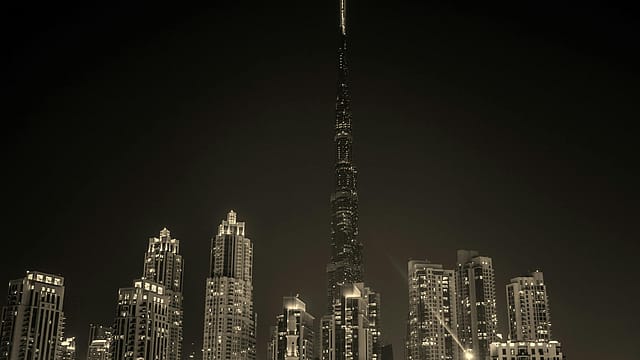
Over the last few decades, the Emirates have plunged their oil wealth into building monuments to human engineering and new-age services to pivot towards a future less dependent on fossil fuels. Dubai International Airport handles close to 90 million passengers annually. Jebel Ali Port is the largest manmade harbour in the world. It is a logistics nerve centre linking Asia, Europe and Africa. Billions of dollars in trade, aviation, tourism and financial services flow through these arteries each year.
Today, those symbols of Dubai’s modernism are being blighted by Iranian wrath. Fires have been reported at Palm Jumeirah and Burj Al Arab, and repeated incidents at Dubai International Airport have left staff injured. Thousands of Middle Eastern flights have been suspended, and smoke has been seen rising from Dubai’s major port, threatening its status as a global logistics hub.
Dubai’s Real Estate Index has dropped nearly 20 per cent, wiping out all gains made in 2026. The correction comes after a boom in which property prices had risen around 60 per cent between 2022 and early 2025. Each unsold or unrented apartment or villa represents a crisis of sentiment.
Dubai’s rise was predicated on promising investors and expatriate human capital that it was an island of stability and moderation in an area of radicalism and extremism. Even as it hedged its bets in recent years by deepening commercial ties with China and maintaining channels with Russia, the bedrock of its security architecture remained American power projection in the Gulf. Today, that proximity to America, that friendship, to paraphrase Kissinger, is acquiring the character of a fatal embrace that no amount of insurance can cover.
There are many who will say that Dubai and its satellite desert kingdoms have bounced back after being hit by economic turmoil. That the moment the war ends capital will return. But this analysis presumes a neat outcome: the overthrow of the clerical regime in Tehran and the emergence of a moderate dispensation. But what if there is no regime change? What if the mullahs hang on, nursing a festering wound that promises to avenge those who stood by their “satanic” adversary? What if that sullen resentment finds expression in a continued war by proxy against the UAE and other US Gulf allies?
As things stand, Dubai’s brand equity is now being risked by a war that the Gulf states are in danger of being subsumed by. The very security umbrella that enabled Dubai and the UAE to reimagine its future now risks turning it into the frontline of someone else’s conflict.