2026 Forecast: The Year of the Violent Whirlpool
IT IS NOT WISE TO COMPLAIN about the editor, but the distinguished, mild-mannered dictator of this elegant publication might have committed a journalistic solecism by asking the wrong people to peer into time’s telescope. Given the dubious track record of media oracles, he should have invited astrologers, palmists, stargazers, doomsdayers, or sibyls as contributors.
If the deadline for this article had been January 2 rather than five days later, not a single pundit would have placed the American abduction of Venezuela’s President Nicolás Maduro anywhere on the newslist of 2026. So much for collective insight.
Historians escape risk or censure because they focus on the past. A challenge for the best of them: prophesy, from the edge of a decade, what might happen over the following ten years. Facts will consistently outstrip the most inventive imagination.
Let’s start with 1910 since in my view the modern era begins in 1918. World War I was the last, brutal chapter of the old world.
Even the bleakest Cassandra of 1910 never foresaw the havoc and spectacular geopolitical consequences of World War I. War, yes. Some optimists in August 1914 were contemplating its end by Christmas. But World War? Forty million casualties? Lenin and a Red Star over Russia? The collapse of the Chinese, Tsarist, Ottoman, and Austro-Hungarian empires which had controlled vast swathes of Europe and Asia for centuries, triggering a volcano which continues to stain headlines with blood more than a hundred years later? The first great Arab intifada against the ‘Christian West’ began in Iraq in 1920 and consumed the region for two years as Britain and France expanded their colonisation into Ottoman lands through feudal surrogates instead of giving people freedom. The British Balfour Declaration of 1917 set off new episodes of bloodshed.

Open Minds 2026
26 Jun 2026 - Vol 05 | Issue 26
The power of ideas and arguments in 50 portraits
Which English fatalist in 1910 foresaw the long sunset over the British Empire after the barbarism of Jallianwala Bagh? In 1920 contemporary British acolytes laughed at a strange fantasist-fetishist named Mohandas Gandhi who thought he could destroy the mighty British Empire clad in a dhoti, armed with ahimsa, or non-violence.
No American seer in 1920 saw the Crash of 1929, the near-collapse of capitalism and ensuing economic depression. Which European in 1930 mentioned that a certain Adolf Hitler would seize power in civilised Germany within three years, start the conquest of Europe in 1939, and order a Holocaust against Jews aimed at their elimination from the human race? Which Asian visualised Japan’s sweeping victories over Britain and America across the Pacific? Who in 1940 predicted Pearl Harbor? Or dared to suggest Hiroshima and Nagasaki? Or thought that World War II would be followed quickly by a Cold War which froze Europe and terrified the rest of the world with heat as hot as hell?
There was no Indian in 1940, even one with a particularly malicious mind, who believed that a pernicious secret deal between Viceroy Lord Linlithgow and malcontent Muhammad Ali Jinnah would lead to Partition in 1947 and a hundred-year war on the subcontinent. Who in 1950 thought a Korean War would unnerve America; Vietnam defeat France in 1954; and the Cold War stretch into space? Did anyone in 1960 predict Berlin or the Cuban Missile Crisis which brought the world as close as it has come to nuclear armageddon? There was certainly no one in Delhi who sensed that the Chinese would invade across the Himalayas in 1962, destroy Indian pride and wreck the credibility of Congress. In 1970 the most extravagant optimist did not envisage the birth of Bangladesh a year later; or a pessimist mourn the coming imprisonment of Indian democracy in 1975. Who in China knew about Mao Zedong’s last hurrah, the Cultural Revolution, and the dramatic transformation after his death?
You get the point, so some quick shorthand. 1980s: secessionism in Punjab, Operation Blue Star, Indira Gandhi’s assassination, India’s intervention in Sri Lanka offensive. 1990s: the young Rajiv Gandhi’s assassination. Mumbai bombing. Iraq war. Internet. Global media.
India’s economic reforms. 2000s: 9/11. Afghan war. Iraq war. Pakistan-sponsored terrorist horror in Mumbai. Fast forward: Did anyone take a bet on an international plague called Covid?
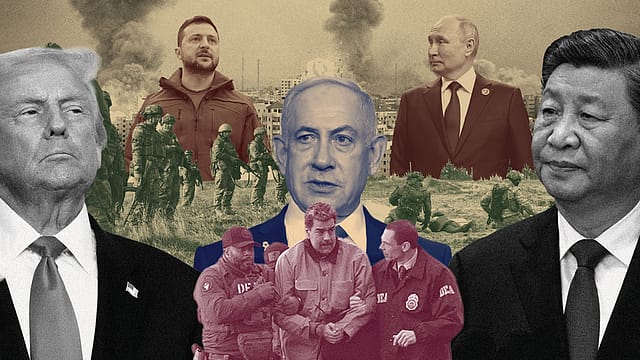
That was a long prelude. What does our new friend 2026 look like? Already, like the most dangerous year of the 21st century. January is named after Janus, the god with two faces, one looking back and the other ahead. When Janus 2026 looks back it sees the world ablaze with conflict; when it looks ahead it sees multiple derivative conflagrations. Every continent is septic with war.
Benjamin Netanyahu’s war is not over. The ceasefire of 2025 is a comma, not a full stop. Each time he sees Washington’s belligerence, Netanyahu cheers and moves a step closer to a renewal of conflict through which he can acquire more land from Palestine and hope to destroy the 400kg of uranium which he believes Iran possesses. A paradox is at play. If the mass protests across Iran destabilise the cleric regime in Tehran, Israel’s ability to intervene is reduced since the next government will be ipso facto less hostile to Tel Aviv. The window of opportunity, never fully open and never fully shut, is vulnerable to strange storms.
No one sets out to conquer a poor country. Even a civil war in starvation-stricken Sudan has its logic. They are not fighting for sand. Sudan mined 70 tonnes of gold in 2025. At $4,350 per ounce at the moment of writing and expected to touch $5,000 this year, do the calculus. Someone is getting very rich indeed, and they are not the ordinary people of Sudan. Saharan Africa is fragile; sub-Saharan Africa is incendiary. Radical armies, operating in the name of religion, are killing with impunity.
The conventional European framework of Ukraine has blindsided us to its eastern neighbourhood: Chechnya is next door. The Muslims of the Caucasus have been fighting for independence from Moscow for a couple of centuries. They acquiesce when overpowered but transmit the dream of independence through their genes. Forces hostile to Russia could reactivate them. There is active regional conflict to its south, which borders the Caspian Sea, troubled Iran, partitioned Iraq, and fragmented Syria. Israel, Palestine, and Yemen at the bottom of the Red Sea are a short-range missile away. Aden is within sulfurous distance of Afghanistan, Baluchistan, Pakistan, and thence to India. The Indian Navy is patrolling the Red Sea as the first line of defence.
Donald Trump has lit a flame in Latin America with the reassertion of a doctrine first articulated on December 2, 1823, when the world was ruled by European empires. The Monroe Doctrine affirmed that Latin America was a Washington parish and protectorate. After World War II America, sponsor of the United Nations, announced a world order based on the independence of nation-states guarded by rules. They applied to everyone except America and the Soviet Union, which converted Eastern Europe and Central Asia into a communist empire.
Since 1952 America has intervened directly in about twenty Latin American countries which flirted with defiance, including Cuba, Costa Rica, Guatemala, Haiti, Brazil, El Salvador, Honduras, Nicaragua, Panama, Peru, the Dominican Republic, Bolivia, and Paraguay. Fidel Castro got away, thanks to Soviet support in the 1960s and the blessed absence of oil thereafter. Venezuela’s mistake was neither drugs nor incompetent dictatorship. Neither is a criminal offence in the Pentagon or at Langley, the CIA headquarters.
All that Maduro needed to do was what his successors have done: send heavy crude to America. When the CIA dust settled in Caracas there was a change of leader, not change of regime. The high flag of democracy remained at half-mast, while Trump’s brief flirtation with direct rule in Venezuela quickly floundered under the weight of quiet advice. No American Chairman of the Board for Venezuela, no Viceroy, no parade. The lords of the drug trade can now exhale a huge sigh of relief in between their cigar puffs. The Pentagon will not chase them anymore. Their role as scapegoats is over.
President Trump should be congratulated for having sacrificed any chance of this year’s Nobel Peace Prize for heavy crude required by Texas refineries. America’s oil reserves are just 33 billion barrels; Venezuela’s ten times that. Oil will make America great again. Oil and chips.
Greenland is about chips, and water. Silicon Valley needs silicon. The nuclear industry needs uranium. The 21st century needs boron, phosphorus, indium phosphide, graphite, gallium, lithium, germanium in addition to old favourites like cobalt, nickel and copper. Greenland has 30 per cent of the globe’s known quantities of 30 minerals. America wanted to buy Greenland in 1946 for $100 million, or about $7 billion today. A lapse of urgency permitted Denmark to become its colonial ruler by the 1950s. An estimated annual ice melt of 270 billion tonnes into water to Greenland’s south is widening the passage for ships, shortening the trade routes. The seas between Greenland, Iceland and the northern tip of Britain are the Suez Canal of modern commerce. China has offered a $2.5 billion investment to build a deep-sea port and two airports in Greenland.
China is preparing with great care for global predominance in the post-industrial revolution after it absorbs Taiwan, an avowed ambition that has just got much easier after Russia’s strike for claimed geography in Ukraine and America’s reassertion of the 19th-century Monroe Doctrine in Venezuela. Taiwan produces 90 per cent of the world’s advanced chips, which fits nicely into Chinese dreams. Chips require rare earths.
However, Trump’s habitual hyperventilation may have done more damage to America’s friends than the Pentagon has done to America’s enemies. It has reawakened a sentient suspicion of America. The principal beneficiary will be America’s bête noire, China, which has in the last ten years made massive investments in Latin America, Africa and Eurasia without raising its head too far above a placid horizon.
Conflict through proxies eventually evolves into a mug’s game, which is why there has been continual active war even in the nuclear age. The flashpoint between America and China will be Taiwan. Chinese strategy thus far might be encapsulated in one of its proverbs: kill the chicken to scare the monkey. Taiwan has not been cowed into submission, and the only foreseeable option left with Beijing is military action. It began this year with manoeuvres as dress rehearsal for war. The Japanese responded with tough talk, and it will not come as a huge surprise if they have shifted, in secrecy, even closer to becoming a nuclear power. China has to move before that happens.
If America chooses inaction in the battle for Taiwan, the 20th century will finally come to an end. China will become the power of the 21st century.
2026 will be a year of unprecedented instability, rocked by external confrontation or internal flashpoint insurrections. As international institutions flail and national political systems are unable to deliver a better life, the young have entered what can only be described as the Mood of 1968 in the West, when the Brave New World born in 1945 turned into a mess of drugs, violence, hunger, and disappearing hopes. The so-called international rules-based order has disintegrated. Democracy is under threat from free will slipping into chaos; dictatorship is under pressure from its own cruelties and elitist greed. There is no theorist or realist with any evident answers.
2026 will be the Year of the Violent Whirlpool.