14 Children Dead After Lahore Roof Collapse Exposes Pakistan's State Neglect
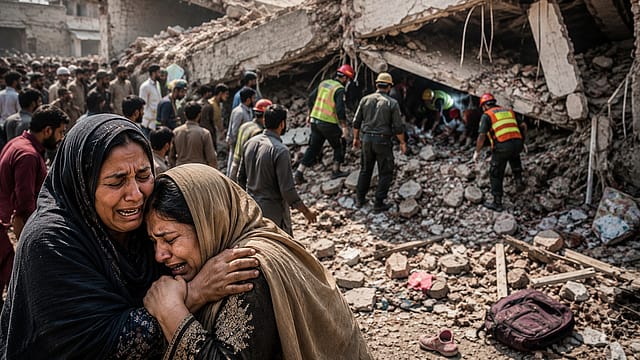
The roof collapse at a neighbourhood tuition centre in Lahore's Kahna area, which claimed the lives of 14 children, has become a stark symbol of Pakistan's crumbling civic infrastructure and governance failures. While authorities have launched arrests and crackdowns in the aftermath, bereaved families and residents say the tragedy was rooted in years of poverty, unsafe construction and institutional neglect rather than the actions of any single individual.
Grieving families blame systemic neglect, not just individuals
The June 30 tragedy has left several other children and their teacher undergoing treatment at a local hospital, according to a report by Dawn.
Among those devastated is Hassan, a labourer living in the same neighbourhood, who lost his five-year-old son Arkam in the collapse.
"We have forgiven the teacher for the death of our son," Hassan said while sitting outside his home.
The teacher, Anila, who conducted classes for children aged between five and 14, was also injured along with her daughter. During a visit to the site on Saturday, the house stood deserted after male members of the family were taken into custody by Lahore police, while the women reportedly fled.
Residents described the locality as a cluster of half-built and structurally unsafe homes, reflecting years of unchecked urban decay.

The Great Indian Male Makeover
03 Jul 2026 - Vol 05 | Issue 27
The craze for a perfect look is reshaping masculinity
"Most people here are very poor and build their homes slowly whenever they get some money to afford it," a resident told Dawn, pointing to the absence of state support and effective enforcement of building regulations.
Locals also said Katchwana Road, originally planned as a 50-foot-wide link to Ferozepur Road, has been severely compromised by illegal encroachments.
"This might not be the last tragedy in this area, as many people have occupied the sewage drain and built houses on top of it," the resident warned.
The neighbourhood's deteriorating living conditions have intensified over the past two decades, with large families living in cramped spaces and extending their homes whenever finances permit.
"We are trying to just survive," another resident said, describing the daily struggles faced by families in the area.
Recalling his son's aspirations, Hassan said Arkam had not yet been enrolled in school but was attending the local tuition centre to prepare for formal education.
"To prepare him for school, we sent him to the tuition centre in the neighbourhood. My other children are not interested in studying, and Arkam's older brother does not go to school as he is training to be a tailor. He [Arkam] wanted to become a police officer," he said.
Hassan also recalled that a child had previously been injured by a falling tile from the same building, highlighting long-standing safety concerns.
"She did not listen to them, and we lost our children," he regretted, referring to warnings allegedly given by children and a mason to suspend classes before the collapse. The family, he added, had been carrying out construction work with only one labourer because of financial constraints.
Authorities respond with arrests and regulatory crackdown
Following widespread outrage, Punjab Chief Minister Maryam Nawaz visited the affected neighbourhood to offer condolences, saying the grief she experienced upon learning of the children's deaths was beyond words.
Authorities subsequently detained two people, including the property owner. DIG Operations Faisal Kamran also confirmed that the contractor responsible for constructing the building had been taken into custody.
Punjab Education Minister Rana Sikandar Hayat announced a drive to shut down unregistered academies and schools, with district education officials serving notices to such institutions.
Critics question crackdown as education gaps persist
The government's response has drawn criticism from education stakeholders, who argue that home-based tuition centres exist because Pakistan's public education system has failed to meet the needs of low-income families.
Speaking to Dawn, All Pakistan Private School Management Association President Kashif Adeeb Jawadani said such neighbourhood academies, many operated by women, are a direct consequence of the country's socio-economic challenges.
"Due to the socio-economic circumstances of both the teachers and the parents, such tuition centres and academies are the only option for the poor," Jawadani stated.
He argued that instead of imposing penalties and pursuing legal action, authorities should have introduced a grace period, offered free registration and provided long-term financial assistance.
Questioning the government's approach, he asked, "If such educational institutions, along with low-fee private schools, are shut down, what alternative is being provided by the government?"
The Lahore tragedy has once again drawn attention to the dangers posed by unsafe construction, weak civic oversight and inadequate public services, with residents warning that unless systemic issues are addressed, similar disasters may continue to claim lives.
(With inputs from ANI)