What Are Optical Tornadoes? Scientists Create Swirling Light for Quantum Tech
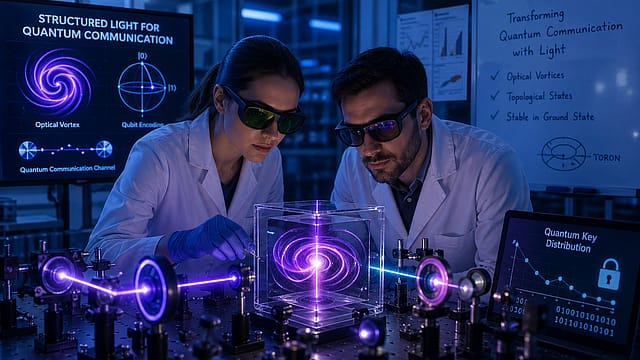
Scientists have developed tiny swirling beams of light—dubbed “optical tornadoes”—that behave like miniature whirlwinds. These beams twist, spiral, and rotate in highly structured ways, opening up new possibilities for controlling light at extremely small scales.
As researchers explain, “You can think of it as an optical vortex,” says Dr. Marcin Muszynski. “The light wave twists around its axis, and its phase changes in a spiral manner. Moreover, even the polarization — the direction of oscillation of the electric field — begins to rotate.”
This ability to structure light so precisely is crucial for advanced technologies like quantum communication.
How did researchers create these swirling light beams?
Instead of relying on complex nanotechnology, the team used liquid crystals—materials that flow like liquids but retain an ordered structure like solids. Within these crystals, special defects called torons form naturally.
Joanna Medrzycka explains, “They can be imagined as tightly twisted spirals, similar to DNA, along which the liquid crystal molecules are arranged. If such a spiral is closed by joining its ends into a ring resembling a doughnut, we obtain a toron.”
These torons act as microscopic traps for light, forcing it to spiral into vortex-like patterns.
What makes this approach different from earlier methods?
Traditionally, generating structured light required complicated nanostructures or large experimental setups. This new method is simpler and more scalable because it relies on self-organising materials.

Survival Instinct
22 May 2026 - Vol 04 | Issue 72
India navigates global economic turmoil with austerity and smart diplomacy
“Our solution combines several fields of physics, from quantum mechanics, through materials engineering, to optics and solid-state physics,” explains Prof. Jacek Szczytko.
“The inspiration came from systems known from atomic physics, where electrons can occupy different energy states. In photonics, a similar role is played by optical traps, which confine light instead of electrons,” he adds.
What is a “synthetic magnetic field” for light?
One of the key breakthroughs was creating conditions that make light behave as if it were influenced by a magnetic field.
“Spatially variable birefringence, that is, the difference in the propagation of different polarizations of light, acts like a synthetic magnetic field,” explains Dr. Piotr Kapuscinski. “We call it ‘synthetic’ because its mathematical description resembles the behavior of a magnetic field, even though physically it isn't there. As a result, light begins to ‘bend,’ much like electrons moving in cyclotron orbits.”
To enhance this effect, the researchers placed the system inside an optical microcavity, where mirrors repeatedly reflect light, strengthening its interaction.
“This makes the field much stronger,” says Dr. Muszynski. “Additionally, we can control the size of the trap, and thus the properties of the light, using an external electric voltage.”
Why is achieving this in the ground state significant?
A major milestone of the study is that these light vortices were produced in the ground state—the lowest-energy and most stable condition.
“In typical systems, light carrying orbital angular momentum appears in excited states,” explains Prof. Guillaume Malpuech. “For the first time, we managed to obtain this effect in the ground state, i.e., the lowest-energy state. This is significant because the ground state is the most stable and the easiest for energy to accumulate in.”
“This makes it much easier to achieve lasing,” emphasizes Prof. Szczytko. “Light naturally ‘chooses’ this state because it is associated with the lowest losses.”
To verify this, the team added a laser dye and observed coherent, laser-like light.
“We obtained light that not only rotates but also behaves like laser light: it is coherent and has a well-defined energy and emission direction,” says Dr. Muszynski.
How could this impact quantum technologies?
The discovery could simplify how advanced photonic devices are built, especially for quantum communication.
“It’s interesting that our approach draws inspiration from very advanced theories involving a so-called vectorial charge,” adds Prof. Dmitry Solnyshkov. “So, in a way, we’ve managed to make photons behave not even like electrons, but like quarks, the charged particles which make up protons.”
The broader implication is a shift away from complex fabrication toward self-organising systems.
“This discovery opens a new pathway for creating miniature light sources with complex structures. It shows that instead of relying on complex nanotechnology, we can use self-organizing materials,” concludes Prof. Wiktor Piecek. “In the future, this may enable simpler and more scalable photonic devices, for example for optical communication or quantum technologies.”
(With inputs from ANI)