AI Gender Bias: A study finds people reward male-presenting AI assistants more than female ones
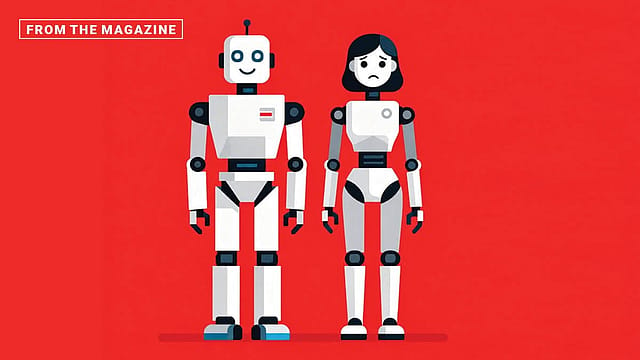
One may assume that the presentation of an AI agent will have little bearing on our attitudes towards it. But a new study shows that we are replicating gender-based discrimination at the workplace in our interactions with AI agents.
The study, conducted by researchers from the University of Limerick, looked at how people treat AI assistants in a workplace setting. The researchers had 189 individuals in a virtual reality office work with a text-based chatbot, a desk robot, and human-like AI agents presented with either male or female appearance to complete a set of tasks. The participants were then given money and asked to divide it between themselves and the AI assistants for the work done. Even though the AI assistants used the same underlying technology to complete the tasks, the male-presenting AI assistant was paid 10.25 per cent more than the female-presenting counterpart. The participants also perceived the male-presenting AI agent as more human-like than the female-presenting one.
The participants claimed that they didn’t care about the gender of the AI assistant, and preferred AI that was clearly non-human. But it rewarded both human-like and male-presenting AI assistants more than those that were female-presenting and non-humanlike. “We often think of AI as being neutral, but the way we design and present these systems can activate those same assumptions and biases that exist in our interactions with other people,” Mary Hausfeld, the study’s co-author, was reported as saying.
Meta’s Muse Gadgets

Meta’s new AI agent Muse may have already become a big hit among users, but it seems clear that the tech giant doesn’t want it to only be a standalone chatbot. Meta has introduced Muse Gadgets, an open-source project that which developers build their own hardware that connects to Muse. It is providing open-source firmware and a Linux software development kit along with a few project ideas to get users started.
Watermarking AI Text
OpenAI will soon start adding an invisible watermark to text generated by ChatGPT and Codex in the European Union to comply with new EU laws. The watermark is not an actual symbol visible to readers, but something a detector can pick up. OpenAI had built a text watermark before but hadn’t released it. Anthropic, meanwhile, has said it will be releasing its watermark for texts generated by Claude, something it is applying worldwide.
Hands Free
Besides a new line-up of Kindles, Amazon recently unveiled new accessories that will make reading easier. One of these is Kindle Click, a Bluetooth remote control that lets you flip through pages without having to touch your device. It comes with an attached wrist strap, which means you don’t have to worry about holding the remote control. It also introduced a cover with physical buttons called the Page Turn Cover, and a wireless charging stand.