Indians have been among pro wrestling’s biggest fans. A new promotion tries to bring the action closer home
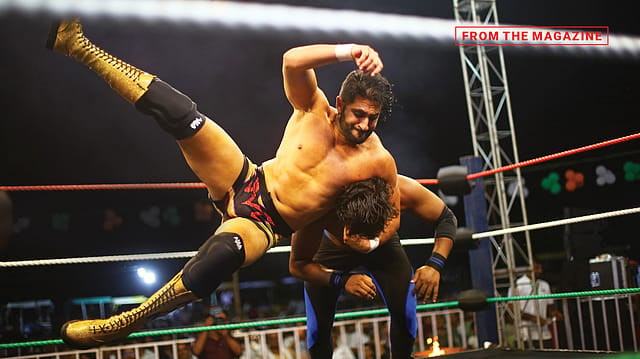
Mark Dallas, pro wrestling promoterON INDEPENDENCE DAY, tricolour balloons frame a wrestling ring in the playgrounds of Raunaq Public School in Ganaur, a town in the Sonipat district of Haryana. It is the setting for ‘Road to Kranti’— an event by Pro Wrestling Rebellion (PWR), a new promotion founded by wrestler Jeet Rama to popularise pro wrestling talent and live events in India. The third match of the evening is tailor-made for a brawl. The wrestler Kushagra enters the arena alone, but his opponent Sadique has an entourage that includes Zorawar and Toofan. They feud with the crowd and cheat when the referee isn’t looking. Kushagra eventually wins but his opponents immediately enter the ring and start hitting him all at once.
This is the sort of classic beatdown that fans of pro wrestling are familiar with—a situation in which rescue is almost always on the way. It comes in the form of Guru, one of PWR’s marquee talents, who rushes in with a steel chair (another leitmotif of pro wrestling matches). The opposing faction leaps out of the squared circle as he shoves the chair at them and leaps onto the ring ropes. “Fight us like men,” he yells. Jeet Rama enters the arena and declares that Guru and Kushagra will take on their opponents in a tag team match—the main event of the night.
Off-stage, Guru swaps his belligerent ring persona for disarming charm. “I am sweating,” he laughs, shaking hands, hours before he is set to be in the ring. “Some wrestlers fight with their heads. They plan and strategise. I fight with my heart,” he says. “Guru is my way to show my inner qualities and abilities that are not expressed in everyday life.” As a key member of PWR, Guru has been preparing for his match as well as working on technical aspects that range from checking the sturdiness of ring ropes and turnbuckles to giving his opinion on presentation. “I like it when people ask for my opinion about such things. There are more experienced people than me here. I’ve only been doing this for 11 years,” he says. “There is pressure to put on a good show but I enjoy all of it.”
Before he became a pro wrestler, Guru, whose off-ring name is Laxmikant Rajpoot (pro wrestlers are conventionally known by their ring names), was a javelin thrower and trained in taekwondo and MMA. His father was a mud wrestler, which sparked his interest but Guru was seeking something unique. After training in Punjab, he went on to WWE (World Wrestling Entertainment) tryouts and joined the company in 2019, facing Finn Bálor in his first match at the WWE Superstar Spectacle in 2021. After leaving WWE in 2024, he served as a coach and worked closely with Jeet, who involved him with Kranti. “It is my dream to see live pro wrestling events happen in India,” Guru adds.
India has a massive audience for pro wrestling, serving as a major market for global promotions like WWE, which has hosted shows here and runs dedicated social media pages for the country. The country has its own tradition of pro wrestling, from Baksh Dutt aka The Great Gama in the early 20th century to the legendary Dara Singh who was inducted into the Legacy category of the WWE Hall of Fame in 2018. In 2006, Dalip Singh Rana—famously known as The Great Khali—became the first pro wrestler from India to be signed to WWE. He went on to become WWE World Heavyweight Champion and brawled with major stars, including The Undertaker, Rey Mysterio, Kane and Batista.

Years later, Jeet Rama discovered its appeal. Jeet, whose name is Satender Dagar, was a heavyweight amateur wrestling champion and three-time winner of the Hind Kesari award before he went for his WWE tryouts in Dubai. “I did not even know about pro-wrestling,” says Jeet, a towering, soft-spoken man, settling down for a conversation between overseeing the event and welcoming guests. “I realised only after joining WWE that a large number of Indians watched and enjoyed pro wrestling,” he recalls. “My first big event was in Delhi in 2015 [part of a WWE event where he beat Chad Gable]. I was both nervous and excited because it was my debut and there were almost 20,000 people. That one match showed me how even a single match could make someone a star.”
Jeet often receives messages from aspiring pro wrestlers, particularly from South Asia, asking him how they can pursue the profession. It has fuelled his motivation over the years, following his release from WWE in 2021. “I turned the dream every pro wrestler in this country has into my own. It is my goal to do something for them for as long as I live,” he says. “India has among the largest audiences for pro wrestling in the world. Our aim is to reach every one of them. Many people here have watched wrestling on TV but few have seen it live. My strategy is to take PWR everywhere—not just big events but also smaller villages and towns. Everyone has the right to see these events and not just those who can travel to the big shows.”
Kranti, which is PWR’s first flagship event set to be hosted on September 11 in Delhi’s Talkatora Indoor Stadium, offers a model. In the run-up, PWR is putting on smaller shows in towns and villages that are free to attend. Ganaur follows a show in Baghru (where Jeet grew up and started wrestling) and another is scheduled for Ludhiana. Tickets for the Delhi event are also affordably priced, going from `99 to `499—the best seats in the stadium sold out in hours and PWR has since added more. The matches will assemble a host of Indian wrestlers, including Guru, Shanky Singh, JT Baba, Saurav Gujjar, Balliyan Akki and others with international names like Big Damo, Kanji aka Winona Makanji, the Japanese joshi (women wrestlers) Emi Sakura and Mei Suruga and Donovan Dijak. One of the highlights will be the appearance of Johnny TV aka John Hennigan who has performed with several companies, and is currently signed with All Elite Wrestling (AEW). At Kranti, where he will perform as Johnny Bollywood—a name chosen by local fans—the pro wrestler will share the ring with fellow AEW wrestler, Mansoor.
Mansoor, who serves as PRW’s chief creative officer (CCO), is in Ganaur for the event—his bout with Indian wrestler Ayush begins the match. Dressed in a red, black and gold jacket and shorts, with glittering long golden boots, he enters the arena to the beat of local musicians, getting the crowd to cheer. It is a whirlwind trip and a busy schedule but Mansoor crackles with energy, still as enamoured with wrestling as he was as a child growing up in Riyadh. “I was at my tutor’s house and her son was watching SmackDown [one of WWE’s flagship programmes] on TV. It was Kurt Angle versus Brock Lesnar in an Iron Man match and I had to be dragged away because I was glued to the screen,” he says. “It felt like a live version of superhero cartoons or films—these larger-than-life athletes and characters battling it out.” Like many of that generation, his heroes included WWE greats such as The Undertaker and his ‘brother ’, Kane. “But I’d never thought I’d be able to see it with my own eyes because it was just one of those things that didn’t happen in Saudi Arabia.”
When Mansoor moved to the US in his teens, pro wrestling became his great dream. “I would go to bed thinking about wrestling and I spent hours and hours training to be the best I could be.” He volunteered at local promotions, watched a variety of shows and live events and trained with The Stoner Brothers before getting an opportunity at a WWE tryout. “I treated that tryout like it was the only one I’d ever have to achieve my dream.” He made the cut and still remembers the gruelling experience—at least seven others quit after throwing up. “In-ring conditioning is an experience unlike any other. It’s not just about being physical or being a great athlete. You also have to emote and that takes a toll,” he observes.
Mansoor worked with WWE for several years before being released in 2023. It was heartbreaking, but he went on to sign with AEW where he continues to perform. The company, helmed by Tony Khan, has grown rapidly since its inception in 2019 and is now the second-largest wrestling promotion in the world. Mansoor had AEW’s support when he got the opportunity to work with Jeet Rama on PWR. The two had earlier worked together at WXM (Wrestling Xtreme Mania), a promotion Jeet had co-founded before leaving earlier this year to start PWR.
Echoing Jeet, Mansoor says that their aim is to bring live events to the Indian audience to not only “relive their childhood but to establish their fandom now”. As CCO, Mansoor also works on booking talent, social media and storytelling at PWR—a role that has opened new creative possibilities: “Being the person bringing these talented personalities together and creating a show—it’s so incredibly difficult but also rewarding.”
Another key member of PWR is Mark Dallas—a former pro wrestler and the founder of Insane Championship Wrestling (ICW), which grew from a Glasgow-based pro wrestling promotion into a cultural phenomenon that served as a launchpad for wrestlers like Drew McIntyre. Dallas was among those who created a wrestling ecosystem for Scotland, and says the same can happen in India. “This is a country that deserves to have pro wrestling in a way that athletes from here, and from different backgrounds, can try their hand at it and become superstars,” he says, noting the importance of live experience in building a fan following. “People like watching wrestling here but they don’t always feel emotionally attached to it. We want to give them something to look up to, to feel proud of, to get behind and support.”
Dallas brings years of experience in running a high-profile promotion to PWR, consulting across the board from promotions, business and bookings to creative insights and mentoring talent backstage. Indian wrestlers, he observes, look the part, “which is half the battle in pro wrestling”. What they need is an extra edge—training to be in front of a live audience or learning to talk to cameras. These are the skills that make stars out of wrestlers. “Their charisma, strength and conditioning are all very impressive. We just need to work on their showmanship, the razzmatazz,” Dallas adds.
sets pro wrestling apart is its singular mix of action and storytelling. There is a popular notion that pro wrestling is fake—it is a misplaced term. Industry professionals and fans prefer the term kayfabe—a practice where pro wrestlers fictionalise their lives and characters to create stories that culminate in fights and performances. Think of it as a live-action combat performance—with heroes (known as babyfaces) and villains (called heels), wins and losses, feuds and redemption arcs. The audience is an equal participant in this act, believing in the stories they watch spanning months and years. The physical impact and risks are not make-believe. When they are in the ring, every pro wrestler puts their body on the line and improvises based on audience reaction, be it while fighting or cutting a promo—it is what makes this one of the most exhilarating professions in the entertainment business.
When Mansoor isn’t wrestling, he experiences discomfort as much as anyone else. “But in a ring, I can get smashed in my face with a chair. I can get slammed through a table, my head could be driven through the mat—it doesn’t matter. I’d get right back up,” he says, adding that no bruise compares to the sheer adrenaline of performing to an audience. “Thousands of people chanting your name, cheering you or even booing you—it’s the same energy. I’ve been a bad guy and I’ve been a good guy and they are both as rewarding. It’s an emotional connection with the audience, whether I am hated or loved.”
Kanji aka Winona Makanji knows this feeling. “As professional wrestlers, we have an opportunity to share our vision for a match and put it into action. It’s such an amazing output of your creative insights,” the British wrestler says. “It also gives you an outlet to bring a variety of emotions through storylines, put it into a character and bring it to life. It’s a feeling of freedom.” Kanji is Indian on her paternal side and grew up watching wrestling with her father, grandfather, and uncle. She found role models in people like the WWE wrestler Paige, and turned to training full-time after finishing university. Kranti will mark her second time performing in India; she is bringing her mother along. “I love being in India. It’s a place I’ve always wanted to come, and see where my grandparents grew up and for my father,” she says. “He never got to see me train but I think of him every time I wrestle. I am so grateful that he introduced me to wrestling, and the fact that it brought me to India made it that much more special. It feels like being at home.”
There are comparatively few Indian women in pro wrestling. Jeet and Dallas both observe that they are keen to bring more women into their roster. Women’s wrestling, once relegated to the sidelines and heavily sexualised, has entered a new phase as strong and talented wrestlers take the spotlight across the world. Yet, as Kanji rightly argues, “Worldwide, pro wrestling is a male-dominated industry. The fight for women’s representation is constant.” Her family’s support has fuelled her own journey and Kanji is eager to play a role in promoting pro wrestling among women in India and creating greater access for them to join the profession.
Be it for women or anyone else, developing talent lies at the heart of PWR’s goals. “Even with few opportunities so far, so many have been eager to pursue pro wrestling,” Jeet says. “When they find more opportunities, more people will step up.” With infrastructure still in nascent stages, this also includes building on other areas—storytelling and programming, technical details of setting up matches and broadcasting. We also need to develop an appreciation for homegrown talent. “We must believe in our wrestlers, and trust that they are at par with international performers,” says Jeet. Dallas adds that they are aiming for greatness. “We want to create an entire generation of world-class professional wrestlers from India.”