World Cup '26: Jimenez's Headlining Act for the Ages
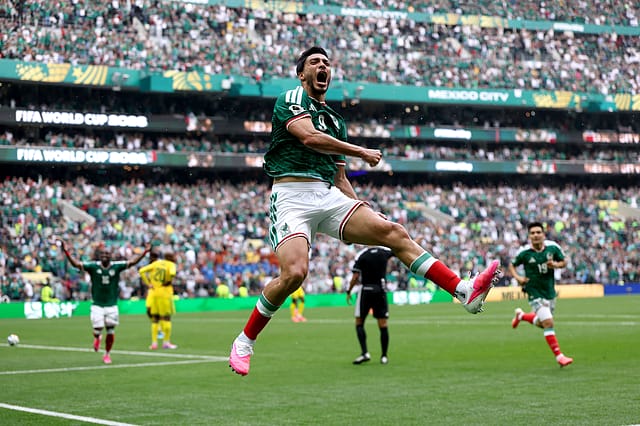
Just five minutes into the opening game of the 2026 edition at Estadio Azteca in Mexico City, Raul Jimenez nearly scripted one of the great storylines spanning all FIFA World Cups. Nearly.
Having hurtled down the right flank with the ball and somewhere near the corner post, Mexico’s full back Israel Reyes whipped a screaming cross past South Africa’s sleeping defenders. The ball fell on the bounce in the box to Mexico’s beloved No.9, Jimenez, who unleashed his left foot with great power and accuracy towards goal. It looked certain to lash the back of the net, or so the capacity Azteca thought in their roaring unison, only to be foiled by goalie Ronwen Williams, who plunged to his right in the nick of time.
Jimenez held his banded head in his hands, some 80,000 Mexican spectators groaned, and the moment had seemingly passed for the 35-year-old striker, and swiftly so, especially once Julian Quinones put Mexico ahead just four minutes later.
But amid all that mirth with Mexico 1-0 up at half-time, Jimenez ostensibly remained hell bent on completing the script perhaps written by the footballing gods, one about overcoming incredible tragedy: the kind that could have not only ended his career prematurely, but also his life.

What Rahul Gandhi Wants
28 Aug 2026 - Vol 05 | Issue 35
He is desperately courting the angry youth. That won't be enough to credibly challenge Modi
While representing his club side Wolverhampton Wanderers in the Premier League back in 2020 – the Covid era where matches were played in front of empty stands – Jimenez clashed heads with Arsenal’s David Luiz during an aerial challenge, leaving both players writhing on the bed of grass at the Emirates. Luiz rose soon after, Jimenez didn’t.
He was stretchered off in critical condition to a nearby London hospital, only then did he regain consciousness. The news he woke up to was catastrophic: a fractured skull, a traumatic brain injury, with haemorrhage inside his brain. The bleeding required emergency surgery to save his life.
Thanks mainly to the power of modern-day medicine, Jimenez returned to the field a little over a year later, but not the player he once was. A protective band now sat permanently around his temples – bulging with extra padding over his right ear – and he was admittedly afraid to head the ball. Jimenez did mark his return to football with goals for Wolves, but they were scored predominantly with his feet.
The headed finish remained altogether elusive, until, of course, he decided to unsheathe it in his own country, in perhaps the most storied stadium of them all, and at certainly the greatest stage of them all.
Twenty minutes into the second half, the hosts up 1-goal-to-nil and 11-men-to-10 up after Sphephelo Sitole was shown the red card, Jimenez made use of the extra space with a flurry of passes to the Mexican midfielders before charging expectantly into the box. The pinpoint cross arrived from Roberto Alvarado on the far right, which Jimenez met with his ramming head, angling it into the near post.
As soon as he scored, Jimenez skated away towards the nearest vibrating stand in celebration, fingers up in the air, before he was swallowed by his teammates for a long huddle. When they dispersed, Jimenez wept into the camera, which soon panned into the crowd and there wasn't a dry eye to be seen in all of the Azteca. Perhaps even all of Mexico.
Like that, surrounded by tears and the first drops of rain, the comeback of all comebacks was now complete.