Why This New Zealand Series Feels Like 2003 All Over Again
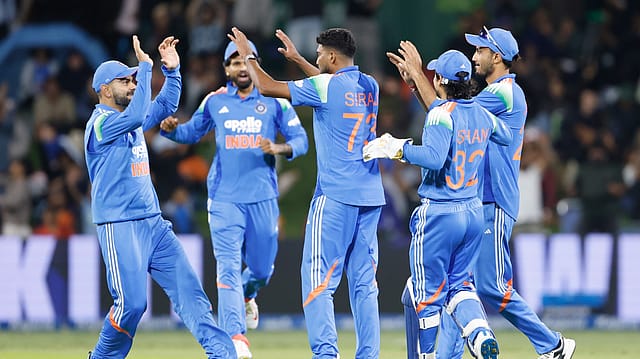
It may be 2026, but it feels a lot like 2003. Then too, the Indian men’s cricket team had toured New Zealand before the 50 over World Cup in South Africa (Zimbabwe and Kenya), and then too, it’s batters had returned with their reputation in tatters. By the end of that series, it appeared certain that a great embarrassment lay in store for them at the World Cup. No Indian batsman, with the exception of Virender Sehwag (two centuries) and Yuvraj Singh (a half century), scored a fifty; and there were plenty of batting collapses in the seven match ODI series that India lost 2-5. The then captain Sourav Ganguly looked forlorn as he tried to explain the abysmal batting performance, which had come after an equally disappointing outing in the Test series (which again India had lost 2-0). “We had better [prepare for the World Cup]. Instead of hoping that it would recover, we have to [recover],” he had said. “We have been to South Africa before where there have been runs scored, so it’s not that it hasn’t happened, but it has to happen again. The past has no meaning, it has to happen in the World Cup.”
It is another matter that the team went on to have one of its best World Cup campaigns, stumbling at the final against Australia.
The current series didn’t pan out that badly. India did win the series 2-1. But the win has come with a sour aftertaste. The batting collapsed frequently, once for a paltry 84 (in the fourth ODI), and apart from a 74 by Virat Kohli in the first match, no Indian batter even scored a 50. At the post-match interaction after the final ODI, India’s stand-in captain Shreyas Iyer was right in pointing out that it wasn’t only the Indian batters, but also New Zealand’s, who struggled throughout this series, but much more would have been expected of this Indian side.

The Wealth Issue 2026
06 Nov 2026 - Vol 05 | Issue 45
Portraits of Dreamers and Doers under 35
Among the batters who played throughout the series, the form of Iyer and Rohit Sharma will raise the most concern. Iyer’s weakness was an old one – the short ball. He may have been peerless since his return to India’s 50 over side – so good that the selectors turned away from Surya Kumar Yadav to make a place for him in the T20 side and grant him its captaincy and also gave him the ODI team’s vice-captaincy; but much of his exploits came in batting friendly conditions. With his vulnerability against short-pitched bowling resurfacing – made worse perhaps by his compulsion to assert no such weakness exists by attempting to pull the ball when safer options are available – suddenly Iyer doesn’t quite look the devastating batsmen he has been in the last few years.
But the biggest concern will be that of Sharma. On the surface, his numbers are peerless. But you don’t need to scrutinise them to know that he has tweaked his game in recent times. He isn’t the enforcer that he was until a few years ago, taking on the bowlers from the get-go and setting the perfect platform for others to exploit upon. He now takes his time knocking about the ball, at a slower clip than the other two who make up the top order (Shubman Gill and Kohli), and while this approach has brought him runs, he doesn’t amass the kind of monstrous scores he did when he first employed such an approach and made his name in the format.
Some of this perhaps has to do with age and slowing reflexes. A lot has to do with him becoming a one-format player, where there is now little cricket between series for him to build and sustain his rhythm. Sharma will be well past 40 by the time the World Cup begins. He certainly wants to play that tournament, and he feels he can win it for the team. But, if reports are to be believed, the selectors didn’t necessarily feel that way. About five months ago, midway through India’s tour of England, the selectors reportedly told Sharma that he was not part of their plans for the upcoming World Cup and that the final ODI match at Lord’s would be his final match. Not all of this is confirmed, but according to reports, Sharma is believed to have taken up the matter to the higher ups in the BCCI. He didn’t announce his retirement, scored a 138 in the very next match, and has since reeled off scores of 32, 101 and 92 against West Indies at home to effectively put a lid on that conversation. Ajit Agarkar, the then chief of selectors, who has taken some big calls, and managed to shepherd the team through the retirements of Kohli, Sharma and R Ashwin in the Test format, tripped on the last stretch when it came to Sharma’s ODI retirement. A few months later, it was Agarkar instead who chose not to seek an extension on his job.
Sharma has now had a big failure in this New Zealand series, scoring just thirty runs at an average of 7.5.
One of the reasons why Agarkar and Co. wanted to move on from Sharma is because they wanted to prepare another opener for the World Cup. Yashasvi Jaiswal, a regular for the Test side, was the obvious contender. But although he’s been around for quite some time, he’s only played six ODI matches so far, impressing almost every time he’s given a chance. Now, with an estimated 18 to 20 ODI matches to play for India between now and the World Cup, it is perhaps a tad too late to try out Jaiswal.
It would also be unfair to move on from Sharma. One bad series where almost all batters struggled shouldn’t necessarily be held against him. And then there are the coming ODIs, most of which will be played in batting friendly tracks at home, where one expects Sharma will again score runs.
But the New Zealand series has certainly led to some uncomfortable questions. For all you know, the team might put in a commanding performance like it did in South Africa in 2003. But for now, that unease between those assignments of New Zealand and South Africa has returned 23 years later. Luckily, there are a few home matches to calm those nerves.