Virat Kohli at 38: How Long Can a Man Run on Fire?
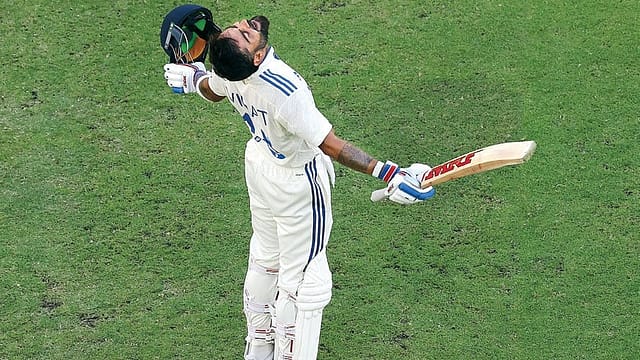
In Auckland, a day before his 38th birthday, Virat Kohli went down for a catch. Nathan Smith’s edge was travelling low through the slips. Kohli dived, reached out with one hand and took it just above the grass. Later, he made 74 off 51 balls as India won a rain-shortened ODI against New Zealand. The birthday could wait. There was work to do.
The catch belongs in this story as much as the runs. A batter can survive on reputation between innings. In the slips, the ball offers very little time to negotiate with it. Kohli still wanted that piece of the afternoon.
On November 5, he turns 38 with 15,183 ODI runs and 55 centuries in the format. The numerical monument keeps growing. But the more revealing question concerns the man maintaining it: how do you sustain a career built around an intensity that even you have sometimes struggled to produce?

The Era of Forever Wars
30 Oct 2026 - Vol 05 | Issue 44
Coping with an explosive Middle East
Kohli supplied the uncomfortable starting point himself.
“I was trying to fake my intensity a bit recently,” he told Star Sports in August 2022, in an interview reproduced by the ICC.
For years, spectators had watched him turn a wicket, a boundary or a confrontation into a visible declaration of intent. Now he was acknowledging a gap between the performance of conviction and the feeling underneath.
The body he built
Kohli’s physical transformation began with an assessment of his own shortcomings. Speaking in 2016, he identified the 2012 IPL as the turning point after which he began paying close attention to conditioning, food and training. As Cricket Australia reported, he had wanted to become the best batter in the world before possessing the physical capacity he believed it required.
That distinction helps explain his career. Ambition came readily. Making himself capable of meeting it required changes that continued when the cameras were elsewhere.
“I never wanted to be average,” he said.
Fitness expanded the work he could do. He spoke of becoming more confident in the field as he grew fitter, lighter and stronger. For a batter whose game could turn on the accumulation of singles and twos, physical preparation had an immediate cricketing purpose.
The consequences extended into captaincy. The BCCI’s account of his Test career credits him with raising the team’s fitness and competitive standards. His 40 victories in 68 Tests remain the most by an Indian captain; the 2018–19 side became the first Asian team to win a Test series in Australia.
He did not create those victories alone. Bowlers had to take wickets, colleagues had to make runs, and coaches had to prepare the team. His influence was in making an uncompromising level of preparation feel like the price of admission.
That is also a demanding identity to carry. Once effort becomes your public signature, an ordinary afternoon can look like a failure of character. The audience sees the result and searches your face for an explanation.
The summer that required patience
The familiar image of Kohli can obscure how much of his best batting required him to hold himself back.
In England in 2014, he managed 134 runs across five Tests. Four years later, he returned to Edgbaston and made 149 in a single innings. India had been 100 for five. James Anderson repeatedly examined his outside edge, and dropped catches helped him survive.
Those chances are part of the achievement. They prevent the innings from becoming a neat story about a great player deciding to conquer an old weakness.
He had to endure uncertainty, accept that the bowler could be better for a spell and remain available for the next ball. By the end of the series, he had 593 runs at 59.30. India still lost 4–1.
The distinction between his progress and the team’s result would recur. Kohli could solve a considerable part of the problem and still walk away defeated.
His aggression often looked most convincing after a boundary. Its harder expression was the discipline that allowed him to wait for one.
When intensity became work
By 2022, he was describing a different kind of difficulty.
During his break, he went a month without touching a bat. Training and practice had stopped exciting him. For someone who had organised so much of his professional life around preparation, the loss of that appetite was disturbing.
Kohli said he had needed to step away. His account acknowledged that a reputation for mental strength could coexist with reaching a limit.
There is a temptation to treat such admissions as the explanatory key to everything that follows. They are not. They tell us what he said about that period. They cannot establish the cause of every subsequent success or failure.
But they do complicate the easy instructions routinely handed to struggling athletes. Train harder. Show more hunger. Want it enough. Kohli had built an extraordinary career doing those things. He was describing circumstances in which continuing required a different response.
Two months after that interview, he made an unbeaten 82 off 53 balls against Pakistan at the Melbourne Cricket Ground. India needed 28 from eight deliveries before he hit Haris Rauf for consecutive sixes. The chase went to the final ball.
It was a spectacular return to the role people expected him to perform. It did not erase the account he had given of the cost.
What Federer and Biles help us see
Global sport offers useful comparisons, provided we resist turning every comeback into the same story.
Roger Federer returned from a six-month injury layoff to win the 2017 Australian Open at 35. He beat Rafael Nadal in five sets, recovering from a break down in the decider. It was his first major title since Wimbledon in 2012.
The appeal of that victory lay partly in seeing a familiar champion become possible again. Yet the interruption belonged to the story as surely as the trophy. A late career can depend on how an athlete manages absence as well as competition.
Simone Biles presents a different experience. After withdrawing from several finals at the Tokyo Olympics, she took time away from competition. Her return brought four gold medals at the 2023 World Championships and the Laureus Comeback of the Year award in 2024.
Her circumstances should not be collapsed into Kohli’s. The useful connection is the space both athletes created for a public understanding of limits.
For spectators, resilience is easiest to recognise when someone keeps going. Elite athletes also have to decide when to stop, what to change and which demands they can continue to meet.
Kohli’s career makes that question particularly sharp because his visible energy had become such a reliable part of the spectacle.
The scoreboard could not promise happiness
At the 2023 ODI World Cup, Kohli scored 765 runs, the highest aggregate by a batter in a single edition of the men’s tournament. He was Player of the Tournament. Australia won the final.
The numbers documented his excellence precisely. They could offer no protection against the result.
The following year produced an almost inverted experience. He arrived at the T20 World Cup final with 75 runs from seven innings, then made 76 off 59 balls against South Africa and won Player of the Match as India took the title.
Looking back on the final on the RCB Podcast, in remarks reproduced by the ICC, Kohli said: “I was walking in with no confidence.”
That admission deserves to sit beside the triumphant pictures. Here was a player with an immense history of successful chases, describing uncertainty before another defining innings.
The familiar assumption is that champions carry an inner assurance unavailable to everyone else. Sometimes they have to begin without it. Kohli’s record did not tell him exactly what the next delivery would bring.
Nor did the final settle every question about how he should play T20 cricket. He later acknowledged that a younger generation was playing a different game and needed time to develop. His departure from T20 internationals made room for that process.
An athlete can remain capable of a great performance while recognising that the team’s future requires something beyond him.
Leaving the game he loved most
His Test retirement in May 2025 left 9,230 runs, 30 centuries and a career batting average of 46.85. Those are substantial achievements. They also leave a record less statistically overwhelming than his ODI career.
A serious account of Kohli must allow that difference. His captaincy record and influence on Indian Test cricket can be exceptional without making every part of his batting career equally dominant.
Then came an unusually revealing moment. After Royal Challengers Bengaluru won their first IPL title in 2025, Kohli spoke about Test cricket. In the middle of a celebration he had waited years to experience, he still ranked the longest format above it.
“That's how much I value Test cricket. That's how much I love Test cricket,” he said.
The attachment had survived the departure. Retiring had not required him to persuade himself that the format mattered less.
There is no need to invent a private explanation for that tension. His words establish its existence. A cricketer can leave something he continues to regard as the highest expression of his profession.
The next ball at 38
Kohli now occupies a narrower international role. Tests and T20 internationals are behind him. ODIs remain, alongside the IPL.
That changes what endurance asks of him. He no longer has to sustain the same presence across three international formats. He still has to prepare for the occasions that remain and justify his place when they arrive.
Yesterday’s innings in Auckland gave an immediate answer. It cannot guarantee the next series, or a place in the 2027 World Cup. At this stage, the uncertainty is part of watching him.
A birthday invites a finished portrait. Kohli keeps interfering with it. The young batter who changed his habits, the captain who demanded more, the exhausted player who stepped away and the veteran who admitted doubt all belong in the frame.
The question is how much more cricket he can make from everything he has learned.
In Auckland, he had already given the afternoon 74 runs. Earlier, when an edge dipped towards the turf, he had gone after that too.