The 2026 IPL shows how franchise allegiance shapes Indian cricket today
EVEN IF YOU were present at the Chepauk stands on May 18, you perhaps would have missed the swift set of hand gestures made by Ishan Kishan, movements that have immediately split the followers of the Indian Premier League into two clear halves—only one of which deems them deeply disrespectful. Soon after his match-winning 70 had all but eliminated Chennai Super Kings (CSK) from making the playoffs, the lack-of-qualification confirmed in their own backyard no less, Sunrisers Hyderabad’s Kishan made a few blink-and-miss actions from within a larger group of SRH’s orange shirts at the departing Chennai crowd.
But camera lenses don’t blink. And Kishan’s send-off to both CSK and their noisyfans—about35,000ofthemequipped with football-referee whistles—was captured and widely shared on Instagram by zoomed-in mobile phones in its intended chronology: first he sticks his fingers in his lips and teases CSK’s unique “whistle podu” celebration, then makes the universal sign for a ‘house’ with the tips of his index fingers, and, finally, with the back of his hand, shoos them away. As if to say: “Time to go home, eliminated CSK fans.”
Whether you frown upon this behaviour, or back it as a flex, there is no denying that this was possibly the moment that the creators of the league could only have dreamt of 19 years ago—a time when the IPL entered its post-national era; which it almost certainly has now. The last time Kishan was in Chepauk was back in late February, during the T20 World Cup, very much in India’s blue. On the back of his match-winning 77 against Pakistan, Kishan was given a hero’s welcome to the crease by the fans in Chennai, followed by a hero’s send-off.
None of that could have mattered less to Kishan on May 18, a boy from Jharkhand, representing Hyderabad and antagonising fans from Chennai. The 27-year-old wicketkeeper couldn’t even be bothered by the fact that at the other end of the same ground, the greatest Jharkhandi to ever play the game, the injured MS Dhoni, who had led CSK to a record-five IPL titles in the past and couldn’t recover in time to take the field this season at the age of 44, was perhaps waving his final goodbye to his beloved supporters in yellow. Best represented by that one moment of Kishan fury, the emotional grammar had now become franchise-first. The IPL was no longer merely a tournament within Indian cricket. For millions of fans, it had become the main event itself. As it was once designed to be, given that it was largely based on club football rivalries in Europe.
None of this means Indian fans care less about the national team, of course. But over 19 seasons, the IPL has built a world of its own—with its own loyalties, rivalries and mythology. Fans now celebrate (and by the same measure, dislike as well) franchises with an intensity once reserved mainly for international cricket, while players move between cities and teams with the ease of global club sport. The IPL is no longer just part of Indian cricket’s calendar. It increasingly feels like the centre of it.
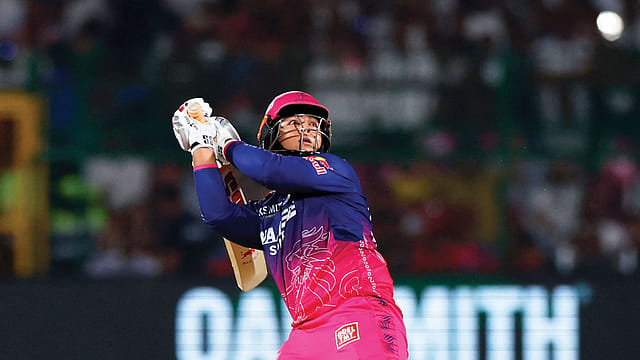
AT THE VERY HEART of this new centre lies the very future of the sport, 15-year-old Vaibhav Sooryavanshi—quite easily the greatest teenage prodigy to play top-flight cricket after Sachin Tendulkar. Playing in his second season when boys his age are busy writing their Class 10 Boards, the Rajasthan Royals’ discovery sits on top of the run-getters’ list with 579 runs in 13 completed innings, with one group match to go.
If his century on IPL debut last year—the second-fastest in the history of the league, no less, and scored at the tender age of 14—shocked the watching world, Sooryavanshi’s heroics in the opening game of the 2026 season—a 15-ball fifty against CSK, the second-fastest by any Indian—was seen as a reminder that the kid from Samastipur, Bihar, was the real deal, a superstar in the making, a successor to Virat Kohli. Two matches later, Sooryavanshi faced Jasprit Bumrah for the first time and off the very first ball, Bumrah was smacked for a six. The second IPL hundred arrived at the Sawai Mansingh Stadium against SRH, followed by a 38-ball 93 in the penultimate match, where each of his 10 sixes put Rajasthan Royals within touching distance of the playoffs.

Yet, perhaps the most extraordinary part of Sooryavanshi’s rise is how quickly it has come to feel normal. The IPL, now old enough to contain entire cricketing generations at once, has created a stage where a 15-year-old prodigy can arrive fully formed, even as veterans from the league’s inaugural season continue to command it. Which is what makes Kohli’s 19th season with Royal Challengers Bengaluru (RCB) feel almost surreal. Even at 37, and nearly two decades into the IPL journey, the game’s biggest star continues to move through the tournament as its defining force.
HIS TALLY OF 542 runs thus far for RCB may only be the sixth-best in this edition, yet they have been scored at an average of 54.20—the best for any batter over 300 runs in 2026. Kohli is, of course, a big reason why the defending champs qualified for the playoffs while perched on the very top of the standings. To ensure they stay there and perhaps even chase a second crown, Kohli’s form ripened further at the fag end of the group stage with a banging hundred on the back of two ducks (he hilariously celebrated the first run with a pump of the fist, even as the bat stayed down on getting to the three-figure mark). It was his ninth IPL hundred overall, two more than the next best, Jos Buttler.
Kohli, though, has not been the only ageing RCB star to turn back the clock this season. If the one-club-wonder is a constant reminder that greatness can endure, then Bhuvneshwar Kumar’s season has shown that it can also be rediscovered. The 36-year-old seamer had not played top-flight cricket outside of the IPL in a long while, his career seemingly drifting towards a quiet fade-out after years of injuries and dwindling pace. Yet, in a tournament that increasingly doubles up as cricket’s grandest rehabilitation stage, Bhuvi has come to the fore spectacularly by the end of the group stage, leading the Purple Cap race (highest wicket-taker of the season) with 24 scalps.
THE FORMER INDIA seamer, who won back-to-back Purple Caps as the IPL’s leading wicket-taker in 2016 and 2017—achievements that now feel from another cricketing lifetime— last represented India in any format back in 2022, or Uttar Pradesh in 2024. Yet, somehow, Bhuvi has once again found himself giving RCB early breakthroughs and late control with the sort of precision that once made him indispensable to the teams he represented, be it with white or red ball.
While the cricket itself reached new extremes in 2026, with 200 increasingly turning into a par score, just as compelling as the action was in the off-field theatre, franchise loyalties now completely shape the league’s discourse far beyond the boundary ropes.
KISHAN VERSUS CHENNAI was merely the most recent example. The most visible of the lot had to do entirely with Arshdeep Singh, the country’s most Instagram-obsessed cricketer. It was in one of these social-media ‘stories’ when the Punjab Kings seamer referred to Mumbai Indians batter and fellow T20 World Cup winner from a couple of months ago, Tilak Varma, as ‘andhera’—a remark widely criticised as colourist rather than harmless banter.
Expectedly, the reaction split instantly along franchise lines. Mumbai Indians then appeared to respond with a pointed Instagram post after defeating Punjab, turning the controversy into yet another episode in the IPL’s permanently online ecosystem of rivalry and outrage.
Nearly every major moment in the tournament now lives multiple lives at once: first on the field, then on reels, timelines and fan wars, where team colours increasingly matter as much as the cricket itself.
Nearly two decades since its birth, the IPL has become exactly what its architects once imagined and what traditionalists once feared—a self-contained cricketing universe. One where loyalties are inherited, rivalries spill beyond stadiums and into reels and timelines, even as players representing the same national side can become heroes or villains depending entirely on the colour of the jersey they wear that evening. Somewhere along the way, the league stopped being merely a spectacular addition to Indian cricket and turned into the emotional centre of it.