Team India Gets a T20 Makeover
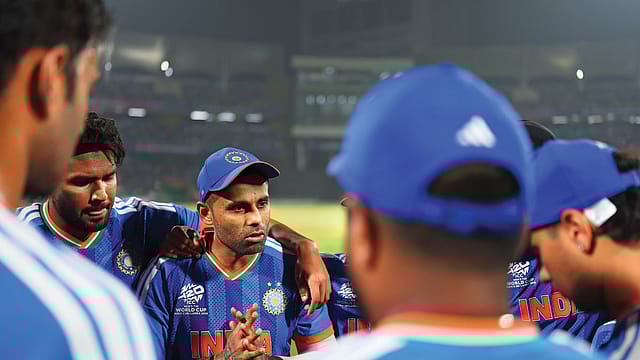
INDIA, THE T20 World Cup champions, are all set to defend their crown, well under two years after they won the tournament in Barbados. After all, the 10th World Cup edition of international cricket’s shortest format, which was first played in 2007, or just 19 years ago, will be held in the defending champion’s backyard (co-hosted by Sri Lanka) from February 7 all the way until the final on March 8, most likely to be played in the largest cricket venue of them all, the Narendra Modi Stadium in Ahmedabad.
Yet, despite both the sheer volume of completed editions and the speed at which they seem to pass by, no defending champion has yet won the T20 World Cup. Incredibly, neither has the host nation. The weight of history also informs us that no team has won the tournament on three occasions as well. This young Indian cricket team, led by the captain-coach combination of Suryakumar Yadav and Gautam Gambhir, will therefore look to buck all three trends. And if there’s ever been a squad custom-built to topple over records, it has got to be the one that will begin their campaign against the US in Mumbai on the opening day of the tournament.
At the very hour that India won the previous edition against South Africa, two top-order legends of Indian cricket—Virat Kohli and Rohit Sharma, Man of the Match in the final and the captain who collected the country’s second T20 World Cup trophy, respectively, retired from the format (as did the astute all-rounder, Ravindra Jadeja). Far from leaving a void or forcing upon the team a period of transition, the slots were immediately filled by the likes of Abhishek Sharma, Tilak Varma, and, of late, Ishan Kishan—young men groomed by the pressures of the Indian Premier League, who have taken international cricket by storm, all of them seemingly smashing hundreds for fun, at a ludicrous strike of in and around 150 to boot.
So much so, that in the period between the end of the previous T20 World Cup and the beginning of the upcoming one, Team India boasted of an insane win percentage of over 85 per cent, victorious in 33 out of the 41 T20Is played in the bracket—by far the most in the format across all parameters. When New Zealand landed on these shores in January for a final tune-up series consisting of five T20 matches, India scored 238 runs in the first match, chased down a target of 209 runs in 15.2 overs in the second, chased another target of 154 runs in just 10 overs (yes, 10) and posted 271 runs on the board in the final match. It was breakneck batting, sputtering with easy sixes, handing India a comfortable 4-1 win.
This explosive revolution is not just due to India’s phenomenal top-order, but their middle-order too, packed with big-hitting all-rounders such as Shivam Dube, Harshit Rana and the evergreen Hardik Pandya, who—with their finishing roles in the death overs— ensure that India breaching the 200-run mark is now an everyday occurrence. Collectively, these batters have papered over the few cracks that the Indian team has, such as the revolving door for the second opener’s slot that saw the exit of India’s Test and ODI captain Shubman Gill from the World Cup squad, and Sanju Samson from the playing eleven. But the biggest cloud of doubt, for the longest time at least, hung over the batting form of India’s captain, Suryakumar Yadav.
For all practical purposes, it was Surya’s gravity-defying catch of South Africa’s David Miller that won India the World Cup in 2024 in the first place. And given the phenomenal form he was in—having struck four T20I hundreds in the space of a couple of years—Surya became the man to lead the country’s next generation into the new era. But soon after taking over, Surya went through a batting slump that stretched from October 2024 all the way until the recent New Zealand series this year, where he didn’t score a single fifty in 23 completed innings, averaging in the low teens during the period. But as fate would have it, the Indian captain found his touch in the eleventh hour, scoring three fifties, two of them unbeaten, in the last four matches against New Zealand.
“This tells me that I wasn’t out of form, just out of runs,” the man known as SKY said with a big smile at the end of India’s last official T20I match ahead of the World Cup. “I think the ‘sky’ wasn’t blue for a year. But that’s life. It’s part of the journey. I took it in my stride, went back to the drawing board, tried to understand what was going wrong.” Even if Suryakumar hadn’t found a thick vein of form in the nick of time, the format of this World Cup—20 teams placed in four relatively relaxed groups of five—would have given him, the coaching staff and the country’s vast legion of supporters plenty of solace. For, in Group A, India finds itself pitted against three minnows (in the US, Namibia and the Netherlands), and Pakistan, who will most likely concede the points by pulling out of the India match in Colombo, slated to be held on February 15.
Geopolitics, then, has been the other great talking point of this World Cup, what with Bangladesh already having pulled out of the tournament and swiftly replaced in their group by Scotland. The chain of events leading up to their withdrawal began with the prompt removal of Bangladesh fast bowler Mustafizur Rahman from the Kolkata Knight Riders (KKR) squad for the upcoming IPL, upon the behest of the Board of Control for Cricket in India, reportedly as a response to the attacks on Hindu minorities in Bangladesh.
Citing “security concerns”, the Bangladesh Cricket Board (BCB) pleaded with the International Cricket Council (ICC) to shift all their matches to Sri Lanka, quite like when BCCI had asked for all of India’s matches at last year’s Champions Trophy— hosted by Pakistan—to be played at a neutral venue, Dubai. Unlike with BCCI, BCB’s request wasn’t granted by ICC, thus Bangladesh became the first country to ever pull out of a world event in cricket.
Pakistan could well have been the second, with plenty of unconfirmed rumours in the lead up to the tournament threatening that the Pakistan Cricket Board (PCB) may follow BCB’s suit, in solidarity. But on February 1, the government of Pakistan decided to boycott the India fixture instead. Their official handle on X announced: “The Government of Islamic Republic of Pakistan grants approval to the Pakistan cricket team to participate in the ICC World T20 2026. However, the Pakistan cricket team shall not take the field in the match scheduled on 15th February, 2026 against India.”
Whether PCB follows through on the threat remains to be seen. However, with or without the marquee clash of the group stages, the World Cup will thunder on regardless, with favourites, hosts and champions India at the very centre of it, geographically or otherwise.