Messi, Maradona, Pelé: Kolkata and Kismet
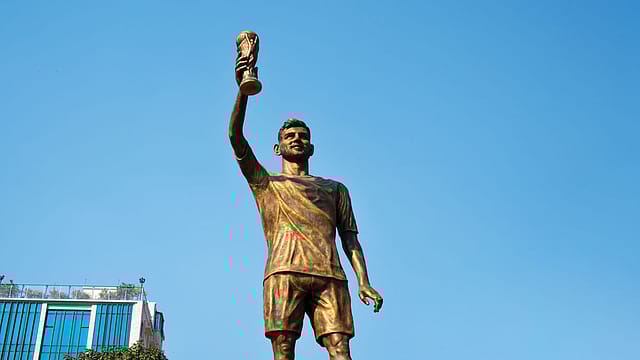
I PUT EVERYTHING I HAD INTO MY SHOT. AND THE SCREAM CAME: GOOOALLLL. No, not a goal. An endless orgasm. It was unforgettable.” Thus spoke Sócrates, Brazil’s captain, reminiscing about shooting the ball into the net over legendary Soviet goalkeeper Rinat ’Iron Curtain’ Dasayev in the 1982 World Cup without even looking up the pitch.
Perhaps the late Sócrates was oblivious to the fact that he was sanctifying the truism that football and sex are the only universal language. Is there a difference between passion of one kind and another? Otherwise, why would aggression be so easily transferred? If the life instinct and the death instinct, like the glow ahead and the shadow behind, are never apart, it follows that chaos always chases order. One moment, it’s all sweetness and light. In the next, culture has turned into anarchy.
Sport and violence have always enjoyed close proximity, often entwining themselves in grand spectacle, with or without codes of honour between contestants or, more accurately, combatants. That’s why we still have blood sports. Sport is the ultimate arena of transference—of love and hate, of identity and desire, of hope and anger. When it no longer suffices, we fight wars. Starting with throwing the nearest thing at hand, be that a bottle or a stadium seat.
No words can defend what happened in Kolkata on December 13 when Lionel Messi’s GOAT tour bequeathed the city a prolonged groan its reputation will take years to recover from, by when it would be time for the next catastrophe. We have been here before. And we will be here again. Ask Sunil Gavaskar.

The BJP Nation
08 May 2026 - Vol 04 | Issue 70
Now all of India is in his thrall
It’s a misconception that Kolkata, or Bengalis, have a passion only for football that breaks bad when things go wrong. In 1984, Gavaskar was hit with fruits and abuse at Eden Gardens because Kapil Dev was dropped for the third Test against England. But the iconic ‘No Kapil, No Test’ chant and that poster on the stands belonged to a different era. This was the same discerning crowd that called out a bad shot or cheered a good one even when it didn’t get a run. It was a time when spectators, before they became ‘fans’, had the eye and the time for the subtler things. By the time Eden Gardens exploded during the India-Sri Lanka semi-final in the 1996 World Cup, the display of passion had long ceased to be a fine art.

The point is: what went for football also went for cricket as far as Kolkata, or Calcutta, was concerned. But the connection with football runs deeper and longer because of its early transformation into an instrument of defiance against the colonial state. Football was also a sport everyone could play, needing no equipment. Since Mohun Bagan lifted the IFA Shield on July 29, 1911—the first all-Indian team to do so, and barefoot to boot, by beating the crack East Yorkshire Regiment 2:1—Bengal hasn’t let go of that link of shared memory. It’s in its DNA. That’s why one is loath to blame the crowd for what happened at the Salt Lake Stadium on December 13. The fans who felt cheated were as much victims as the damaged venue. Could things have turned nasty elsewhere had the event been so mismanaged? We don’t know. What we do know is that it happened in Kolkata. But a little history puts this latest fiasco in context, or even in a tradition of sorts.
Corruption and mismanagement had produced fake tickets and 20,000-odd extra spectators at Eden Gardens for the December 31,1966-January 5, 1967 India vs West Indies Test. Sir Gary Sobers’ West Indies won by an innings and 45 runs but the crowd had expected India to make a comeback. On January 1, fans rioted and invaded the pitch. Incidentally, it was Bishen Singh Bedi’s debut.
But Kolkata’s own, and India’s, Hillsborough had happened in 1980, almost a decade before the English football tragedy in which 97 people died in a crowd crush in Sheffield on April 15, 1989, the worst sporting disaster in Britain. Sixteen football fans died on August 16, 1980 when the Kolkata derby between Mohun Bagan and East Bengal turned into a riot that caused a stampede. The number of fatalities may not be comparable with that of the Hillsborough disaster but August 16 is commemorated by the Indian Football Association (IFA) as Football Lovers’ Day.
Two strands of passion had played into and resulted in the 1980 tragedy. One, the reality of football being something more than a sport in the Bengali mind. Two, the cultural rivalry of the two kinds of Bengalis: Ghotis, or native West Bengalis, and Bangals, or East Bengalis settled in West Bengal mostly after Partition. The first has never gone out of fashion. It charmed and intimidated Pelé in 1977. It irritated but also delighted Maradona in 2008. The second has faded with the Bangal-Ghoti divide having largely bridged over generations although the history of that animosity could have filled the Library of Babel. Trouble did return to the Kolkata derby in the last decade, notably in 2012, but on that day in August 1980, the Bangal-Ghoti rivalry had demanded a blood sacrifice.
The first half of the 1980s was the only time football was a bad word in Bengal, helped not insignificantly by the growing popularity of cricket after the 1983 World Cup triumph. Mothers wouldn’t let their sons go watch football matches, wives would warn their husbands at a time the football ground was still overwhelmingly a male bastion. A gender study of football spectatorship could perhaps relate the transmogrification of what is basically a love of the game into blood and gore to that fact, although the idea itself might be inherently sexist. (A family friend used to say you don’t become a football fan till you buy the cheapest ticket and kick people around at the slightest hint of trouble.)
But football soon recovered that emptied ground with, first, the Salt Lake Stadium’s (formally the Vivekananda Yuba Bharati Krirangan and the site of the Messi mess) inauguration in 1984, and second, the 1986 World Cup which Doordarshan had the good sense to telecast in its entirety. And yet, the Maradona World Cup also showed up the widening gap between international football and its domestic apology in real time.
It wasn’t always that way. When Mohun Bagan won the IFA Shield in 1911, the Manchester Guardian wrote: “A team of Bengalis won the IFA Shield in India after defeating a crack British regimental team. There is no reason… to be surprised. Victory in association football goes to the side with the greatest physical fitness, quickest eye and the keenest intellect.” That might be true of football anywhere, anytime, but the paper missed a vital ingredient: passion. Passion distilled by anger fuelled by the lived experience of discrimination. Mohun Bagan, founded in 1889, began life as a pan-Bengal club. For that IFA Shield match, the crowd of 60,000 had many who had journeyed all the way from eastern Bengal to support their ‘native’ team. East Bengal, founded in 1920 by a group of aggrieved administrators, was named not so much in an act of defiance within an act of defiance but to celebrate the founders’ antecedents. Over time though, this youngest of the three city giants (Mohammedan Sporting being the second) would become the club of East Bengali migrants and, post-1947, of refugees from East Pakistan.
I recall hearing, sometime in the early or mid-1990s, Bobby Charlton tell BBC radio: “Well, you play India in Calcutta and, you know, it’s really difficult.” He was talking about local advantages and seemed stuck in time although, in the 1990s, Calcutta was still the Mecca of Indian football. What he meant was that a team like India was no challenge without home advantage. But even in the 1990s, foreign coaches visiting with their teams would see the skills of Krishanu Dey and ask why India didn’t play in the World Cup. That was when the ‘Indian Maradona’ was already nearing the end of his career while IM Vijayan was rampaging, Sudip Chatterjee had recently retired,and Bhaichung Bhutia was the talk of the town.
FOOTBALL WAS THE original colonial sport to become a vehicle of payback. It wasn’t an accident that it all began in Calcutta, the colonial capital where the first football club in Asia was established in 1872. It quickly became the religion it was everywhere though it was never allowed to stray far from politics. That couldn’t be helped. But when Pelé arrived in the city in 1977, he experienced that passion firsthand as Mohun Bagan played his New York Cosmos to a 2:2 draw before a crowd of 80,000 at Eden Gardens on September 24. The same passion, albeit in a non-contest, led to an epic crowd mismanagement that embarrassed Kolkata when Diego Maradona visited in 2008. But Maradona acknowledged the unbounded love he was shown. And, on a visit that may now be remembered for its uneventfulness, when Messi led Argentina in a friendly against Venezuela in 2011 in Kolkata, the referee was visibly star-struck. The poor bloke should have been asked to stand aside and watch.
There is a sentimental subtext to Kolkata’s fanaticism vis-à-vis foreign teams and visitors that hasn’t exhausted itself yet. Brazil was the first foreign national team Calcutta had adopted. That was natural given the Seleção’s successes in 1958, 1962 and 1970, followed by Pelé’s visit. Argentina, in 1986, was the second team Calcutta picked for good, not least because Indians saw a full World Cup live on TV for the first time—and how Maradona attached his name to it. While the Bangal-Ghoti disagreement about most things had worked its way into Brazil (Bangal) versus Argentina (Ghoti), themselves bitter arch rivals, it was largely a generational switch, quite like the Cola wars. Winning seemed more important than merely playing beautiful football and losing—the aftertaste of the disappointment with Telê Santana’s brilliant Brazil in 1982. Maradona provided both: art and triumph.
The subtext, however, was Latin America. Englishmen and Scots had introduced football to South America, too, albeit with a very different outcome. Still,
Latin Americans were “like us”; we could identify with them in their third worldism for one. There was, moreover, a distaste for the drawing board and teamwork that European football stood for. That was ironical because in Syed Abdul Rahim—the man behind the near-bronze in Melbourne in 1956 and the two Asian Games golds in 1951 and 1962—India had had a world-class thinking coach from whom even the Brazilians had learnt a thing or two. Nevertheless, Bengalis loved the great individual who could turn a game around and even win a World Cup almost singlehandedly, no pun intended. Which, again, is not to say everybody felt the same way or that one couldn’t have multiple loyalties. Johann Cruyff or Franz Beckenbauer had plenty of admirers in Calcutta and beyond, as did the 1974 Flying Dutchmen and almost all West German/German teams since 1974 till the Mannschaft’s collapse in 2018, or the unbeatable, all-conquering Spanish team of 2008-14. But it’s doubtful Cruyff or Beckenbauer or Iniesta would have triggered the catastrophic crowd trouble Maradona and Messi did.
Indian football’s original sin was the inability to participate in the 1950 World Cup at the pinnacle of the national team’s reputation, technically because of FIFA’s refusal to let the Indians play barefoot. That disqualification allowed the AIFF to absolve itself as it had not grasped the significance of a World Cup slot. There wouldn’t be another. Despite India’s successes in the 1950s and 1960s, the transference of desire to foreign sides had already begun. Just as sport in a poor society always becomes a vent and an escape—a classic case of transference—Brazil and Argentina have provided Bengalis their vent and escape. Economies expand, incomes rise, living standards improve, but some things don’t change. Or they take much longer.
Kolkata would have lost its centrality to Indian football had Mohun Bagan not been turned around under professional management, proper investment, and a long-term vision of where the club wants to go. In the process, it recovered its old glory with its serial successes at the top tier of national leagues, keeping the club’s identity intact and living up to its values. While East Bengal is still ahead in the head-to-head count of the Kolkata derby at 144 to 134 and the most (29) IFA Shields, it is a case study today in how not to run a football club. Once the club of anger and rebellion, it might be necessary to see where the disappointment of its fans is going. Something excellent is happening in Kolkata football at one end. And something is very rotten at the other. And emotion is a dangerous thing where things go bad.
“You play football with your head; your legs are there to help you,” said Cruyff about the legendary ‘Cruyff Turn’. But when the legs have a long distance to cover, the head can be overwhelmed. According to an anecdote from the late 1980s or early 1990s, a young player had asked PK Banerjee (or Subrata Bhattacharya) after watching a visiting foreign club train: “If that’s how they run with the ball, how are we going to play?” The coach had replied: “Parle khelbi, na parle dekhbi (Play if you can, otherwise just watch).” When it comes to a Messi, we are all watchers. But many of us are worshippers too. And that’s a dangerous thing as well. Hope breeds disappointment because the gods don’t show. When they do, they quickly disappear again. The worshipper is left with desire that seeks a vent as anger which takes tangible form as violence. Does the fault lie in Kolkata’s stars or in itself?