Grit and Glory at the Asian Games
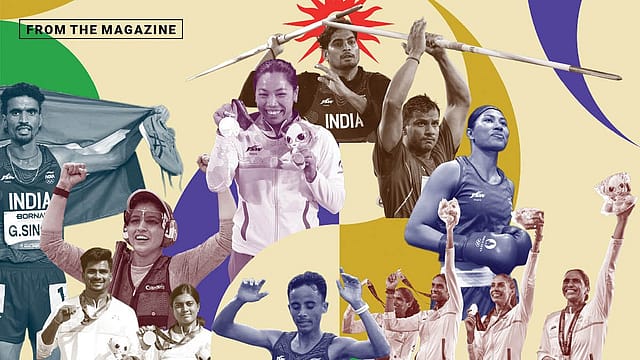
Just 10 days before she won India’s first individual gold medal in trap shooting at the Asian Games since 1978, the 26-year-old Neeru Dhanda was rushed to the hospital with a fever that refused to subside. It was suspected that she had contracted H1N1. The illness was severe enough for her to miss over three weeks of training. Having won an individual trap gold at the ISSF World Cup just a few months before—the first for an Indian woman—there had been high hopes riding on her. Now, it seemed she might not even make it to the flight to Japan.
Somehow, she did. And somehow, despite the lingering exhaustion from the illness and the disruption to her training, the trap shooter from Haryana put in one commanding performance on top of another in a discipline India has been overshadowed by other countries for years. On a rainy day in the finals, sticking her tongue out as she took aim, Dhanda set an Asian Games record on her way to a gold medal in the women’s trap category, hitting 28 out of 30 targets, and becoming in the process the first Indian woman to win an individual gold and the first Indian since Randhir Singh’s gold in 1978. Her shooting tally, along with those of the shooters Aashima Ahlawat and Manisha Keer, also meant that India would win a silver in the women’s trap team category. The next day, she would team up with Kynan Chenai for the mixed trap event to win another gold, hitting 34 targets and creating another record at the Games.
From being an uncertain starter at the Games, she now had three medals in her kitty.
As the Asian Games draw closer to a conclusion, while India hasn’t been able to replicate its best-ever show at the last edition, where they won 107 medals, including 28 golds, there have been some incredible performances by athletes like Dhanda who have stirred people’s imagination. The most striking of these performances was the one by India’s 4x400m women’s relay team.
The team of Kiran Pahal, MR Poovamma, Prachi Choudhary and Vithya Ramraj, all runners from different parts of the country, put together one of the most thrilling runs to save India the ignominy of returning from Japan without a gold medal in track and field. Each of them had overcome their own peculiar set of challenges to reach the track that day—from India’s most experienced quarter-miler, the 36-year-old Poovamma who had to fight through the depression she had plunged into while serving a two-year doping ban from 2022, to Ramraj who wanted to make good on her potential as one of India’s most promising runners after seeing the sacrifices her father, a truck driver, had made while supporting her.
Ramraj had in fact already cemented her reputation. Just the day before, she had broken what is arguably India’s most iconic and long-standing national records—PT Usha’s 55.42 seconds 400m hurdles at the 1984 Los Angeles Olympics. Usha’s record had lasted 42 years, as much a statement about that incredible performance as the state of Indian running since, and Ramraj had finally bested that record with a 54.75 seconds run that also fetched her the bronze. At the relay, Kiran had got off to a slow start, handing over the baton in third place. But from then on, Poovamma and later Choudhary kept improving on it, till Ramraj produced a strong final leg to finish the race at 3:29.69. It was a performance that appeared to stir the rest of the Indian contingent, as bigger hauls followed over the next few days.
Among these were the dominant performances by India’s compound archers, who swept all the three team categories. Sahil Jadhav and Chikitha Taniparthi, who would be part of the gold-winning men’s and women’s teams, would also come together in the mixed team category, a final that would go down to a shoot-out. What made this final even more significant is that its winners would book a spot for Los Angeles 2028, where the mixed team event will make its Olympic debut. The two held on, while their Korean opponents wilted under pressure. Both Jadhav and Taniparthi come from backgrounds that have required many sacrifices. Taniparthi’s parents, who are farmers in a remote village in Telangana, have supported her ambitions by taking loans, once even selling a rice harvester to get her a bow. The support continues, although the pressures have eased slightly since she got enrolled in the Sports Authority of India’s centre in Sonipat. Jadhav, who hails from Satara in Maharashtra, had an equally tough background, with his mother once having to sell her jewellery to get him a bow.
While the Games offered a platform for youths like Jadhav and Taniparthi to deliver on early sacrifices, for decorated legends like Mirabai Chanu, it was about securing a legacy. With an Olympics medal, three World Championship medals and three Commonwealth Games (CWG) medals in her cabinet, there is little doubt that Chanu is already India’s greatest weightlifter ever. Yet, the one missing piece of silverware was an Asian Games medal—a void she finally filled by snatching 87kg and clean-and-jerk lifting 111kg to secure a historic silver in the women’s 49kg category.
There have been several more noteworthy performances at this edition: Yashvir Singh and Rohit Yadav stepped up in the absence of Neeraj Chopra to claim silver and bronze in the javelin throw; Sawan Barwal shattered his own national record by 21 seconds to win a historic marathon silver in 2:11:37—India’s first marathon podium in 44 years; and Gulveer Singh showcased staggering range and endurance by winning three distance medals (silvers in the 10,000m and 1,500m, and bronze in the 5,000m). Combined with first-time medals in soft tennis and mixed martial arts by Jay Meena and Suchika Tariyal, every podium told a story of hard labour and difficulties surmounted.
At the time of writing, athletes like boxer Lovlina Borgohain, the men’s and women’s hockey squads, and the men’s cricket team continue to advance deeper into their brackets. Meanwhile, the men’s and women’s kabaddi teams, the 10m Air Pistol mixed team, and the women’s cricket team have already locked down gold medals. India may not hit the sheer numeric high of the last edition, but the grit on display proves the nation’s sporting trajectory hasn’t veered off the mark either.