Glenn Phillips: From Struggles to Stardom with a Record-Breaking Century at Eden Park
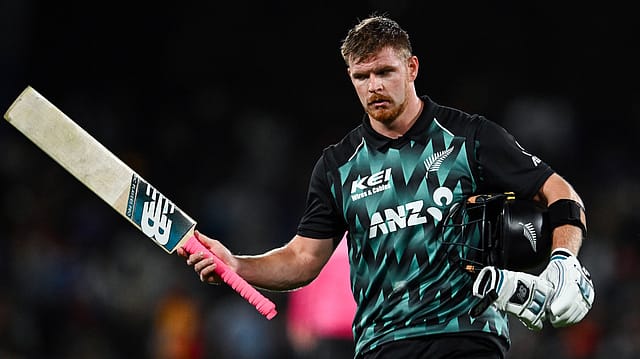
At Eden Park, Glenn Phillips hit four successive deliveries from Nitish Kumar Reddy for six. An over that cost 32 runs helped turn New Zealand’s innings into an ordeal for India. Phillips finished with 107 from 49 balls, including six fours and 10 sixes. Eighty-four of his runs had travelled to the boundary or beyond it.
There was a time when getting the ball away was considerably harder.
In January 2018, Phillips made three from 10 balls in one T20 international against Pakistan and five from 11 in the next. New Zealand dropped him. Across those two innings, he had consumed 21 deliveries for eight runs. Coach Mike Hesson sent him back to Auckland to develop his game.

Look Who's Talking Regime Change
23 Oct 2026 - Vol 05 | Issue 43
The distance between those scorecards contains the story of Glenn Phillips. It involves an uncomfortable relationship with wicketkeeping, a fascination with bowling and an appetite for movement that he eventually learned to accommodate. Along the way came extraordinary catches, some very ordinary misses, and injuries that took him out of cricket.
At 29, Phillips can make an international attack look helpless. Getting here required him to work out what sort of cricketer he could bear to be.
THE GLOVES BECAME A PROBLEM
Born in East London, South Africa, Phillips moved to Auckland with his family at five. He reached New Zealand’s T20I side in 2017. Wicketkeeping offered a useful route into a team, but the role increasingly frustrated him.
“I was always an off-spinner,” he told The Cricketer in 2021.
He explained that he had initially taken the gloves because he was tired of watching others drop the ball. Competence became an obligation. Teams needed someone who could keep, and Phillips could do it.
“But bowling is where my passion lies.”
That left a young professional with an awkward problem. A skill valuable to selectors was keeping him from the work he enjoyed. Escaping the role meant establishing enough value elsewhere to justify someone else wearing the gloves.
His subsequent career gives that decision weight. Every spell of off-spin, every sprint across the outfield, belongs to a version of Phillips that wicketkeeping would have restricted.
In a 2024 Wisden interview, he described another adjustment: learning to live more comfortably with his own energy. Phillips has spoken openly about having ADHD and how he came to regard aspects of it as helpful to his cricket.
“I had people tell me to slow down a lot when I was younger,” he said.
He explained that trying to suppress that energy had diminished something distinctive in his game. His account is personal, rooted in his experience. It also helps explain why a job involving long stretches in one position had begun to feel so confining.
THE PHONE CALL AFTER A SWIM
His first Test arrived with almost comic abruptness.
In early January 2020, Phillips had been body surfing at Tawharanui, north of Auckland, when New Zealand chief selector Gavin Larsen called. Illness had swept through the Test squad in Australia. Phillips needed to reach the airport for an evening flight to Sydney.
He arrived expecting to provide cover. During the warm-up before the SCG Test, coach Gary Stead told him he would play.
His first innings brought 52, though the route there included two dropped catches and a reprieve after James Pattinson overstepped. Pat Cummins eventually bowled him. Phillips understood exactly how much assistance the day had supplied.
“Sometimes you get lucky, sometimes you don’t,” he said afterwards.
It is a useful early glimpse of him. He could enjoy the improbable arrival without polishing away the luck. International cricket had granted him a chance, and then several more within the same innings.
Later that year, he produced a performance far harder to explain through generosity from opponents.
Against West Indies at Mount Maunganui in November 2020, Phillips reached his hundred in 46 balls, then New Zealand’s fastest T20I century. He also contributed two catches and a run-out as the hosts secured the series.
The breadth of that performance suggested how much he could offer once freed to roam. A batting contribution might be followed by another intervention almost immediately. Opponents had to account for him through both halves of the match.
A HUNDRED WITH THE INNINGS IN TROUBLE
Sydney offered a different examination in October 2022.
New Zealand were 15 for three against Sri Lanka at the T20 World Cup. Finn Allen, Devon Conway and Kane Williamson had gone. Phillips had to rebuild an innings with very little protection left above him. He finished with 104 from 64 balls.
Sri Lanka helped. Pathum Nissanka dropped him on 12, and another chance went down later. Those reprieves belong in the account of one of his greatest innings. Phillips survived them and made the opposition pay.
There was substantial running beneath the headline number. Forty of his runs came between the wickets. On a difficult surface, with a slow outfield and long boundaries, he found a way to keep scoring without demanding a six from every opportunity.
Even his stance at the non-striker’s end drew attention. Phillips crouched like a sprinter, keeping a foot behind the crease and preparing to accelerate. He explained that the position helped him watch the bowler and leave quickly without stealing ground.
It was a small, revealing piece of problem-solving. He had considered the mechanics of a run before the ball had even been delivered.
THE BOWLER GETS HIS TURN
His all-round game acquired another dimension in Bangladesh in December 2023.
In the Mirpur Test, Phillips scored 87 in the first innings and took three wickets. During the chase, New Zealand slumped to 69 for six in pursuit of 137. He and Mitchell Santner put on an unbeaten 70 to win the match and square the series. Phillips finished on 40.
For a player associated with explosive movement, his explanation was measured. He spoke about keeping his processes calm, following his plan and breaking the chase into individual runs.
“It was about knocking down one run at a time,” he said.
By March 2024, the off-spinner who had wanted more opportunities had a Test five-wicket haul against Australia. His five for 45 at Wellington was his first in Tests.
The achievement gave substance to a preference he had expressed years earlier. Bowling had remained important to him while wicketkeeping occupied the more obvious place on his professional description. Eventually, he had the opportunity and skill to make it count at the highest level.
WHAT THE HIGHLIGHTS LEAVE OUT
Phillips’ fielding can make his athleticism seem inexhaustible. He launches himself at balls that appear to be travelling beyond any realistic catching position. The successful attempts circulate for days.
His memory also holds the failures.
In an April 2026 interview with The Indian Express, he recalled a straightforward boundary chance in the Caribbean slipping through his hands. He discussed how waiting beneath a catch could give doubt time to intrude. A sudden dive sometimes left him less opportunity to overthink.
That is a striking admission from someone whose fielding invites such certainty from spectators. He knows the sensation of anticipating a mistake as the ball approaches.
The body, too, has imposed limits. In April 2025, a groin injury sustained while fielding for Gujarat Titans ended his IPL campaign. He had been on as a substitute and had yet to play a match that season.
In July, another right groin injury, sustained in the Major League Cricket final, forced him out of New Zealand’s Zimbabwe tour. Selection and ambition could do little once recovery became the immediate requirement.
During his time away with injury, he pursued flying and obtained his private pilot’s licence in September 2025. He had found another demanding skill to learn while cricket was interrupted.
BACK AT EDEN PARK
On October 30, India encountered the accumulated force of those years.
Phillips’ hundred came in 46 balls. His partnership with Michael Bracewell added 115 in 41 deliveries, helping New Zealand reach 259 for seven. India had already secured the series, but Phillips supplied an innings with a ferocity of its own.
The numbers will draw readers to him. The career behind them offers more to hold their attention: a young international sent home to improve, a keeper trying to hand over the gloves, a bowler waiting for his work to be taken seriously.
He has needed dropped chances, survived poor scores and spent time injured. He has also kept expanding the ways in which he can affect a match.
At Eden Park, the ball repeatedly disappeared into the stands. Years earlier, Glenn Phillips had been trying to persuade cricket to let him move.