England vs Argentina: Six Defenders, One Tactical Mistake That Changed the FIFA World Cup Semi-final
England were within touching distance of reaching their first FIFA World Cup final since 1966 after Anthony Gordon's second-half goal handed the Three Lions a deserved lead against defending champions Argentina in Atlanta.
Instead, Lionel Scaloni's side mounted a remarkable comeback, scoring twice in the closing stages through Enzo Fernandez and Lautaro Martinez to seal a 2-1 victory and book a place in the FIFA World Cup 2026 final against Spain.
The dramatic turnaround was shaped as much by tactical decisions as by moments of individual brilliance. While Argentina became increasingly adventurous in search of an equaliser, England gradually retreated into a defensive shell that surrendered control of the contest.
England Were in Control Before the Tactical Shift
For much of the opening hour, England looked organised and balanced. Defending with a back four while attacking through the pace of Morgan Rogers and Anthony Gordon, they matched Argentina across the pitch.

Look Who's Talking Regime Change
23 Oct 2026 - Vol 05 | Issue 43
Their reward came in the 55th minute when Rogers delivered an inviting cross from the right and Gordon finished at the far post to give England a deserved lead.
At that stage, England appeared well placed to end their 60-year wait for another World Cup final.
Tuchel's Defensive Changes Altered the Contest
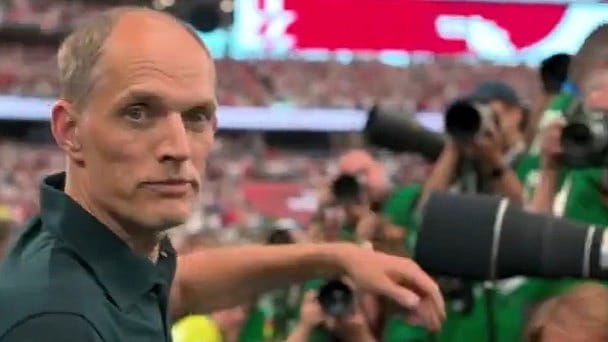
The complexion of the match changed in the 72nd minute when Thomas Tuchel replaced goalscorer Anthony Gordon with defender Ezri Konsa, switching England from a back four to a back five.
Ten minutes later, the England manager made another defensive substitution, withdrawing midfielder Declan Rice for defender Nico O'Reilly.
Reece James was also replaced by Dan Burn in the 82nd minute, leaving England with six recognised defenders on the field.
The tactical reshuffle significantly reduced England's attacking threat. Elliot Anderson, Jude Bellingham, Morgan Rogers and Harry Kane were left to carry the attacking burden without fresh pace for counter-attacks, while Argentina increasingly pushed England deeper into their own half.
Scaloni Chose Attack Over Caution
While England became more defensive, Argentina moved in the opposite direction.
In the 81st minute, Lionel Scaloni sacrificed left-back Nicolas Tagliafico and introduced striker Lautaro Martinez, making it clear that Argentina intended to win the match in normal time rather than settle for extra time.
Earlier, Nicolas Gonzalez had also been introduced and consistently troubled England's defence with intelligent movement and direct running.
The contrasting approaches from the two managers soon became evident.
The Numbers That Defined the Momentum Shift
Statistics reflected just how dramatically the balance of the match changed.
From the middle of the second half until Lautaro Martinez scored in stoppage time, Argentina enjoyed more than 92 per cent possession.
During the same 25-minute period, England attempted only 12 passes and completed just five, illustrating how little control they retained once they retreated into their defensive setup.
Between Gordon's opener in the 55th minute and Lautaro Martinez's winner in the 90+2nd minute, England had only 12 per cent possession as Argentina launched relentless waves of attacks.
Messi and Argentina Made England Pay
Argentina's sustained pressure finally produced results in the 85th minute.
Enzo Fernandez received a pass from Lionel Messi outside the penalty area before firing beyond Jordan Pickford to level the scores.
Seven minutes later, Messi once again made the decisive contribution. After beating Djed Spence on the right flank, the Argentina captain delivered a cross beyond Pickford for an unmarked Lautaro Martinez, who headed home the winning goal.
England introduced Marcus Rashford and Ivan Toney only in the 90+6th minute, replacing Djed Spence and John Stones, but by then Argentina had already completed the comeback.
Tuchel Accepts Responsibility
After the defeat, Thomas Tuchel acknowledged that his tactical decisions would inevitably come under scrutiny.
"I believe that's just nature of the game. As soon as you lose, you get criticised. It's what it is," he said.
"No one knows what would have happened if we had made different decisions. I made them; I take the criticism. It is what it is," the German national added.
Reflecting on the momentum shift after England took the lead, Tuchel admitted his side gradually surrendered possession as Argentina increased the intensity.
"I think it was a very close match. I was happy with the way we played it, a very close match, took advantage and went 1-0 up. At that point of the match, that was also deserved, not undeserved. Unfortunately and strangely enough, it came with a momentum shift. Argentina played with more risk," Tuchel stated.
"We suddenly played with a feeling that we had a lot to lose. We dropped into a deep block, which isn't a problem, but we struggled to (win) any duels and (have) any ball possession anymore," he added.
What Happens Next?
England's FIFA World Cup 2026 campaign ended in heartbreaking fashion after controlling large parts of the contest before conceding late under sustained Argentine pressure.
Argentina, chasing a fourth World Cup title, advanced to their seventh FIFA World Cup final, where they will meet Spain on Sunday at the New York-New Jersey Stadium. England will now take on France in the third-place playoff.
(With inputs from ANI)