2026 Forecast: Sport: Champions’ Arena
A FIFA WORLD CUP, which still comes once in four years, is special enough. But for sports fans in India to experience the football World Cup in the same year as the T20 World Cup, which will be played in the subcontinent no less, makes 2026 a red-letter calendar for team sports. Here is Open’s sports forecast for the upcoming year that promises to thrill from start to finish.
FIFA WORLD CUP
EVERYTHING ABOUT THE FIFA World Cup this year is bigger and more commercial than ever before: from a renewed figure of participating nations to the number of countries that are hosting the 2026 edition. The most-watched sports event in the world—which began in Uruguay back in 1930 with 13 teams, before really settling into a rhythm by the very end of the previous century (France ’98) with 32 contesting countries in the finals—will now feature 48 teams for the very first time, spread over 12 groups (from A to L) and three host countries, again a first for FIFA. Welcome, then, to the 23rd edition of football’s grandest prize, to be played in Mexico, the US and Canada over June and July.
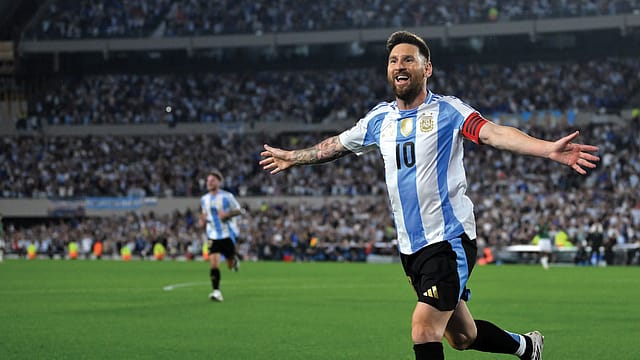
Whether one frowns upon or agrees with the reasons behind the tournament’s very obvious profit-centred bloat, the 2026 World Cup will surely do what it is designed to—grab eyeballs around the world and make FIFA a whole lot of money. That Argentina’s Lionel Messi, the most sellable face in the history of football, is the defending champion makes the whole enterprise so much more lucrative than it had set out to be. But the fact that Messi will return for a sixth World Cup to defend his title (at the age of 39 no less) may help the organisers monetarily, but it also certainly makes the world a happier place to live in.

I.N.D.I.A. Falling
12 Jun 2026 - Vol 04 | Issue 75
The Unravelling of an Alliance
INDIAN PREMIER LEAGUE

EVEN THOUGH THE INDIAN PREMIER LEAGUE (IPL) never does need a reason for the fan to tune in (just ask the millions who do so religiously, every day, seven days a week and for months on end), the 2026 edition received the most perfect build-up at the culmination of the previous one, where the greatest IPL batsman of all time, Royal Challengers Bengaluru’s Virat Kohli, at long last, completed his story by hoisting the only elusive trophy of his storied career. Like a TV series that returns for a new season despite having tied up all loose ends, the 19th edition of the IPL is now tantalisingly about what life looks like for first-time champions RCB and Kohli after they pulled off their version of ‘happily ever after’.
Winning combinations seldom remain so in the cut-throat world of the toughest T20 league in the world (fact: only Chennai Super Kings have defended a title, all the way back in 2011), even less so after the kind of shake-up that the franchises experienced at the end of the last mini-auction, which saw the ten teams level up in terms of personnel pretty quickly. Australia all-rounder Cameron Green became the most expensive international signing in the history of the league, when he was picked up by Kolkata Knight Riders for `25.2 crore. But all eyes will still be on Lucknow Super Giants, who still own the most expensive signing of all time (`27 crore), their captain Rishabh Pant.
FORMULA 1
IN THE 26 FORMULA 1 SEASONS that have been held since the turn of the century, there have been only four one-time winners, this new millennium wholly dominated by men who have won multiple Drivers’ Championships. McLaren’s Lando Norris, who ended Max Verstappen and Red Bull Racing’s reign of four consecutive titles in the very last race of 2025, will hope that he is more like the man he snatched the throne from, versus the likes of Kimi Raikkonen, Jenson Button and Nico Rosberg— all greats in their own right, but only one-time champs since 2000.
Norris, Britain’s newest F1 world champion, of course has what it takes to make a run of it, but not if his Australian teammate, Oscar Piastri, has anything to do with it. In 2025, the orange-coloured McLarens’ pushed each other hard around all circuits and often to the very apex of all grids, so much so that both drivers were in with a shout for the championship until the very end of the final race in Abu Dhabi. This turned out to be a win-win for the team itself, who have a name for this ‘clean but hard’ battle between team-mates: Papaya Rules, of which more shall certainly be seen in the upcoming season.
T20 WORLD CUP
THE LAST (AND ONLY OTHER) time that the T20 World Cup was played in India, the home side crashed out at the semifinal stage. That was in 2016, a whole decade before T20’s biggest international prize returns to the land where it is cherished the most, this time with the added pressure of hosts India being defending champions. The turnaround time is very fast between two editions of the T20 World Cup: so quick that even though Rohit Sharma winning the trophy for India in Barbados feels like it happened just yesterday, already it is time for the next edition of the trophy to take place, the 10th T20 World Cup no less, within just 19 years of its inaugural tournament.
At the end of the previous, victorious campaign of 2024, captain Rohit, Virat Kohli and Ravindra Jadeja rode together into the sunset of their T20I careers, leaving the field open for the next generation of talent (put on vivid display during the IPL) to take over. They did, but a young team is always prone to inconsistency, hence it comes as no great surprise that Suryakumar Yadav’s men enter their most important tournament yet with a mixed record and several question marks. All those questions, including ‘can they’, will be answered over February and March, where India begin their campaign in the relative ease of a group that consists of Namibia, the Netherlands, the US and Pakistan.
TENNIS
CARLOS ALCARAZ. JANNIK SINNER. If these are the only two names that one was aware of, one would still be up to date with all the requisite information of the newest era that has formed in the blink of an eye in men’s tennis. Such is the dominance of these two greats that the gap in ATP points between No.2 Sinner and the next best, No.3 Alexander Zverev, is far greater than that between Zverev and the world’s No. 1000 player.
In the last two years, 2024 and 2025, Spain’s Alcaraz and Italy’s Sinner have split all the Grand Slams neatly between them— four and four, right down to dividing it two per year (Alcaraz leads the overall count six to four). Last year, in fact, one of them (Alcaraz) took the No.1 ranking while the other (Sinner) ended up with the equal-weighted Year-End Masters title. But a serious shift in legacy could well occur in 2026, given that both players are on the verge of winning all four Grand Slam titles at an abnormally young age. If Alcaraz wins the Australian Open, dominated by Sinner in recent years, he would’ve completed a career Slam by the age of 22, a feat that Sinner could already have mustered by his current age of 24, had he converted his match point against Alcaraz at Roland Garros last year.
The ‘Sincaraz’ rivalry is already up there with the all-time greats and already seems well-aged, given how often they tend to meet in the finals. But the scary truth is that these rivals, both well under the age of 25, have only just gotten started.