2025 In Review: Sport - The Terrific and the Tamed
LARGELY BECAUSE OF just how much Indian cricket tends to pack into a single calendar year—from world events in one format to franchise cricket in the other, lest we forget long bilateral Test tours in between—the process of first unpacking and later digesting all that took place in the space of 12 short months is certain to have a rather surreal effect on the fan. In 2025 alone, the most beloved sport in this country witnessed the sudden exits of three legends from Test cricket, which then led to a tumultuous red-ball season that saw both courageous away victories and shocking home losses, all of this played alongside the metronomic consistency of India’s white-ball teams that won the big world events in men’s and women’s cricket—the ICC Champions Trophy in one and the 50-over World Cup in the other.
The story begins in early January, of course, with the loss of the Border-Gavaskar Trophy in Australia, a Test series that would see the last of India’s highest active run-getter and wicket-taker, Virat Kohli and Ravichandran Ashwin, as well as their captain Rohit Sharma, all retiring in one fell swoop. Perhaps never before did an Indian team require such sudden and severe transitioning, the direst of situations for the new management made so much worse from the fact that coach Gautam Gambhir had, in late 2024, overseen India’s first home defeat in a Test series in 12 years (blanked 0-3 by New Zealand).
The Abandoned Kejriwal
01 May 2026 - Vol 04 | Issue 69
Brain drain from AAP leaves Arvind Kejriwal politically isolated
Yet, they bounced back in their very next assignment, during an arduous tour of England no less, under the stewardship of India’s new long-term Test captain, Shubman Gill. That began only in June, so we must first review the sensational few months of white-ball cricket that delighted short-format fans between the months of February and May, of both club and country. First, India’s now 50-over specialists in Kohli and Rohit captured the Champions Trophy hosted by Pakistan, albeit by playing (and winning) all their matches in the neutral venue of Dubai. Then, a tearful Kohli won the IPL trophy for the very first time in its 18- year history, all of it spent with Royal Challengers Bengaluru, the luckless franchise now champions at long last (the victory parade would end in the tragedy of a stampede outside Chinnaswamy Stadium, instantly decommissioned until further notice).

Not much was expected from India’s new-look Test squad when they landed in Leeds. But expectations changed rather quickly after Rishabh Pant banged twin centuries during the narrow loss at Headingley. For the second game, they moved south to Birmingham, where India levelled the series thanks to Gill leading from the front, and how. His 430 match runs (269 and 161) at Edgbaston will go down as possibly the greatest batting performance away from home by an Indian in the long history of the game. Gill would end up scoring over 750 runs in the series, but he wasn’t alone in ushering in the new era—Ravindra Jadeja and KL Rahul would both score over 500 runs in the series, with Yashasvi Jaiswal and Pant crossing the 400-run mark too.
The Birmingham victory would prove to be a pivot on which India eventually drew the series 2-2 by the time the fifth Test ended at the Oval, yet another thriller for the ages that saw Gill’s side win a game despite England being 73 mere runs from a series victory, with as many as seven wickets in hand. On the final day of that incredible series in London, it was Mohammed Siraj’s five-wicket haul (and 23rd wicket of the series) that caused the win by just six runs, the narrowest margin of victory in Tests for India. Little could the celebrating bunch have known then that by the end of the year, the same squad would suffer its largest loss in the sport as well. At home, no less.
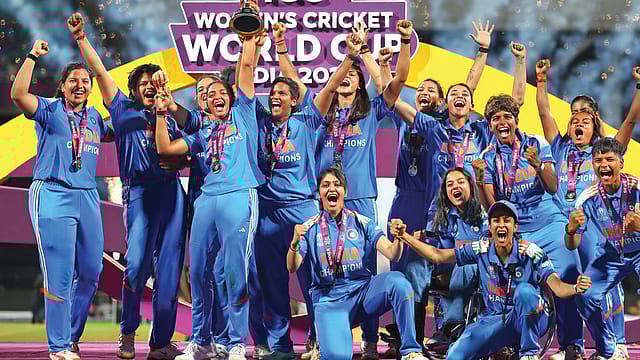
Between that peak and trough in Test cricket, the Indian women’s team surfed its greatest wave of glory in early November by winning the 50-over World Cup for the very first time. At the end of the group stage, Harmanpreet Kaur’s side found themselves in a do-or-die match against New Zealand, in which India’s star batter, Smriti Mandhana, rose to the occasion with a hundred. In the semifinal, against seven-time champions Australia – the only unbeaten team in the tournament no less – Jemimah Rodrigues turned centurion to pull off the most stunning heist of the event, a record chase 339 runs. Then, in the all-important final against South Africa, replacement batter Shafali Verma responded to her calling with an all-round performance (87 and 2/36) and India were champions.
Back to men’s cricket. In late November, the reigning world champions in Test cricket, South Africa, didn’t just beat India over the two-match series played in Kolkata and Guwahati, they ended up humiliating the hosts. The 408-run loss—India’s largest in terms of runs—ensured a second whitewashed series in their own backyard in successive years, in turn ensuring that coach Gambhir had experienced terrific highs and lows in the shortest of spans. The clamour for the coach’s resignation only quietened during the three-match ODI leg that followed, where the returning Kohli’s insatiable appetite for big runs handed him consecutive hundreds and India a series win.
Indian cricket’s coach and captain weren’t the only leadership duo in sport to embrace such incredible swings in fortune in the year 2025, for Liverpool’s top brass have lived through very similar experiences. Like Gambhir and Gill, Slot and Salah have lived through the rough and tumble, which neatly brings us to the big highlight in the world of football for 2025. In a calendar year without any major international trophies—world or intercontinental events—all eyes were on the Premier League, dominated by Pep Guardiola’s Manchester City. Looking to snap City’s four-year winning-streak were Liverpool, led by a new manager in Arne Slot.
Not much was expected from Dutchman Slot in his very first season in the toughest top-flight league in the world, who had the unenviable task of replacing Jürgen Klopp, the much-loved exiting German manager of Liverpool, who in his rich tenure had ended the club’s 30-year league-title drought in 2020. What had taken several excruciating attempts by the German great was achieved in Slot’s maiden run, who, thanks to his unstoppable Egyptian playmaker Mohamed Salah (29 goals and the Golden Boot) won the Premier League within nine months of his arrival at Anfield.
That was May. By December, the Slot-Salah relationship had imploded to such an extent that the Egyptian is wholly uncertain of playing for the club again even as Slot’s Salah-less side languish at tenth place by the halfway mark of the ongoing 2025-26 season. While it is true that Salah didn’t show the form that saw him score 188 goals for Liverpool in his not-so-long tenure at the club, few expected him to be left out of three successive Premier League games by the start of December, at which point the Egyptian had had enough. “It seems like the club has thrown me under the bus,” Salah said after a high-scoring stalemate in Leeds that he didn’t feature in. “It is very clear that someone wanted me to get all of the blame… Someone doesn’t want me in the club.”
If turbulent fluctuations in fortunes have been the big talking points in football and cricket, international tennis has thrived in 2025 by being the polar opposite, for Jannik Sinner and Carlos Alcaraz’s twin-dominance has redefined consistency in the sport. For the second straight calendar year now, Italy’s Sinner and Spain’s Alcaraz have split all-four Grand Slam titles between them—meeting in three out of those four finals this season. In 2024, the Italian had secured the hardcourt Slams of Melbourne and New York, while Alcaraz had thrived on the natural swing of Paris’ clay and Wimbledon’s grass.
On paper, the first half of 2025 was a repeat of the previous year, with Sinner and Alcaraz defending their Australian Open and French Open titles. But the Roland Garros trophy could well have been Sinner’s, having been two-sets-to-love up against Alcaraz, and a hair’s breadth from ending the Spaniard’s Paris reign. But in a comeback for the ages, Alcaraz won the French in five sets, saving a match-point along the way.
Such a loss would have destroyed the confidence of a lesser player, but Sinner has fought greater stabs to his reputation, such as the doping allegation that plagued him through the first half of this season (for which he even served a short ban). So, he simply bounced back a fortnight later, defeating Alcaraz in the final of Wimbledon, ending the Spaniard’s two-year reign at SW19, London. Alcaraz then turned the tide by defeating Sinner in the final at New York, before the two of them met once again in the last competitive match of the year, the final of the year-end Masters in Turin, Italy. Sinner won the ATP Finals in straight sets, ensuring that the pair had split the honours of the year right down the middle—one took home two Grand Slams and the No 1 ranking, while the other bagged the other two Grand Slams and the most-important tournament beyond the majors.
No 1 Alcaraz and No 2 Sinner are the runaway leaders of world tennis, so much so that the gap of 6,340 points between Sinner and the next-best player, Alexander Zverev at No 3, is far greater than the gap of 5,143 points between Zverev and the world’s No 1,000, Britain’s Patrick Brady. Imagine that.