What Rahul Gandhi Wants
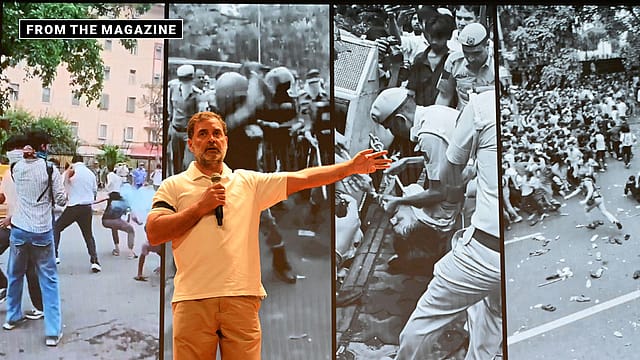
ABOUT FIVE KILOMETRES FROM WHERE CONGRESS LEADER Rahul Gandhi addressed a ‘Chhatron ki Goonj (Student Echoes)’ event, urging a women-only audience to “smash patriarchy” and reject “Manusmriti”, the Bharatiya Janata Party (BJP)-aligned Akhil Bharatiya Vidyarthi Parishad (ABVP) rallied to celebrate patriotism and sing the full version of the national song ‘Vande Mataram’. ABVP’s ‘Yuva ki Awaaz (Voice of the Youth)’ event was intended to hold the mirror to Congress over its refusal to play the full six stanzas of ‘Vande Mataram’ as mandated by a law passed by Parliament during the recent Monsoon Session. The ABVP organisers could only have guessed Rahul’s likely theme, but the contrast was near-perfect. On the one hand, Rahul referred to a controversial text often used to attack Hindu orthodoxy and, on the other, ABVP zeroed in on a video purportedly showing Congress leader Sonia Gandhi’s discomfiture over the rendition of the full version of ‘Vande Mataram’ at the party’s Independence Day programme in Delhi.
The event at a ground near an engineering college addressed by Rahul Gandhi saw him denouncing attitudes that see women as chattel of male relatives. He argued girls need to break free from cages (pinjras) they were confined to while boys were allowed all freedom, referencing Prime Minister Narendra Modi’s comment that the language used by young women at the Cockroach Janta Party (CJP) protests in New Delhi was shocking but that he was willing to forgive and move on. Gandhi sought to conclude that while the behaviour of women was problematic, the prime minister had nothing to say about men. It is unclear just how much the ‘progressive’ reasoning resonated with the female crowd. Pune has a well-earned reputation for being one of India’s more enlightened cities. It was the centre of Maratha renaissance under the Peshwas and has been a font of education, culture and the arts. The city is defined by a solid middle-class work ethic and the freedom it affords to women has been long evident. Much ahead of other cities, women of all ages riding two-wheelers was a ubiquitous sight in Pune. Coupled with a progressive and pragmatic ethic, the city has celebrated freedom fighter and Hindutva icon Vinayak Damodar ‘Veer’ Savarkar who studied at Ferguson College, organised nationalist demonstrations and was held in Yerwada jail. Pune continues to be an education hub drawing students from all over India and has developed as a business and commercial powerhouse taking a lead in sectors such as electronics and information technology.
Home Minister Amit Shah was quick to latch onto the spectacle at the Congress office and launched a sharp attack over the party leaders refusing to sing all stanzas of ‘Vande Mataram’ and questioned the claim that this was only in keeping with what was decided by Jawaharlal Nehru and Mahatma Gandhi. Shah accused Congress of being economical with the truth. The Congress decision to restrict the full rendition of ‘Vande Mataram’ in 1937, the home minister said, was a result of the party’s decision to kowtow to the Muslim League and reflected its continued pandering to Muslim separatism. Shah’s stance reflects the assessment that public opinion is more receptive to a ‘nationalist’ rendering of history and to BJP’s unapologetic embrace of figures like Savarkar alongside decisions like the abrogation of Article 370 in Jammu & Kashmir and the use of military force against Pakistan-sponsored terrorism. If Congress’ problems with the national song stem from the discomfort of a section of Muslim opinion with the “religious” imagery of the composition, the party must say so in as many words, the home minister said. The clash of narratives was obvious, with BJP’s cultural articulation being assertive and unafraid in its preparedness to confront ideological opponents and seek out vulnerabilities in political rivals on issues of nationalism and minority appeasement. Meanwhile, the war on social media escalated too, with a handle called Jhoot ki Goonj (Echoes of Untruth) on X, which does not hide its sympathies, challenging Rahul’s claims at his outreach programmes. “Forty rallies, Forty claims,” the handle says, arguing that 29 of Gandhi’s statements are false and 11 are misleading.
In a rare interaction with media during the tenure of Modi 1.0, at a time when Congress resisted the passage of a landmark constitutional amendment to implement the Goods and Services tax (GST), Rahul Gandhi had explained that he had asked his aides what they felt were Modi’s strong points. The prime minister’s credibility stood out as a significant quality, the aides felt. The goal before Congress then, Rahul said, was to spoil the “feel good” about the government and in this he felt he had succeeded. Congress did delay the rollout of GST by advancing conditions such as capping the peak rate at 18 per cent in the Bill itself, scrapping of a 1 per cent levy to compensate manufacturing states as GST was a consumption tax, and the setting up of an independent dispute resolution body. The hundreds of changes in tax rates the GST Council has undertaken is evidence of the impracticality of setting a peak rate in legislative text and then-Finance Minister Arun Jaitley had argued that very high-end goods would need a separate classification and rate. The compensation to manufacturing states like Gujarat and Tamil Nadu lay at the heart of the compromise to bring all states on board and an additional body to resolve disputes would duplicate the functions of the GST Council where all states were represented and accorded due weightage. The GST legislation was finally passed in September 2016 after the Congress brass received persistent feedback that the party was being seen as a roadblock to a reform viewed positively by the public at large. Using BJP’s lack of numbers in Rajya Sabha to its advantage, Congress teamed up with the Left and other parties to thwart economic legislation and had even forced amendments critical of the government in the President’s Address to the joint sitting of both Houses. The passage of the law providing a statutory framework for Aadhaar was similarly opposed until the government found a way out by designating it as a “Money Bill” so that the government’s majority in Lok Sabha prevailed over the Rajya Sabha veto.
Rahul Gandhi’s strategy has not changed much since, as he has sought to level direct and personal attacks on Modi, believing that this is the best way to challenge the prime minister’s public standing. Repeated allegations of corruption and claims of lopsided contractual commitments in the acquisition of Rafale fighters that disadvantaged the Indian public sector defence firm Hindustan Aeronautics Limited (HAL) framed Congress’ campaign for the 2019 Lok Sabha polls. The taint of corruption allegations regarding the Bofors 155mm howitzer deal that had led to the defeat of the Rajiv Gandhi government in the 1989 Lok Sabha elections has rankled the Gandhi family for long. The Rafale allegations, however, fell flat, with the Supreme Court holding that the government-to-government contract was above board and with Congress barely improving its tally from 44 to 52 seats in Lok Sabha. This, however, did not lead to any meaningful introspection as Rahul rather accused senior leaders of being unenthusiastic about the Rafale accusations in a meeting of the Congress Working Committee (CWC) after the second successive Lok Sabha debacle. While Gandhi had concentrated his firepower on issues that proved non-starters, Congress underestimated the impact of Aadhaar-based welfare schemes like free cooking gas, subsidies for housing, construction of toilets in rural India, and banking accounts for the poor.
The CJP protests that took BJP by surprise were the first significant challenge faced by the Modi government after its re-election with a reduced majority for a third term in June 2024. The protests against the leak of NEET question papers, the test for admission to undergraduate medical studies, began with CJP becoming an instant internet phenomenon and while its initial forays did not gain much traction, its second stint at Delhi’s Jantar Mantar, beginning June 20, was a different matter. The CJP protest and the fast by Ladakh activist Sonam Wangchuk became a lightning rod for student discontent and anti-BJP groups and the involvement of Left student organisations gave it organisational muscle and a street presence that led to the violent showdown on July 20.
The success of unconventional outfits like CJP in mobilising discontent rather than regular opposition parties was disconcerting for Congress just as it was a serious challenge to the authority of the Modi government. The ability of political newbies like actor Vijay who humbled both the Dravida Munnetra Kazhagam (DMK) and the All India Anna Dravida Munnetra Kazhagam (AIADMK) in Tamil Nadu or Jan Suraaj’s Prashant Kishor’s shock win in the Bankipur bypoll in Bihar could well be more than straws in the wind.

Rahul Gandhi’s student outreach then is a determined bid to ride the perceived youth discontent over compromised public examinations and lack of jobs and in that sense it competes with CJP as much as it seeks to take on the Modi government. Although BJP suffered a serious erosion in its Lok Sabha tally, which fell to 240 in 2024 from 302 in 2019, Congress struggled to reach three figures, and its trenchant attacks on almost every aspect of the Modi government’s policies, from economic, development and welfare to security and foreign affairs, have not gathered much traction beyond the already converted. A strong mobilisation of minority voters and certain communities and caste groups as well as the liberal opponents of BJP remains the core of Congress’ support. Yet, often enough, it was the regional parties that offered more resistance to BJP and these too have seen a decline. BJP’s 2024 subpar show is attributable to several reasons, including a largely undetected undercurrent that the party’s ‘400 Par (400 plus)’ slogan amounted to a plot to undo reservations for the weaker sections. But the opposition’s gains proved impermanent with BJP clawing back in states where it had lost ground and winning new ones in the Assembly elections that followed.
The view in Congress is that the CJP upheaval presents an important opportunity for the party to advance its political narrative. The CJP protest organised in Pune on July 24 got an impressive attendance with reports stating that about 10,000 marchers took to the streets. What stood out was not just the youthful character of the marchers but the participation of students from elite institutions, including professional colleges such as law and engineering. According to some observers, criticism of BJP as being socially prescriptive and domineering and the woke-liberal view of India’s democratic “backsliding” have gained adherents as evident on exclusive campuses. The record of regional parties in putting up with dissent in states where they held power, such as Maharashtra, Tamil Nadu, Punjab and West Bengal, is actually bleaker but the charge has stuck.
Rahul Gandhi’s bid to reach out to students is not new and his preferred attire of Ts, dark trousers and casual footwear is intended to convey informality and youthfulness. On occasion he has asked his audience to address him by first name and he has more than once visited campuses of women colleges where he has spoken of the need to build a loving society as a counter to BJP’s alleged sectarianism. In Pune too, he intoned “Pune manje prem (Pune means love)” but the results so far have not been promising. Despite being older, Modi has consistently connected with younger voters and his interactions such as ‘Pariksha pe Charcha’ and regular meetings with young entrepreneurs—most recently with startups in space—and sportspersons have seen him advocate pursuit of excellence and opportunities. The Modi government initiatives like Make in India, value-added agriculture, skilling and, most importantly, a web of welfare and health support by way of free rations and a health card to name just two, are intended to support those at the lower end of the socio-economic scale and contain social unrest. The large number of job seekers, particularly for government employment, indicates limited opportunities as also social preferences and skill deficits that make many aspirants unfit for the private sector. A restless and volatile section with aspirations but not necessarily adequate qualifications was a significant presence at the CJP protests. Congress’ attempt to mount a fresh challenge to BJP’s political dominance seeks to draw in the discontented and question the government’s development narrative. But the Gen Z it seeks to woo is not an undifferentiated mass. The mismatch between urban livelihoods, incomes and aspirations is real enough and has indeed boiled over from time to time as it did in Noida and Manesar earlier this year. Increases in daily wages helped assuage the anger but even so it is a moot point whether urban anxieties would lead to a change of voting choices given the strong welfare web the Modi government has built.
The ‘Chhatron ki Goonj’ programme is a concerted bid to connect and align with a voter segment seen as a harbinger of “change” and while Rahul’s outreach can be seen in this context, his messaging and perceptions of the leader are more complex. In his attempts to untether BJP’s broader Hindu coalition, Rahul has taken a strident ‘Mandal’ line that even social justice parties like RJD and SP don’t articulate. His criticism of caste representation in the bureaucracy and private sector, claiming that “90 per cent” of the population—a reference to Dalits, tribals, OBCs, and the poor—is “out of the system” and that wealth is commanded by a handful of corporate entities repels a vocal segment of the population even as the gains are unclear. His demand for representation in keeping with population sizes and insistence that Congress state governments pass a “Rohit Vemula” law to punish caste discrimination, with stiff fines and jail time, setting up of equity committees and a range of offences, does not go down well with the forward classes.
BJP is mindful of social empowerment issues but its commitment to “sarv samaj (all of society)” rules out overtly sectarian and caste appeals and it is doubtful if Rahul Gandhi’s Mandal advocacy will deliver the anticipated returns. The Modi government has rolled out schemes such as the Vishwakarma programme for artisans who are largely from OBC communities and has ensured its farm initiatives cover middle and small agriculturalists also drawn from these sections. Modi’s “Viksit Bharat” formulation is at once aspirational and set in concrete plans intended to strengthen domestic capabilities often described as “atmanirbharta” or self-reliance. Emerging challenges like those of urbanisation, exposed by the fury of monsoons every year, call for smarter and better governance and rising public expectations, and while these issues present opportunities, it will require more than denying and denigrating the Modi government’s record in office.