The Wrath of Mothers
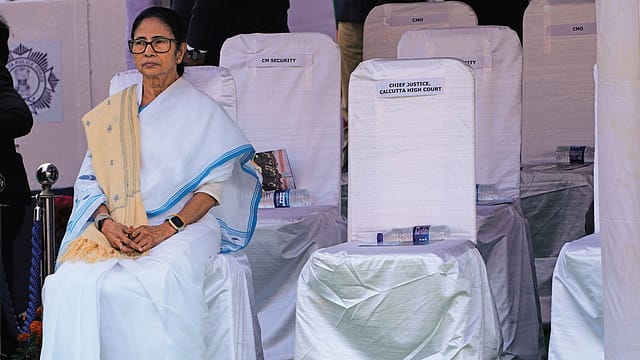
ON SUNDAY, MAY 3, word spread through the gossip arcades of social media that Calcutta’s markets had run out of saffron gulal powder, thrown into the air in traditional celebration. There were no takers for green gulal. The market knew what most media had missed or refused to recognise. Change was just hours away. By Monday afternoon, election results would confirm what people already knew: saffron BJP was set to overwhelm the ruling green of Trinamool Congress, washing away a decade of hope followed by five years of rage.
The end of a relationship between an elected government and the electorate is not all that different from a marital divorce. A gradual sequence of pinpricks creates discord, which escalates to discontent, dismay and distance until a final crisis triggers an irrevocable break. At this point of a deep and pervasive bitterness, the voter’s search for an alternative accelerates into a mass urge for any alternative.
Mamata Banerjee lost Bengal because you cannot cheat the Bengali woman and hope to get Bengal’s vote. Bengal does not worship gods. It venerates the goddess: the holy circle of divinity is Ma Durga, Ma Kali, Ma Saraswati, and Ma Lakshmi. A mother is the heart and mind of a Bengali family. Mamata Banerjee understood this during her ascendant phase, when the flames of the firebrand rose from the streets rather than the salons of Calcutta. In 2011 she stormed the local Marxist Kremlin, the Writers’ Buildings, armed with a powerful trident: Ma, Maati, Manush. Mother, Land, People. Narrative is the artillery and air force of democracy. That evocation of Bengali ethos, pride and people destroyed 34 years of Left rule in Bengal.
Mamata Banerjee self-destructed when she betrayed that promise to her most dynamic constituency, women. With wanton disregard for the minimal requirements of governance, she handed over power to the lumpen, a German term for an underclass that Karl Marx made famous in political literature. The avaricious bully became the spearhead of maati-level corruption. Voters are not naïve. They understand that democracy is not a public parade of saints. A party machine needs the lubrication of money. As long as politicians take money from the rich, they shrug and shift the scales of judgment to other factors. Mamata Banerjee and her lumpen regiment stole from have-nots, in city and village, already under economic distress in a regional economy that has stuttered far below its capacity. The lumpen became the leering face of the party, expanding the breadth of corruption into ordinary lives. Corruption poisoned existence, injured the family, wounded the mother.
Ma watched, and waited, as ministers and cohorts took money wherever they could, from employment of primary schoolteachers to the appointment of administrators of public hospitals. Bribes bought protection for criminals even in cases of rapacious murder.
Calcutta Corporation became Calcutta Corruption. This hurt Calcutta’s pride as much as it further destroyed the city’s withering civic facilities. Every Calcuttan recalls that their iconic hero Subhas Chandra Bose, symbol of service and integrity, was once mayor of Calcutta. The contrast was too much to tolerate. Wafting on illusions of greater glory, including dreams of becoming prime minister of India, Mamata Banerjee lost sight of the mother who had trusted her with power. The most visible women in her vicinity became glamour icons from a cupboard of fickle celebrities.
The first significant turning point in Bengal’s mood came in July 2022 when the education minister was sent to police custody on the charge of collecting cash in return for jobs to bogus teachers. More than `20 crore were recovered from his hidden stash; we do not know the total size of the fraud. For any mother the education of her children is the highest priority; in Bengal, faith in education is almost religious. It is a central component of the Bengali image of themselves as bhadra, a word that is not easy to translate.
Ruling parties across the east and south of India who lost in April may have missed the irony in their proclaimed campaign themes. Mamata Banerjee promised Aabar Jitbey Bangla: Bengal will win again. True. Bengal, said the voter, would win only if Mamata lost. In Tamil Nadu, MK Stalin heralded the Rising Sun: Rise with Tamil Nadu. The voter changed the spelling of one word. Sun became son. A fetid DMK dynasty was rejected. In Kerala Marxists put People First, Progress Always. Voters placed the engine of progress in different hands. With Marxists erased, DMK stunned and Trinamool eviscerated, these elections have triggered a flux which will reshape national equations. Congress remains stagnant on the sidelines. It is up to some new collation of regional parties to scribble a policy programme and generate sufficient cooperation to become relevant in the 2029 General Election. The only party capable of taking this initiative in 2026 is Akhilesh Yadav’s Samajwadi Party, if only because its fortunes have not been tested in an election. Uttar Pradesh goes to the polls in the spring of 2027. That will be another watershed moment.
Every election in India has a story from the past and a message for the future. Assam was an exception, for regional reasons, but results elsewhere indicate a quiet but growing narrative. In much of the country, the establishment is under stress, compounded by fatigue with the familiar. There is uncertainty and apprehension among the young. Those born in 2000 are already over 25. Social welfare schemes can placate elders, but they cannot keep unrest out of the ballot box. Many first or second-time voters are unable to find the bridge between aspiration and reality. For BJP, Bengal was both a milestone in its effort to become a nationwide party and the need to expand frontiers in order to preserve parliamentary space before 2029.
Mamata Banerjee knew the stakes. A fourth term would have placed her at the forefront of national politics, making her a credible claimant for the prime minister’s office. Instead, she is shell-shocked, wondering what to do next. Her initial reaction was greeted by mockery rather than worry. Histrionics are elemental to her politics; this might have been supplemented by delusion if she actually believes that some colossal power in Delhi stole the elections from every Bengali voter in every part of the state. Congress, typically, thought that every election had been stolen except in Kerala, where its alliance defeated the Left. Once Mamata Banerjee moves away from the hall of mirrors, it is quite possible that she will still attempt to reassemble her ambitions from the debris and enter Parliament by asking one of her MPs to resign from Rajya Sabha. It is always difficult to know what to do next when locked in an abyss.
Mamata Banerjee, the most dramatic leader in Bengal’s modern history, was the antithesis of her iconic predecessor, patrician Jyoti Basu, the most charismatic 20th-century Bengali after Netaji Subhas Chandra Bose. Basu schooled his leftist (calling them Marxist would be an exaggeration) comrades well in the spirit of democracy. They did not raise a murmur when similarly demolished in 2011. Basu, who read Marx as a student in England and spoke English in a clipped style, steered Bengal from the violent chaos of rampant Naxalism in the 1960s and 1970s to the comparative calm of democratic socialism. He could have become prime minister in 1996 if the communist politburo had permitted him to lead a non-Congress coalition. For reasons so stupid as to be inexplicable, they did not; Marxists lost their way and have not found it again yet. Another Bengali who might have become prime minister was Pranab Mukherjee, but Congress tripped him because he was not considered obedient enough. Mamata Banerjee, the latest claimant, sabotaged herself.
The great Russian revolution of 1917 began with the wrath of mothers; not the command of Bolsheviks, Mensheviks or Socialists. There were no political leaders since they had either been banished to Siberia or were living abroad as exiles. It is called the February Revolution because on February 23, 1917 (March 8 in the Gregorian calendar), International Women’s Day, the women of Russia rose against a repugnant monarchy which had driven millions of their sons to death in a senseless World War, for a cause no one could understand. When Tsar Nikolai Alexandrovich Romanov (Nicholas II) was told that four million young men had been killed in the first year of operations, he shrugged and said that many more might be needed in the graves. His autocratic, dictatorial regime destroyed a fertile economy. Russian mothers did not have bread for their families while the dukes and princes literally feasted on caviar and champagne. Within two days, crowds swelled to hundreds of thousands. The spine of imperialism broke when the Cossack cavalry refused to disperse their mothers, sisters and wives with their dreaded bull-hide nagaika whips. On Sunday, February 26, the Pavlovsky Guard Regiment came out in support of the people. The Tsar, heir of a dynasty that had spanned three centuries, whose reign had begun in 1894, spent that Sunday evening playing dominoes. On Monday, the Pavlovsky regiment troops shot their commanding officer, the people seized the Peter and Paul Fortress in the capital, freed prisoners and burnt the headquarters of the Okhrana, the secret police. The Tsar abdicated.
The last person to discover that the end has come is almost always the Tsar, or a Tsarina.