West Bengal Assembly Election 2026: Kolkata Diary
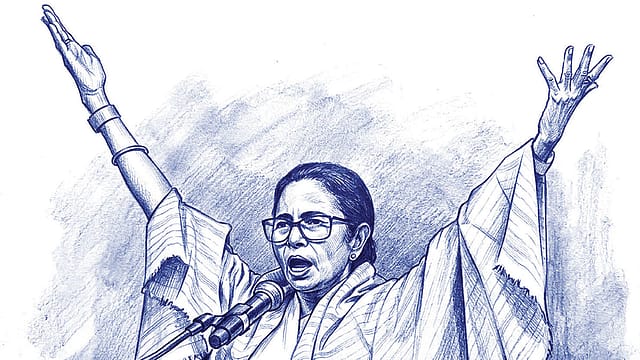
April is the month for metaphor hunters in West Bengal, and on Poila Boishakh, the New Year day on the Bengali calendar, the distant thunder heralding the seasonal gloom and glory in the gathering clouds over Kolkata, they all could indulge in the deconstruction of the Mamata Banerjee Inevitability. Indian politics’ last woman in power fired up by the twin forces of victimhood and raw-earth endorsement, she is grievance and aggression wrapped in crisp cotton, braving the wretched lands of the east in nothing more bouncier than those mythical rubber slippers, getting angrier by the day, and lately, sounding desperate in her struggle to retain not just power but her own legend as the ultimate counterrevolutionary in a state that preserved communism as a ruling ideology for more than three decades till she stormed in as our frail lady of deliverance. Balancing the burden of history and the fear of the future, rattled by the momentum of the fury in saffron, weakened by the erosion of the social base with an overwhelming communal content, and still brazen about the official culture of violence, she, the most visible face on the walls and cardboards of the city, is seeking her fourth mandate as a lone fighter pitted against the ‘invaders from the north’. Existential fights are always lonely.
Returning to metaphors, there is no place better than Harish Chatterjee Street to look for one. On this Thursday after Poila Baishakh, Kalighat is hardly simmering in election heat. Basking in the afterglow of the New Year celebrations, Kolkata is a city in post-lunch lassitude under a mild sun. Even the holy hustlers who bargain for a quicker darshan of the Goddess are taking a break as there are a couple of hours more left before the Kali temple gates are opened for devotees. It is as if Kolkata campaigns in something between the prose of social upheaval and the poetry of cultural confidence. Harish Chatterjee Street this afternoon is neither; the guarded emptiness of which is perhaps a pointer to the isolation of power in a state where the groundswell of resentment is shattering the idyll on which every ruler nurtures delusion. The resident of 30-B Harish Chatterjee Street has acquired the aura of rage and renunciation through an epic struggle against power. Today the struggle is all about curtailing the disintegration of the TMC empire she built singlehandedly. And she is the last of her league: women who broke the male citadels and reigned by honing the politics of suffering and certitude to terrifying perfection. Jaya is gone; Maya is a pastiche of her earlier self; is Didi dreading the onset of autumn? On Kolkata’s most protected street where exhausted policemen pretend to monitor movement, the question lingers over the modest house of Indian politics’ most powerful woman. She is elsewhere in the ghettoised hinterlands where the shirtless still sway to her shrillness, but for how long? Postponement of political mortality is serious business and Mamata knows it.

If the Mamata mythology is no longer a bestselling pulp in social realism but a tragedy in the making, we need to return to her origin story to know why. And therein lie the signs of the next dawn, and BJP, whose surge is akin to TMC’s rise in the dying days of CPM rule, thinks it is not far away. If Bengal is the countryside, she was the agitationist who mesmerised the falling soviets of Bengal as a revolutionary more radical than your redundant communist. She won—and built the lore of the avenger on the detritus of communism by acquiring the same social base that sustained the comrades for so long. Today, BJP, the state’s fastest growing party, finds an opportunity to win the same social base (minus the Muslims) she had taken from the communists. The party has an effective hook: the Hindu consciousness, very much a part of Bengal’s backstory, political as well as cultural. Bringing heritage to everydayness requires urgent political motifs and a matching vocabulary that resonates on the stump. That is why BJP is not turning its campaign for the future into a crude demonisation of Mamata. And that was BJP’s biggest campaign error five years ago: personal attacks only made Mamata more formidable. This time round, there is no bogeywoman in white sari hovering over the Hooghly. The BJP campaign, apart from the customary invocation of development, is an invitation to join a Bangla Renewal Movement.
Which is essentially a movement of the mind, maybe Bengal Renaissance Part Two. In the glorious back pages of Bangla Boom, the exuberance of ideas was powered by a cultural long march, stretching from the quintessential Hindu reformer Ram Mohan Roy to the poet and polymath Rabindranath Tagore. Throw in other names such as Vivekananda and Ramakrishna and what you get is a civilisational high in which the H-word was not a political motivation but a cultural identity. It didn’t require political prompting; it just needed a reminder by refined minds, and Bengal had them in abundance. The renaissance mind of Bengal was a blend of East and West; bringing the wisdom of the Occident to the richness of cultural inheritance was such a rewarding intellectual experience then. As Bengal is being asked to play out its Hindu self, can BJP, caricatured by the scared Mamataites as a party of the north, allow such a blending of ideas and cultural attitudes? The BJP candidate from the constituency of Rashbehari in Kolkata makes it a misplaced question. Swapan Dasgupta is a Bengali sophisticate moulded in the vintage renaissance spirit. If there is an added flavour of Englishness to his Bengali identity, it is very Bhadralok—the “native gentleman” is in the fray. Dasgupta, an Open columnist, certainly sees a Hindu consolidation, which is a cultural assertion as well as a political rejoinder. As a candidate who practises the politics of persuasion, he remains unapologetic about his Bhadralok credentials. Arguments, not the shrillness of appeasement, can still win, Dasgupta believes. It is the position of the apolitical politician for whom what matters most is not the expediencies of realpolitik but the truthfulness of arguments. To add the idea of Hinduness to the cultural text of Bengal politics, what you need is not professional proselytisers from the north but the native gentleman sharing his poster space with Narendra Modi on a wall in the temple precincts of Kalighat. Argument is a sacred vocation for the candidate from Goddess Kali’s constituency.
POSTSCRIPT: In Dalhousie Square, the heart of colonial Calcutta in the so-called White Town, adjacent to the now vacated Writers’ Buildings, the chaiwallah in his blazing red uniform serving his dwindling customers from nearby offices is angry at the other Goddess of Kalighat who has made him poorer. This time lotus, he says, holding a hot tea in one hand and an over-buttered toast in the other. Change is the motif where power is a monumental memory, too.