With victories in Assam and Bengal, BJP can finally fix India’s vulnerable eastern border
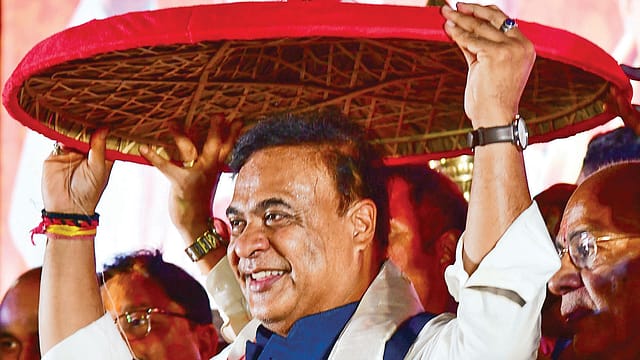
THE BHARATIYA JANATA PARTY’S (BJP) decimation of the opposition in Assam—the third time in a row—and its superlative victory in West Bengal are considered markers of its widening political and ideological expansion. These, however, are not the only things at play. Under Himanta Biswa Sarma in Assam and other leaders in West Bengal, the party’s victories are a result of an alert citizenry worried about demographic changes and security challenges.
The election results in Assam, where BJP led by Sarma trounced Congress, and in West Bengal, where the party won a thumping majority and came within a whisker of a three-fourths majority in the Assembly, signal that Indian citizens have woken up to these serious threats. It goes without saying that in Assam, the BJP government has taken strong steps to defang these threats. Something similar is now expected in West Bengal.
The election results and BJP’s spectacular victories in the two states have, no doubt, different driving forces. In Assam, the party won a third consecutive victory. This was in part due to its performance in office under the chief ministership of Himanta Biswa Sarma. The combination of delivering welfare to the doorstep of disadvantaged communities like the tea garden labourers in Upper Assam and the drive to build up the state’s infrastructure has greatly helped the party. This mattered as, unlike in West Bengal, in Assam BJP was an incumbent party.
That, however, is only one part of the story. A much bigger factor loomed in the Assamese voter’s mind: the risks of adverse demographic changes and the party’s skilful handling of the matter. This was an issue that was earlier discussed and debated in hushed tones at the national level. The most vocal reaction to these changes was denial: it was a figment of Assam’s imagination that demographic changes due to illegal migration from Bangladesh (and East Pakistan earlier) were a factor in the state’s politics.
After the 2023 delimitation in the state, this factor has become clear. Earlier, in key regions—Lower Assam, districts in the middle Brahmaputra Valley, and Barak Valley—the influx of Bangladeshis, mostly Bengali-speaking Muslims, altered politics beyond recognition. It was impossible for an Assamese Hindu (or even an indigenous Assamese Muslim) to get elected from these districts. That has changed now, to an extent.
The interesting part of this exercise was that it was carried out within the bounds of constitutional norms. The number of constituencies in the state remained fixed at 126, as before. The changes included increasing the number of constituencies reserved for Scheduled Castes (SCs) from eight to nine, those for Scheduled Tribes (STs) from 16 to 19. There h been an increase in the number of constituencies in the Bodoland area from 11 to 15. Crucially, the boundaries of some constituencies were changed, reflecting the changes in population, geographic contiguity and administrative requirements. The most crucial changes, considering the “demographically imperilled” districts, were that the number of seats in Lower Assam and middle Brahmaputra Valley areas—with a large number dominated by illegal Muslim immigrants—was reduced from 49 to 44. This was in tandem with the number of seats reserved for indigenous communities going up. The number of seats in Barak Valley, especially Karimganj district, was also reduced.
The results from these changes were obvious. Congress contested in 99 seats and won only 19. Of these 19, 18 are Muslims. The geographic distribution of these constituencies is also interesting. Ten are in Lower Assam, one in the Kamrup area, three in the middle Brahmaputra Valley districts of Morigaon and Nagaon and another four in Barak Valley. All these seats are dominated by Bengali-speaking Muslims and all in zones that have witnessed an influx of illegal migrants. The party has only one Hindu face, its winner from Nowboicha reserved Assembly constituency in Lakhimpur district, a district not dominated by illegal immigrants. In the rest of Assam, the party has been wiped out.
Interestingly, the Asom Gana Parishad (AGP)—the alliance partner of BJP—contested 26 seats with 13 Muslim candidates. None of the Muslim candidates won. AGP did manage to win 10 seats, four in Lower Assam, two in Kamrup, one in middle Brahmaputra Valley area, and the rest in Upper Assam. Its geographic and community presence is far more diversified than that of Congress. BJP now has a pan-Assam presence.
Back in 2020, a relatively unknown Muslim activist made a controversial speech in the wake of protests against the Citizenship Amendment Act (CAA) of 2019. In that speech, activist Sharjeel Imam made a bold pitch: “If we have five lakh people organised then we can cut India and the Northeast permanently. If not permanently, at least we can cut it for a month or so… Let them (the government) go by the (Indian) Air Force… Assam and India will be cut… only then will they (the government) listen to us.”

Imam was arrested and has remained in jail except for a brief period of bail. The infamous speech about the ‘Chicken’s Neck’ area in West Bengal led to his arrest and prosecution under the Unlawful Activities (Prevention) Act (UAPA). But the nefarious idea behind his speech was obvious to India’s strategic planners and observers.
The ‘Chicken’s Neck’ is a thin slice of territory in West Bengal sandwiched between Kishanganj and Purnia districts of Bihar on one side and the Rangpur Division of Bangladesh on the other. At its narrowest, the neck is no more than 20km. The most sensitive part of this zone falls in North Dinajpur district of West Bengal and is part of the Raiganj Lok Sabha constituency. While the parliamentary constituency is currently headed by a BJP MP, the four Assembly constituencies in the narrowest part of the zone—Chopra, Islampur, Goalpokhar, and Chakulia—were won in the current elections by the Trinamool Congress (TMC). Of the remaining five Assembly constituencies in the general neck area, BJP won three seats and TMC the other two. It does not require much imagination to guess the demographic composition of the area. If one were to name the most imperilled zones on Indian territory, subject to both external and internal threats, this area would probably top the list. It is worth noting that in the recent elections in Bangladesh, the area in that country that abuts this region of India—from Alipuduar all the way to South 24 Parganas—came under the influence of the radical Bangladesh Jamaat-e-Islami. The party witnessed the performance of its history when it won 68 of the 300 seats in Bangladesh’s parliament.
With BJP coming to power in West Bengal and the Bangladesh Nationalist Party (BNP) at the helm in Dhaka, the chances of improvement in bilateral relations have gone up considerably. With the defeat of TMC, some of the sticking points in bilateral relations, the prime one being the sharing of Teesta waters—something Mamata Banerjee resisted— may see a satisfactory solution. Similarly, the 1996 treaty between the two countries that provides for sharing of river waters at Farakka, the last point in India where the Ganga enters Bangladesh, is up for renewal/ renegotiation later this year (the treaty was for 30 years). This has been a point of friction between the two countries but neither side has reneged on the treaty even as different governments have held power in New Delhi and Dhaka.
At some point, India will have to reckon with demographic changes in these states. This question, in part, arises from India’s refusal—until now—to confront the ‘Muslim Question’. India was partitioned in 1947 along religious lines. Ideally, that should have marked the end of religious and political strife. The two main communities of the subcontinent had their separate nation-states. But over time, India’s choice to order its political life as a secular republic went astray as a result of how democracy operated in the country. Politics became hostage to vote banks of minority communities. The intellectual climate vitiated to the point that any voice for the majority community was automatically dubbed as communal. State after state became hostage to narrow, sectarian, interests. Nation-building took a backseat. As India began to grow, it became an attractive destination for destitute immigrants from the erstwhile East Pakistan and later on Bangladesh. The wave after wave of immigration—helped by porous borders and compromised politics—added to the problem. The immigrants themselves became a constituency. The problem reached such a proportion that even removing illegal immigrants from the electoral rolls was considered a political sin. The poor immigrants from the neighbourhood were more than willing to support any party that would give them nothing more than a toehold in India. That toehold has now acquired alarming proportions. At each step, India’s democratic processes—including appeals to its judiciary—are abused to the point when security threats become difficult to address, let alone eliminate.
With these two victories, perhaps BJP can begin addressing this question in earnest. The party is in power at the Centre and now in the two states most affected by the problem. This question was raised on the eve of Independence by Gopinath Bordoloi and Syama Prasad Mookerjee, two stalwarts of the freedom struggle. It should surprise no one that the two hailed from Assam and Bengal.