Tamil Nadu: Vijay’s sensational journey from silver screen to political power has the familiar shades of MGR redux
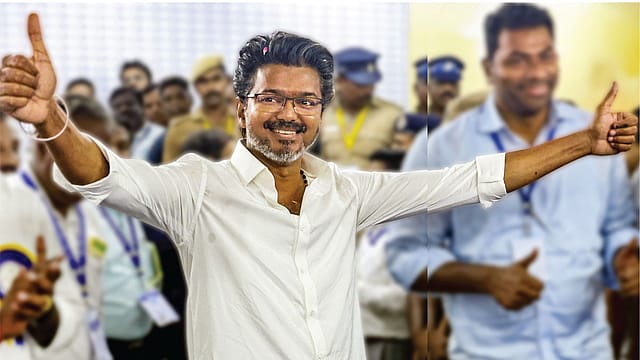
IT WAS PERHAPS the most significant—and certainly the most symbolic—moment of his soon-to-be-victorious campaign, when C Joseph Vijay folded his hands and lowered his head before a statue of MG Ramachandran in Tiruchirappalli (Trichy). On April 2, a full month before his party Tamila Vettri Kazhagam (TVK) would go on to reshape the state’s political map, Vijay had arrived in Trichy to file his second nomination from the eastern constituency of the city. But it was his pause at the MGR statue at the busy cantonment intersection that turned heads.
It made for a bizarre, almost dissonant image: Vijay paying obeisance to the founder of the All India Anna Dravida Munnetra Kazhagam (AIADMK), a party that was not merely a rival but one that had attacked him and TVK through the campaign. And yet, the inconvenient truth lingered: that Vijay had more in common with MGR than any of his contemporaries in the fray. Actor to actor, superstar to superstar, party founder to party founder, and perhaps, in time, chief minister to chief minister, it was a path only MGR had walked before him. In that moment, the homage felt less like contradiction and more like recognition: of a lineage, of a method, of a leadership playbook—even a school of thought—that Vijay now seemed intent on inhabiting.
The parallel is not merely superficial; it is structural. But where MGR inherited a political moment already primed for rupture, Vijay must now define his own. Converting mania into a mandate is one act. Governing it, shaping it into ideology, and sustaining it beyond the charisma that created it—that is the longer test, and one that charisma alone cannot pass.
On May 4, the day the results were declared, Vijay’s TVK came close to the halfway mark in the 234-member Tamil Nadu Assembly, winning 108 seats—10 short of the 118 required for a simple majority—to emerge as the single-largest party in its electoral debut. The party had chosen to contest alone, resisting pre-poll alliances in a state where coalition arithmetic is often treated as a prerequisite. In the days since, Vijay has begun outreach to smaller parties and independents to bridge that gap, even as the scale of his mandate has already altered the terms of negotiation. He himself secured victories in both constituencies he contested—Perambur in north Chennai and Tiruchirappalli East—seats previously held by the Dravida Munnetra Kazhagam (DMK).
The result marked a historic setback for DMK, with Chief Minister MK Stalin losing his own seat, and pointed to a broader unravelling of the party’s urban strongholds. More than that, it signalled the most significant disruption to Tamil Nadu’s entrenched political order in decades: a first-time party breaching the DMK-AIADMK duopoly and doing so at scale, an outcome without recent precedent in the state.
In that sense, Vijay’s victory is not merely electoral; it is historical. He is the first figure since MGR to convert mass cinematic appeal into a direct, statewide mandate for power, collapsing a divide long presumed to exist between fandom and votes. The turbulence along the way—including the deadly stampede at a Karur rally that left over 40 people dead—briefly exposed the volatility of that devotion, the sheer density of feeling that gathers around the man. It might have derailed a less cohesive movement. Instead, the constituency returned a TVK victory, reflecting the depth of a support base that, by polling day, had hardened from emotion into structure. What MGR achieved in the 1970s through celluloid myth and welfare populism, Vijay has attempted in the age of social media and decentralised mobilisation—the translation of devotion into discipline. If MGR governed through welfare as spectacle, Vijay has arrived through spectacle that must now learn to speak the language of welfare.
Vijay is not the first Tamil superstar to command a vast, state-wide network of rasigar mandrams. These fan clubs date back to the eras of Sivaji Ganesan and MGR, later finding new life in the mass followings of Rajinikanth and Kamal Haasan. Nor is his popularity singular; he shares the contemporary cultural space with Ajith Kumar. What is novel, however, is the readiness—and the success—with which these fan networks have been mobilised into a political machine. That leap, from adulation to organisation, is the bridge that only MGR had successfully crossed before him.
BORN JOSEPH VIJAY CHANDRASHEKHAR in 1974 to a film family, he entered cinema early under the guidance of his father, director SA Chandrashekhar. His debut as a lead in Naalaiya Theerpu (1992) introduced him as “Ilaya Thalapathy”— the Young Commander—a prefix that would, over time, shed its qualifier but retain its authority. By the late 1990s, as Vijay’s screen persona settled into the familiar rhythms of the romantic hero, the first generation of his fan clubs began to take shape.
“I was a big fan even then,” recalled KV Vijay Damu (born Damodaran, but who changed his name to honour his hero), an autorickshaw driver who would go on to found one such mandram. “When he came to shoot Love Today on Besantnagar beach in 1997, I stood in the crowd just to watch. After the scene, he came to us, spoke to everyone like a common man. That day, I decided I would start a fan club.” In those early years, the work was simple: posters through the night, banners across neighbourhoods, cut-outs outside theatres. “He would notice,” Damu said. “Sometimes he would tell me to go home because it was too late and I was still putting up banners at 3AM.” Back then, it was posters. Soon, it became votes. Earlier this week, Damu won the Royapuram seat on a TVK ticket.
By the early 2000s, these mandrams had begun to evolve. Vijay’s increasing emphasis on social work—blood donation drives, flood relief, community outreach—gave them a second life beyond cinema. Numbering in the tens of thousands across Tamil Nadu, they became not just instruments of promotion but units of service, connected by the early internet and capable of rapid, coordinated mobilisation. Even as Vijay’s box-office fortunes dipped through the late- 2000s, the network did not thin. If anything, it deepened, as the star’s appeal migrated from screen heroism to something closer to lived presence.
In 2009, at a low point in his film career, Vijay formalised this transformation by consolidating his fan clubs under the banner of Makkal Iyakkam—the People’s Movement—headquartered in Panaiyur along Chennai’s East Coast Road. It was the moment the fandom stopped being cultural and became political. He brought in Bussy Anand, then a legislator from Puducherry, to run the organisation. Over the next decade, the Iyakkam expanded quietly but steadily, drawing in younger members, building layers of local leadership, and acquiring the basic architecture of a political cadre. If MGR’s genius lay in building a party atop his myth, Vijay’s has been in building an organisation beneath it.
That makes his decision in 2024 to found TVK—and almost immediately announce his retirement from cinema after Jana Nayagan (2026)—all the more striking. It came at the peak of his commercial power, before decline could ever be summoned as explanation. From Thuppakki (2012) onwards, Vijay had entered an unprecedented run at the box office: Sarkar, Bigil, Master, Beast, Varisu, Leo, G.O.A.T.—a streak that placed seven of his films among the top 20 highest-grossing Tamil films of all time. Leo alone crossed `595 crore; G.O.A.T. followed with around `440 crore. In an industry where longevity is currency, Vijay walked away at his richest.
And yet, even as he prepared to exit, cinema refused to loosen its grip on his politics. In the weeks leading up to the election, Jana Nayagan—his announced swansong—was withheld from release in Tamil Nadu by the ruling establishment, amid apprehension that its timing and reach might influence voters. Whether or not the film itself carried explicit political messaging became almost beside the point. Its perceived power was enough. If MGR’s films once carried his politics into homes, Vijay’s was treated as a political force before it could even arrive—less a film than a potential intervention.
The scale of that stardom is best understood in places like Rohini Theatre in Koyambedu, where first-day-first-show screenings of his films resemble public festivals. “Watching a big star’s film on day one is part of the social fabric here,” said theatre owner Rhevanth Charan when I met him last year. “But the crowds that gather even for a Vijay trailer—you have to see it to believe it.” Today, Charan sits in the Assembly himself, the youngest MLA (Maduravoyal) in the current House at 30 years of age, elected on a TVK ticket.
This, then, is the architecture of Vijay’s mandate: a fandom that became a network, a network that became an organisation, and an organisation that has now become a government—or is, at the very least, on the cusp of becoming one.