The BJP Nation Racing to 2029
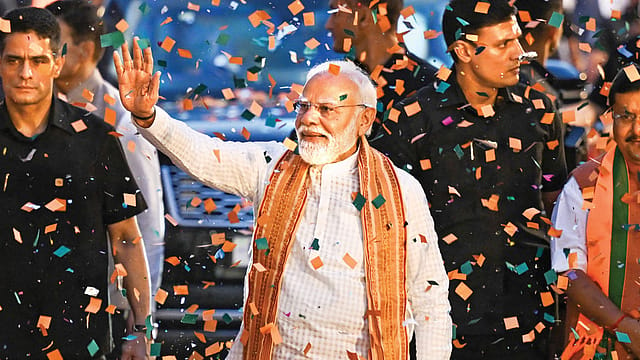
ON APRIL 19, AS THE CAMPAIGN IN WEST BENGAL WAS AT FEVER PITCH, Prime Minister Narendra Modi stopped at a small shop in Jhargram and asked for jhal muri, a spicy snack ubiquitous throughout the state. The video of Modi’s brief conversation with vendor Deepak Kumar and the prime minister handing out the puffed rice to children went viral and seemed to have hit a cultural sweet spot. Three days later he went to Belur Math, the headquarters of Ramakrishna Math and Ramakrishna Mission, and spent half-an-hour to pay his obeisance to Ramakrishna Paramahamsa. The next day he took a ride with a camera and a boatman on the Hooghly near the Howrah Bridge in what seemed a reflective pause in the middle of a hectic campaign.
The cultural connection Modi sought to establish was crucial given that the Trinamool Congress (TMC) and several political pundits had vehemently argued that the Bharatiya Janata Party (BJP) was a “bohiragato (outsider)” at odds with Bengali ethos. There was some evidence to support the view given that BJP’s strong showing of 18 Lok Sabha seats in 2019 did not translate into a winning momentum in the 2021 Assembly election followed by a disappointing 12 seats in the 2024 Lok Sabha polls. There were, of course, other factors at work. BJP’s organisation was not well entrenched in all parts of the state and the influence of local strongmen and gangs was a factor poll surveys could not capture. Yet, it was important to convey BJP’s preparedness to identify with Bengal’s cultural motifs and convey respect for traditions, language, and faith.
The Hindu messaging was equally obvious as the party elevated illegal immigration and the threat of demographic invasion to the centre of its campaign and attacked the TMC government for its alleged complicity in encouraging the influx. The BJP campaign positioned its cultural argument alongside Bengal’s reformist impulses and thinkers who articulated Hindu nationalism and spirituality. In doing so, they sought to flip the “outsider” charge on TMC, attacking the ruling party for deliberately denigrating Hindu interests. The heated campaign played out at several levels with BJP leader Suvendu Adhikari making no effort to gloss over the polarising elements of the party’s electioneering. BJP managers latched on to videos of TMC MP Saayoni Ghosh singing odes to Kaaba and Medina in an election rally to drive home the point about TMC’s relentless pursuit of minority support. Aware that the demographics on close to 50 seats in an Assembly of 294 were daunting, BJP looked to run a no-holds-barred campaign that prioritised cultural revival, security, and livelihoods in its poll pitch.
West Bengal Chief Minister Mamata Banerjee’s targeting of BJP has two sides to it. It sought to paint the party as run by outsiders who would reduce the state to a “colony” while simultaneously signalling to the Muslim vote that she is what holds a saffron takeover at bay. Her steadfast refusal to consider any alliance with Congress and the Left was driven by related considerations. Given her bitter rivalry with the Left when she was a challenger, there was little chance of Banerjee forgetting the past. Her dislike for Congress was almost equally intense, and she harboured a long list of grouses she made no effort to mask when running into Congress leader Sonia Gandhi in the Central Hall of Parliament. Banerjee was determined TMC should remain the sole choice of Muslim voters and effectively shut down any prospects of Congress and Left becoming politically relevant again. This fuelled her harsh attacks on BJP and the strategy worked as long as a large section of women voters and the Bengali middle class backed her. It stopped working when voters refused to trade off arguments about protecting the state’s identity with rising criminality and lack of future prospects. The `1,500 a month given to women under the Lakshmir Bhandar scheme was a useful addition to incomes, but the question whether this would suffice and compensate for a lack of opportunities gained salience. The signs that TMC’s ‘secular’ plank was wearing thin were there. After all, BJP became the principal opposition party in 2021 with 77 seats. That it failed to cross the final hurdle engendered a false confidence in TMC ranks. In the end, the model worked, till it didn’t.

BJP’S ALLIANCE WITH the All India Anna Dravida Munnetra Kazhagam (AIADMK) did not work as well as it hoped for, winning just one of the 27 seats it contested. AIADMK, too, despite a hectic campaigning by its leader Edappadi K Palaniswami, ended up third with other allies like the Pattali Makkal Katchi (PMK) underperforming as well. The undercurrent in favour of actor Vijay’s Tamilaga Vettri Kazhagam (TVK) wrecked the ruling Dravida Munnetra Kazhagam (DMK) but also walked away with a chunk of AIADMK support to reach a vote share of 34.9 per cent. Yet, if AIADMK’s vote share of 21.2 per cent is taken into account, it is evident that the National Democratic Alliance (NDA) played a part in reducing DMK. The anti-incumbency vote—split between TVK and NDA—adds up to a staggering 56 per cent. Although the alliance did not click, post-election developments have taken a new turn, one that will not displease BJP. In a hurry to stitch up a new alliance, Congress leaders met Vijay and offered support of the party’s five MLAs. TVK has 108 seats but Vijay has won in two and one of its MLAs, KA Sengottaiyan, will be pro-tem speaker as the seniormost legislator and can vote only in the event of a tie. This leaves TVK seven short of a majority which Governor Rajendra Arlekar wants Vijay to establish by way of letters of support before ordering a trust vote. Congress’ decision to break with DMK, metaphorically before the ink on the election certificate of MLAs has dried, has not gone down well. DMK’s other allies, the Communist Party of India (CPI), Viduthalai Chiruthaigal Katchi (VCK), and the Communist Party of India (Marxist) or CPM, have two MLAs each, and while inclined to support TVK, they have held back. They have long-term calculations in mind and are not willing to desert DMK at a time when the party is seething over Congress’ alleged betrayal. The Indian Union Muslim League (IUML) has independently declared that it will not support TVK.
Vijay’s decision to accept Congress support complicates his relations with AIADMK. There is no sign of AIADMK considering an arrangement with TVK, with senior party leaders pointing out that they are allies with BJP and Vijay expended considerable energy attacking the saffron party. Prime Minister Modi’s X post congratulating TVK for its “impressive performance” and Vijay’s response that he looks forward to the Centre’s support did create room for cooperation. But his acceptance of Congress support—with the latter justifying its decision as being motivated by a desire to stall “communal forces”—will discourage AIADMK and other NDA partners from helping Vijay cross the majority mark.
The current impasse may end as parties seek to find a way to balance interests with public perceptions but Congress’ act has seriously undermined the I.N.D.I.A. bloc’s viability. DMK leader MK Stalin had closely aligned the party with Congress despite the latter not bringing much to the table in electoral terms even at the risk of alienating the BJP-controlled Union government. In Lok Sabha, senior DMK leader TR Baalu sits next to Congress leader Rahul Gandhi and DMK has lent its support and lung power to disruptions in the House. And though BJP and AIADMK are allies, there is now elbow room for a future realignment. It would not be the first time that this would happen.
BJP’s 11.4 per cent vote share in Kerala and three seats is a more hopeful portent than might seem to be the case. The ouster of the Left Democratic Front (LDF) after 10 years comes in the wake of CPM targeting Congress for its alliance with IUML, a stance seen as ‘anti-secular’ by critics. CPM faced the ire of Muslim voters with some commentators calling its politics “Islamophobic”. A drift of CPM voters towards BJP is a distinct possibility. But while that lies in the future, winning Assam for the third consecutive time makes the state a BJP fortress. Assam Chief Minister Himanta Biswa Sarma has been the architect of the win and has also stitched a network of alliances in the Northeast that accounts for a bagful of 25 Lok Sabha seats. Sarma’s unapologetic targeting of Bangladeshi Muslims as illegal immigrants set the tone for an election where a two-term incumbency might have provided an opening for Congress. The delimitation of seats in Assam had been criticised for advantaging BJP but Sarma’s arguments that the procedure protected the interests of the state’s tribal and other smaller communities has worked. In fact, in Assam as well as West Bengal, tribal and Dalit votes have helped BJP post big wins. It might be a coincidence that 18 of 19 Congress MLAs are Muslim but this has only brought to the fore the fault line in Assam. In West Bengal, TMC similarly posted a strong performance in seats with significant Muslim voters but BJP managed to win a few such constituencies too due to the presence of independents who depleted the ruling party’s vote. Such was the polarisation that a BJP functionary who camped in West Bengal for months estimated that 70 per cent of the Hindu vote backed BJP and pointed to the record 92.4 per cent turnout. “The mobilisation of Muslim votes for TMC was already high. The additional voting has been for BJP. That is why BJP swept south Bengal and won six of 11 seats in Kolkata itself,” the leader said.
The Election Commission’s (EC) Special Intensive Revision (SIR) of the electoral rolls—held by Banerjee as the villain of the piece—did not dent TMC’s performance as the party has not fared badly in constituencies with higher deletions. But what it did was eliminate lakhs of entries that were duplications or shifted and dead voters. The presence of ineligible voters had been exploited to help the ruling party as polling booths were often enough manned by pliant staff. The expedient option of simply taping over the BJP button on the EVM helped too. The removal of such doubtful voters at scale was a major confidence booster for voters who were resigned to genuine votes being negated by fraud. There was increased confidence that genuine votes would be cast and would count. The outrage in the TMC camp over the deployment of Central Armed Police Forces (CAPF) and their intensive pre-poll patrolling had a reason. The TMC delegation that had a heated showdown with Chief Election Commissioner Gyanesh Kumar had been dispatched after the party leadership received insistent feedback that the usual force multipliers—party strongmen and local gangs—might not be allowed to intimidate voters as had been the pattern. The CAPF outreach assuring voters in villages that there would be no fear of violence on voting day and that Central personnel would not leave after polling was over encouraged the record polling.
NDA’S SUCCESS IN the state elections and the fall of DMK and TMC, two key pillars of the I.N.D.I.A. bloc, rests on bold campaign themes that did not fight shy of Hindu mobilisation, smart alliances, shrewd candidate selection and an all-out immersive organisational planning that drew on BJP’s pool of experienced legislators and charismatic campaigners. If Uttar Pradesh (UP) Chief Minister Yogi Adityanath was a top campaigner, popular singer and first-time MLA Maithili Thakur was a hit in her four-day deputation singing Bengali songs evoking Rabindranath Tagore. In Assam, BJP knit a narrative of development along with emotional issues of dispossession and loss of identity while in Bengal it harped on what party leaders said was a sense of being “left behind” as economic opportunities stagnated under TMC. An awareness that even so-called backward states like UP and Bihar were moving ahead caused deep angst that BJP tapped into, promising to restore the state to its status as a leading industrial and intellectual powerhouse. The move worked and comparisons—fuelled by what migrants experienced in other states—led to a deeper disenchantment with TMC. The cultural offensive of TMC failed as it managed to get on the wrong side of popular sentiment when Banerjee made unbecoming references to Modi that seemed to shock public sensibilities as the utterances did not find favour even in circles where foul language is not uncommon.
As the dust settles and a new BJP government assumes office in Kolkata, the party looks well placed at about the halfway mark of Modi 3.0. It has reversed the setbacks of the 2024 Lok Sabha elections and won back states where it had fared poorly. It has ousted rivals in other states and retained the ones it holds. The I.N.D.I.A. bloc’s contradictions have been exposed and suddenly the mass of opposition MPs from Congress, Nationalist Congress Party (Sharad Pawar), Samajwadi Party, TMC, and DMK seems less intimidating. It was barely a few weeks ago that I.N.D.I.A. thwarted the Modi government’s bid to roll out women’s reservation in legislatures paired with a delimitation formula that would guarantee a 50 per cent increase in Lok Sabha seats for all states. The government’s failure to reach the two-thirds votes needed for a constitutional amendment was seen in some quarters as a win for “opposition unity” and DMK and TMC leaders were relieved that BJP had been denied a “win” in the middle of an election. The flipside was that BJP sought to cement its support among women voters by positioning itself as being committed to their rightful representation.
On the whole, BJP has benefitted from the support of women voters, especially in West Bengal where they have backed Banerjee in the past. There is now a stronger possibility that the Modi government could bring the legislation back. The prospects of success are greater with the heat of elections having subsided and I.N.D.I.A. does not look as united as it did. The fallout can persuade parties to consider a likely backlash as the delimitation proposals outline a significant increase in Lok Sabha seats and the opposition of leaders like Stalin will be muted. Other big-ticket legislation like the Bill for one nation, one election may no longer seem a bridge too far. BJP governments are implementing their versions of a uniform civil code and the Centre might explore the likelihood of a law to be tabled in Parliament.
The more difficult political goals apart, the Modi government can be expected to keep its foot down on the reforms pedal as it seeks to build economic self-reliance. Decisions to actively conclude trade deals with developed nations and promote domestic capacities have buffered the economy from global uncertainties and maintained a positive sentiment so far. The choking of the Strait of Hormuz remains the stiffest challenge to the Indian economy and while options are limited, the government has sought to source energy from elsewhere while drawing plans for greater utilisation of India’s large coal reserves. The electoral successes boost the prime minister’s political capital and consolidate his authority to take quick and bold decisions. The BJP brass would be keenly aware that India’s electoral calendar does not offer much respite and 2027 is studded with seven Assembly elections, including UP, Goa, Uttarakhand, Manipur, and Gujarat which have NDA governments. Punjab and Himachal Pradesh are the other states going to polls. UP is one of the major states where BJP suffered serious setbacks in the 2024 Lok Sabha elections when the SP-led alliance won 37 of 80 seats on the back of shrewd candidate selection and errors on NDA’s part. Having turned the tide in Haryana, Maharashtra, and Bihar, BJP needs to establish its command of UP. A string of electoral wins would help BJP position itself for a tough battle as it now has a reputation for being a winner with governments in 22 states.
Although state elections are discrete affairs with an accent on regional issues, the winning momentum does help and now BJP is looking like the party that delivers. The breakthrough in West Bengal was a major achievement as it proved the party is not constrained by certain geographies. The expansion eases BJP’s dependence on northern and western states to deliver a near-maximum result in order to achieve a Lok Sabha majority. As things stand, BJP can bank on gaining seats in West Bengal, Kerala, and even Tamil Nadu as the stakes in a national election differ from those in state contests. Importantly, Congress’ reputation as an unreliable ally and one with a poor strike rate has grown and this could encourage defections from the I.N.D.I.A. bloc while also making it a rickety formation. Indian voters have tended to deliver mandates that make it clear who sits in office and the election results point in a similar direction.