Sun Sets On Dravidianism
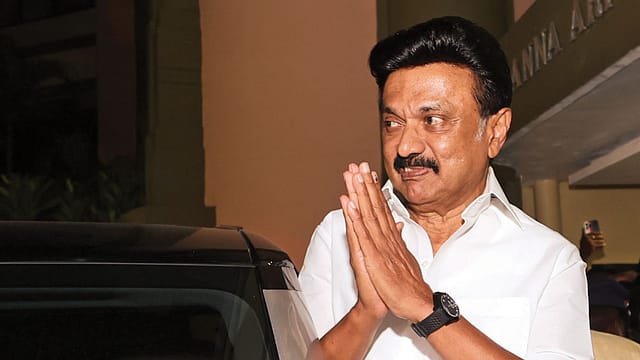
FOR NEARLY SIX decades, Tamil Nadu politics had organised itself around a single dispute: which of the two parties better embodied the Dravidian promises of dignity, autonomy and social justice. That argument is over. The voters have retired it, at least for now. The verdict in favour of film icon Vijay’s Tamilaga Vettri Kazhagam (TVK) could well mark the end of a revolution and the beginning of a new era. Dravida Munnetra Kazhagam (DMK) leader MK Stalin, face of the Dravidian tradition, drew legitimacy as son and successor of M Karunanidhi and elevated the contest to a defining one between Chennai and New Delhi. On May 4, it became evident that Tamil Nadu had chosen a novel path and unceremoniously dumped DMK.
Stalin went into this election holding aloft his Periyar inheritance, banking on an organisational machine Karunanidhi had perfected and on five years in office during which he fashioned himself as a sentinel of federalism.
He commissioned a report on Centre-State relations, tabled it in the Assembly in February 2026, and asked how long the states of India must remain “in the position of beggars at the Union’s door”. He argued the Constitution’s federal structure had always carried a centralising bias, and that this had deepened over decades through legislative encroachment on state subjects, conditional fund transfers and centrally sponsored schemes designed to turn chief ministers into supplicants. The only medicine, he declared, for everything from a fair GST structure to what he termed financial strangulation, was genuine federalism through constitutional amendments.
In a state where DMK and the All India Anna Dravida Munnetra Kazhagam (AIADMK) have been a duopoly, Stalin attacked the Bharatiya Janata Party (BJP) and the Modi government, never losing an opportunity to emphasise the exceptionalism of the “Dravidian model”. NEET, the national medical entrance examination conducted uniformly across India, became a combustible issue in Tamil Nadu. It was argued that students from rural and underprivileged backgrounds, who could clear Class 12 examinations with distinction, faltered in a standardised national test allegedly calibrated to coaching centres they could not afford. DMK went to the people in 2021 promising to abolish NEET in Tamil Nadu. They did win. The state Assembly unanimously passed a Bill to replace NEET with admissions based on Class 12 results, with BJP walking out in protest. But presidential assent never came. The governor returned the Bill and Delhi, as expected, was unmoved. Stalin wrote letters, convened coalitions of opposition chief ministers, and called the Centre cold-hearted, while Tamil Nadu students continued to take the exam.
Ironically, the legislative architecture that enabled NEET had been built partly during an earlier UPA government in which DMK was a partner. Meanwhile, the performance of students from government and government-aided schools kept improving. On Goods and Services Tax (GST), the argument was structural: Tamil Nadu was one of India’s most productive economies, a net contributor to the national tax pool, receiving in return a share of devolved funds that bore no reasonable relationship to what it had put in. Weeks before the election, a shortage of domestic cooking gas cylinders hit Tamil Nadu hard. DMK framed it as yet another consequence of the Centre’s indifference, another example of a state government left explaining Delhi’s failures to its own people, staging protests and announcing an electricity subsidy of `2 per unit for commercial users who switched to induction stoves.
Then there was delimitation, the question that spooked southern states. The southern states, it was argued, have long contributed to national tax revenues, controlled population growth, expanded schooling and improved public health outcomes. The proposed reward, under a delimitation exercise that would use current population as the primary criterion for redrawing Lok Sabha constituencies, was a reduction in their parliamentary voice. Stalin drew a direct line between this and the anti-Hindi agitations of the 1950s and 1960s, the founding trauma of Dravidian political identity. Weeks before polling day, he burned a copy of the proposed delimitation Bill in Namakkal, casting himself as the last man standing between Tamil Nadu and a constitutional reordering being designed in New Delhi. DMK voted against the Centre’s Bills linking the implementation of the women’s quota in legislatures to a delimitation exercise that proposed increasing Lok Sabha seats from 543 to 850—arguing that the expansion, however generous in absolute numbers, would entrench northern demographic dominance over southern representation—and held up the defeat of the legislation as a victory for federalism.
EACH ISSUE—NEET, National Education Policy (NEP), delimitation, GST, the gas shortage—was a brick in the same wall: a Tamil identity besieged by Delhi, a people whose very achievements were being turned against them, a chief minister fighting on every front simultaneously. This deliberate bundling of distinct policy battles under a single ideological frame, recasting them collectively as structural fault lines in India’s federal arrangement, was an intellectually coherent campaign but failed to take into account that popular aspirations had moved on. Tamil Nadu voted against it. The tales of graft and growing arrogance of DMK leaders mattered more. And while voters punished DMK, its rival, the party seeking a new innings under Edappadi K Palaniswami crashed at the hustings despite an alliance with BJP and other smaller parties.
The results delivered some of the most spectacular upsets in Tamil Nadu’s electoral memory. Stalin lost Kolathur, a seat he held for three consecutive terms, to TVK’s VS Babu by a margin of 8,795 votes. In 2021, he had won the same seat by over 70,000 votes. The scale of reversal is hard to absorb. The man who had made the defence of Tamil identity his entire political persona, who had locked horns with Prime Minister Narendra Modi, was turned out of his own constituency by a 75-year-old former MLA who had joined TVK just 10 weeks before polling. “No leader is infallible,” says Raveendran Doraiswamy, a political analyst. “In 1967, Kamaraj, who had commanded prime ministers, was defeated. Likewise, Stalin, who had taken on Prime Minister Modi, has met his defeat.” Kamaraj was the kingmaker of Indian democracy. Stalin was the loudest voice in the Indian federal argument. Both were made to understand, in the end, that electorates do not owe leaders their loyalty in perpetuity.
Out of 32 DMK ministers who contested, 15 were defeated. On the other side of the ledger, Palaniswami secured a landslide in Edappadi with a margin of 98,110 votes, a personal triumph that offered cold comfort against AIADMK’s diminished overall tally of 47. TVK’s average winning margin across its 108 victories was nearly 23,000 votes, more than double the DMK’s per-seat average. This is nothing like the waves Tamil Nadu has seen before. And this wave, as it happened, had been nearly invisible till the end. Money power, that perennial explanation for Tamil Nadu’s electoral outcomes, played almost no role. Instead, fan club mobilisation, social media campaigns, diverse and fresh contestants, and a thirst for an alternative to the two Dravidian parties resulted in an unforeseen churn, the biggest in Tamil Nadu’s history, larger than the upheaval in 1967, when CN Annadurai dethroned Congress, and larger than that of 1977, when MGR, who had split the Dravidian movement, swept to power.

“This is a generational change, a new kind of electoral politics,” says political commentator Maalan Narayanan, “and whether it is temporary or permanent remains to be seen.” According to him, between April 14 and April 21, the final week of campaigning, Vijay spoke at public meetings for a total of 35 minutes. People voted for TVK without knowing who their local candidate was. In a state where caste arithmetic, local credibility, and community organisation have always been decisive, this is without precedent. It is a vote against the status quo of inherited power dressed as trust, of welfare without accountability, of a Tamil politics that had begun in fury and ended in sinecure.
Every party that had fought against Vijay is now lining up to sustain him in power. Congress was quick to offer conditional support, even as the irony of having fought the elections with the party that has just been swept aside, to now back the man who did the sweeping, is sinking in. More audacious still are the signals from across the aisle. An AIADMK MLA-elect has publicly claimed that her party is in talks to provide support to TVK to form a stable government. Speaking to Open, KA Sengottaiyan, one of Vijay’s seniormost lieutenants, neither confirmed nor denied the claim. “TVK is ready to stake claim with the help of many well-wishers,” says the man who was photographed sharing the stage with Vijay post the results with a photo of J Jayalalithaa still in his pocket. Should the entirety of AIADMK back TVK’s 108 seats, it would be the most improbable coalition Tamil Nadu politics has ever produced, against a DMK that has been reduced to 59 seats. There are also reports of a fairly large cohort of AIADMK MLAs who are willing to join former minister and now TVK man CV Shanmugam to extend their support to Vijay.
The Dravidian model, welfare-heavy and identity-driven, is not dead. Its social achievements are too embedded in Tamil life to be simply unwound. But as a political offer, as a reason to vote, it has stopped being sufficient. A generation that grew up with its benefits now asks harder questions about jobs, about corruption, about whether the party that speaks of dignity actually delivers it at the street level. Constitutional arguments are a distant abstraction to a young voter in Chennai or Kumbakonam who wanted something to believe in. They found it, perhaps temporarily, perhaps permanently, in a man whose entire political philosophy remains largely unspoken.
The Dravidian idea was born in resistance—to caste, to northern dominance, to the presumption that some people were born to govern and others to be governed. It was a magnificent resistance. It built schools and hospitals and a political culture of genuine accountability. And then, across 60 years, it evolved into exactly the kind of entitlement it had been created to oppose. On May 4, 2026, Tamil Nadu did what it has always done with power that outstays its purpose. It withdrew its consent. n