The Vanguard: BJP Rearmed for 2029
A TASTELESS EXCHANGE BETWEEN CONGRESS LEADER RAHUL GANDHI and former party MP Sandeep Dikshit at a party convention labelled, ironically enough, ‘Rachnatmak Congress (Constructive Congress)’, about Prime Minister Narendra Modi and a female foreign leader before an appreciative in-house audience quickly became fodder for heated exchanges on social media. The coarse byplay came about in what was an exhibition of lowbrow wit as Rahul sought to mock the prime minister’s trademark hug with which he greets foreign leaders.
Soon enough, social media was abuzz with predictably partisan commentary and some handles aligned with the Bharatiya Janata Party (BJP) put up images of Indira Gandhi, Palestinian leader Yasser Arafat, and Cuba’s Fidel Castro at the 1983 Non-Aligned Movement (NAM) summit in New Delhi. Videos of the event show Arafat’s extended double-handed handshake with Indira Gandhi and Castro famously ignoring an extended hand to hug the Indian leader. The idea was to remind Rahul Gandhi that ‘hug’ diplomacy is not alien to the Gandhis. As commentators at the time noted, Indira Gandhi was not quite comfortable with Castro’s gesture but gamely went along and returned the hug with a loose embrace.
Rahul Gandhi’s onstage mimicry and Dikshit’s sleazy comment incensed the saffron quarter even as the episode evoked wider disapproval. Much of the exchanges between BJP and the Congress-Left ecosystem that followed trod a predictable path that essentially amounted to a trading of insults. While it is legitimate tactics to present a mirror to political opponents, there is a risk of overuse. For example, dipping into Jawaharlal Nehru’s imperfect legacy, felt some in BJP, had its limits, particularly with a younger audience. After Jan Suraaj Party leader Prashant Kishor scored an upset win over BJP in the Assembly bypoll in Bihar in the seat vacated by BJP president Nitin Nabin, explanations offered on social media came across as a laboured and unconvincing attempt to argue that the Rashtriya Janata Dal (RJD) was the bigger loser in terms of vote shares.
A certain sameness in the party’s messaging had become evident for a while and matters came to a head during and after the Cockroach Janta Party (CJP) protests that culminated in the violence of July 20 when a mob of 30,000 attempted to push through police barricades and move towards Parliament. As a fierce debate raged over the handling of the protests and senior ministers were deputed to engage an upstart social media creation, questions were asked about BJP’s ability to communicate and respond to public anger over the leak of the National Eligibility cum Entrance Test (NEET) for admissions to undergraduate medical courses. Sensing the need to put across a direct and simple message, Modi released five selfie videos on Instagram, the preferred platform of Gen Z, which found instant traction. Modi avoided quibbling over the politicised aspect of the CJP protest and promised to fix public examinations. Around this time, the BJP leadership became convinced about the urgent need to recast the party organisation and its messaging.

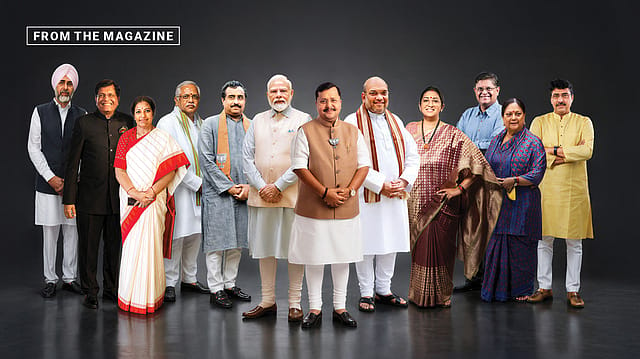
Almost seven months after Nabin formally became BJP president, the party on August 17 released a list of 65 office bearers that added up to a significant overhaul with more than 50 new inductees. Of the eight general secretaries—the key functional post— named only Vinod Tawde and Sunil Bansal remain. There are nine new faces among 13 party vice presidents as are15 of the 16 national secretaries. In an important decision, Deepak Mhaskey, associated with successful campaigns in Chhattisgarh and West Bengal, replaced BJP’s long-serving social media convenor Amit Malviya, bringing the curtain down on the latter’s long stint as the IT cell in-charge. While Mhaskey will work with a new team, there are changes in the regular media cell as well. While Garhwal MP Anil Baluni continues to enjoy the trust of the BJP brass and remains chief spokesperson and media in-charge, other members of the cell have been replaced. Party spokespersons Pradeep Bhandari and Sidharth Yadav are media co-in-charge along with Ashish Agrawal. Taken together, the changes signal a serious reset in BJP’s media outreach.
The finalisation of BJP’s new central team is expected to be followed by a reshuffle of the Council of Ministers which has been in the works for a while. The changes in office bearers have raised expectations of a substantial exercise with regard to ministerial assignments though the ‘pool’ of likely picks is not very large. BJP has provided more room for “lateral entries”, such as External Affairs Minister S Jaishankar, or for leaders from other parties, but cannot lose sight of the BJP-Sangh connection in ministerial appointments. Yet, there is anticipation that the changes will, like the BJP central team, set the course for the next General Election.
The induction of younger functionaries is evident across the board as is a desire to rotate the responsibilities. BJP MP Tejasvi Surya has done well as a youth leader but has been replaced by Vadodra MP Hemang Joshi as Yuva Morcha president. Surya has evolved as a speaker in Parliament and made a forceful speech during the discussion on delimitation, rebutting claims that South India would be disadvantaged. A party source said Surya can expect to get more opportunities in Parliament while BJP opts for a change in the Yuva Morcha. The youth imprint is visible even in the vice presidents, usually the more ‘senior’ of party organisational posts. New faces like Dr Madhuchanda Kar, an oncologist, former Union minister Dr Bharti Pawar, who holds an MBBS degree, Rekha Verma from Uttar Pradesh, and Varshaben Joshi from Gujarat are in their 50s. The new names among general secretaries reflect a similar lower age profile and even Tawde and Bansal, who were part of the old team, are near or just past 60.
The rationale for giving younger leaders an opportunity is clear enough as the party looks to build for the future but this does not mean onboarding greenhorns. The new picks have been through the grind of organisational and electoral politics and have a strong BJP-Sangh background. Satish Poonia began as an Akhil Bharatiya Vidyarthi Parishad (ABVP) activist and became an MLA in 2018; Gajendra Patel, MP from Khargone, a reserved constituency in Madhya Pradesh, is serving a second consecutive Lok Sabha term; Harish Dwivedi has been MP twice from Basti in Uttar Pradesh; and Sanjay Bhatia from Haryana was elected to Lok Sabha in 2019 and is currently a Rajya Sabha MP. Then there are seniors like former Chief Ministers Vasundhara Raje and Tirath Singh Rawat, Commerce Minister Piyush Goyal—back as treasurer—and Sangh ideologue Ram Madhav and former minister Smriti Iran who lend heft and balance to the team. Baijayant Panda, another experienced leader, continues as vice president, having been involved in important assignments such as Assembly polls in Delhi, Assam, and Tamil Nadu.
The list of office bearers marks the return of Irani and Madhav who are experienced hands but not ‘senior’ in terms of age, and who were out of the thick of party affairs for a while. Irani was out of the limelight after she lost the Lok Sabha election from Amethi which she had famously wrested from Rahul Gandhi in 2019. Madhav is a prominent advocate of the Sangh and BJP thinking on political issues and has organisational experience in the Northeast and in Jammu & Kashmir. He had a hand in BJP’s shortlived alliance with the Peoples Democratic Party (PDP), despite the latter’s “soft separatism”, after the fractured mandate of the 2015 state polls. Along with Madhav and Irani, former Tripura Chief Minister Biplab Deb has been made a vice president too, indicating a role for him in the Northeast. Deb became BJP’s first chief minister in Tripura after the party ended the Left’s 25-year rule in the state in 2018 and was a Rajya Sabha MP from 2022 to 2024 before being elected to Lok Sabha from Tripura West in May 2024. Irani is an articulate leader with a significant public following and has made a strong comeback as a campaigner. Madhav has over the years developed an interest in foreign policy and is a prominent presence, often representing the Modi government’s point of view on the international think-tank circuit. He is president of India Foundation which has Shaurya Doval and Suresh Prabhu on its board.
Piyush Goyal, who was treasurer from March 2010 to May 2014, has been handed the same responsibility which will almost certainly run till the next Lok Sabha polls. Although BJP has a one-man, one-post norm, this has been given the go-by on more than one occasion and Goyal is expected to continue in the Cabinet. He is credited with running a tight and effective budget in BJP’s 2014 Lok Sabha ‘Abki Baar Modi Sarkar’ campaign, concluding cost-effective contracts with major media outlets for election advertising. Goyal is a key part of the Modi government’s trade talks. Besides coming across as a shrewd negotiator, he has been an effective spokesperson, robustly countering allegations that India’s business and agriculture interests have been hurt by concessions in sensitive sectors. Irani and Deb are in their early 50s while Goyal and Madhav are in their early 60s and can hardly be called vintage. They bring a solid experience of politics, government and organisation to the table. Since his election to Lok Sabha from Mumbai North, Goyal has taken care to tend to his constituency assiduously.
The important post of General Secretary, Organisation, held by a Sangh nominee, remains with BL Santhosh, who replaced Ram Lal in July 2019. Saudan Singh, who has been vice president since 2021, will be national joint general secretary along with Shiv Prakash. An organisational veteran, Singh had held responsibilities in Sangh and BJP and was, in fact, a little off stage for a while. Seen as a competent mind, he is back in party matters. Among national secretaries, Kavita Patidar from Indore is a Rajya Sabha MP, K Surendran is a former BJP Kerala state president, Bhola Singh is MP from Bulandshahr, Pradip Varma from Jharkhand was recently elected Rajya Sabha MP, Jagdish Patel is a former Surat mayor and former MP, Phangnon Konyak is a Rajya Sabha MP and state president of BJP’s Nagaland women’s wing, Sangeeta Yadav from UP is a Rajya Sabha MP, and Anil Antony, son of former Defence Minister AK Antony, holds a Stanford degree. Almost all the functionaries are in their late 40s to early 50s. Others include M Venkatesan from Tamil Nadu, author and former state office bearer; Manoj Tigga is Alipurduars MP; Sidharth Shambhu from Bihar has been a BJP and Sangh organiser; Swadesh Singh from Delhi has a doctorate from JNU; Mriganka Barman from Assam is a former state BJP youth president; former Congress leader Rohan Gupta from Gujarat and Hardoi MP Jai Prakash are others on the list. The average age of national secretaries is just about 50.
PURI MP AND a familiar BJP face in television debates and press conferences, Sambit Patra is coordinator for the Northeast and has been involved in political management in Manipur—a demanding task with the state riven by ethnic violence since 2023. Patra won his first Lok Sabha term in 2024 and is a trained surgeon. The seven morcha presidents for youth, women, OBCs, farmers, Scheduled Castes and Scheduled Tribes, and minority wings are also a youthful mix. Women’s wing president Roop Choudhary is MP from Mahasamund, OBC morcha head Amarpal Maurya is a Rajya Sabha MP as are farm cell in-charge Bansilal Gurjar and SC morcha chief Shivesh Ram. ST morcha president Mannalal Rawat is Udaipur MP, and Kunwar Basit Ali from Meerut is Minority Morcha head.
The performance of the new team has a bearing on BJP’s preparations for the next Lok Sabha election and the nomination of Tawde as election in-charge for Uttar Pradesh indicates the value the party places on track record as much as the opportunities it provides to new inductees. Punjab leader Tarun Chugh, who has been made in-charge of the central office, has also been given charge of Gujarat. Although Gujarat affairs are closely monitored by Home Minister Amit Shah, the appointment reflects faith in Chugh who was general secretary in the previous team.
It might not have been a specific goal, but the list of office bearers has a significant representation of forward castes who add up to more than half the appointees. The need to be mindful of the “forwards” has engaged BJP, with upper-caste resentment—as also indifference—held to be a factor in Kishor winning the Bankipur seat. The roots of upper-caste annoyance are traced, at least in part, to the University Grants Commission’s (UGC) controversial circular setting out “anti-discrimination” rules that directed colleges to set up an office of equity, a committee to ensure diversity, helplines and checks to detect and prevent unfair treatment of certain sections. The strict definition of discrimination as “caste-based” and applicable to SCs, STs, and OBCs was held to exclude forward-caste students altogether and the rules were stayed by the Supreme Court for being too sweeping, vulnerable to misuse, and less inclusive than the previous 2012 regulations. Although the UGC rules have been stayed, the resentment is seen to have lingered, and there is a view in BJP that the ruffled feathers need to be smoothed.
In state polls in Madhya Pradesh and Rajasthan in 2018, ahead of the 2019 Lok Sabha election, the decision to nullify the Supreme Court’s dilution of certain provisions of the Scheduled Castes and the Scheduled Tribes (Prevention of Atrocities) Act by passing an amendment was believed to have cost BJP. In Madhya Pradesh, an outfit claiming to represent upper-caste interests emerged just before the Assembly polls and vanished just as quickly after the results which favoured Congress. Reading the political signals, Modi 2.0 moved swiftly to enact a quota for economically weaker sections (EWS) and managed to steer it past legal challenges which had stymied previous efforts. The signal from the list of BJP office bearers seems to be on target as far as the argument relating to the UGC rules and the aftermath. There are regional issues that might require attention as southern representation may need more attention when the national executive is announced. The larger body provides more room for aligning caste and regional interests as the central office bearers are a closely knit team where a task-based approach prevails.
In keeping with the BJP norm of providing one-third representation to women, they make up almost 30 per cent of the office bearers. The women representatives will be an important part of BJP’s messaging whenever it makes a renewed bid to legislate the rollout of women’s reservation as part of a fresh delimitation exercise.