The Quiet Rise and Sudden Leap of Nitin Nabin: A portrait of BJP’s new working president
AS EXPECTED, THE CHOICE oftheBharatiya Janata Party (BJP) working president came as a surprise. Also as expected, it was a dark horse.
A one-line statement from the party headquarters, announcing that the BJP Parliamentary Board has appointed Bihar minister Nitin Nabin as the party’s “Rashtriya Karyakari Adhyaksh”, or national working president, came, finally, on a quiet Sunday evening (December 14). Within minutes, just as search engines went into overdrive to know why BJP had zeroed in on him, Prime Minister Narendra Modi posted on X: “Shri Nitin Nabin Ji has distinguished himself as a hardworking karyakarta. He is a young and industrious leader with rich organisational experience and has an impressive record as MLA as well as minister in Bihar for multiple terms. He has diligently worked to fulfil people’s aspirations. He is known for his humble nature and grounded style of working. I am confident that his energy and dedication will strengthen our Party in the times to come. Congratulations to him on becoming the National Working President.”
Home Minister Amit Shah, in his post on X congratulating Nabin, said whether as national general secretary of the Yuva Morcha, or state chief of the Bihar Yuva Morcha, or Chhattisgarh state in-charge, Nabin has fulfilled every organisational responsibility with commitment and success. Shah said that being a five-time MLA and minister in the state government, Nabin has had a long experience of working among the people.
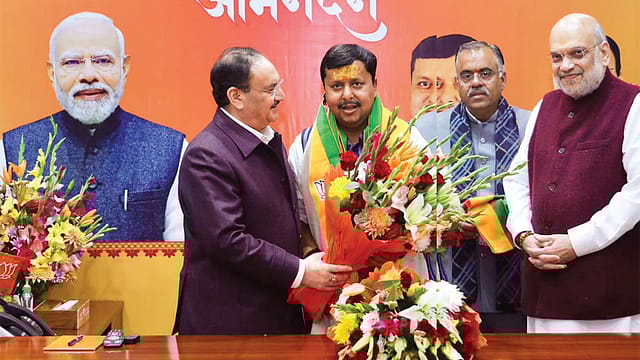
Overnight, posters of Nabin, along with Modi and party president JP Nadda, sprung up in the capital, lining the road leading to the party headquarters on Deendayal Upadhyay Marg where Nabin was to reach the morning after the announcement. With his flight from Patna delayed because of dense fog and low visibility in Delhi, he made it to the BJP office only by afternoon, wearing a white kurta-pyjama, a striped Nehru jacket, and a saffron scarf with a lotus, the party symbol, looking the quintessential BJP politician. After making his way through the crowd of party workers and assembled media, Nabin was felicitated in the presence of senior leaders, including Shah and Nadda.
Nabin, a road construction minister in the Nitish Kumar government in Bihar, where the National Democratic Alliance (NDA) recently swept the Assembly election, is set to take over from Nadda in January, as full-fledged BJP national president. Nadda, who had replaced Shah, was also first appointed the party’s working president before he was elected as party chief in January 2020, a trend that began with him.
What sets Nabin apart from earlier party chiefs is his age, the youngest at 45, his lower profile and being the first from Bihar to rise to the post, once elected. His elevation to the top organisational post, once he eventually succeeds 65-year-old Nadda, is seen as a generational shift, with the party gearing up for the future. Union Minister Nitin Gadkari was the youngest BJP party president before him, at 52. In pre-Independence India, Maulana Abul Kalam Azad was elected president of the Indian National Congress at 35 during a special session held in Delhi in 1923.
Among the multitude of party workers gathered at BJP headquarters to greet the new national working president, those who have known him from Bihar described him as a soft-spoken, amicable leader, someone with no enemies. A senior leader from Bihar attributed Nabin with three distinct qualities—a pleasant demeanour, being accessible, and always patient in giving a hearing—all of which would come in handy in the role of party chief. Besides, Nabin is aware of the nitty-gritty of how the organisation functions. His appointment, according to the leader, underscored the message that a young, dedicated party worker could rise to the top organisational post in BJP, instilling hope among others. Asked if the choice of Nabin came as a surprise, the leader said this is how BJP functions.
According to another leader, being low key went in Nabin’s favour, given the prime minister’s appreciation for such people. At the same time, the leader said, Nabin was effective in tasks assigned to him by the party leadership, remained untainted while several others in the state faced graft allegations and did not align himself with any faction, all of which earned the trust of the prime minister and the home minister. The Patna-based BJP leader recalled that Nabin, who lost his father Navin Kishore Prasad Sinha, a veteran BJP leader, in 2006 when he was just 26, invites all state leaders of the party every year for observing his father’s death anniversary on December 31 at his statue. Describing it as an astute move to choose a leader in his forties, at a time when Congress’ Rahul Gandhi is 55, the leader said BJP keeps reinventing itself.
Educated till the intermediate level, Nabin was catapulted into electoral politics after his father died of a cardiac arrest. He won the Patna West by-election in 2006, and after delimitation fought from Bankipur, winning the following four consecutive Assembly elections. In the recent polls, he defeated the Rashtriya Janata Dal’s (RJD) Rekha Kumari, of the same age as him, by 51,936 votes. A Kayastha, an upper-caste community estimated to be less than 1 per cent of the population in the country and in Bihar, he does not represent a numerically weighty section. This would also mean that Nabin’s being chosen to be at the helm will not hurt the sentiments of electorally dominant communities.
THE BJP LEADERSHIP has taken a different approach, factoring in caste equations, while appointing chief ministers in several states. In Chhattisgarh, where tribal support played a significant part in BJP’s victory, it named Vishnu Deo Sai, a four-time MP and two-time MLA, making him the first tribal chief minister of the state. Nabin was state in-charge for the elections. In Madhya Pradesh, the party picked Mohan Yadav, retaining the trend of an OBC at the helm in a state where the Other Backward Classes (OBC) constitute nearly 50 per cent of the population, but for the first time a Yadav. In Rajasthan, the party appointed Bhajan Lal Sharma, a Brahmin, but did a balancing act by naming two deputy chief ministers— royal-turned-politician Diya Kumari, in a state where Rajputs have political clout, and Prem Chand Bairwa, a Dalit, a section which forms the second-largest bloc after OBCs in the state. In Odisha, where BJP defeated the Biju Janata Dal (BJD) ending Naveen Patnaik’s 24-year-tenure, it went for Mohan Charan Majhi, a Santali tribal. In Delhi, BJP decided on Rekha Gupta, making her the first woman chief minister in the Modi era, while taking into account the fact that she belongs to the Vaishya community which has a significant vote share. In Haryana, the party chose Nayab Singh Saini, an OBC, replacing Manohar Lal Khattar, even before the elections last year. Between Nabin and the chief ministers, there runs a distinct parallel in the boxes they ticked—organisational people who worked behind the scenes; rose through the ranks; are below 60, untainted and uncontroversial.
For those who have known Nabin, he is affable, gentle and professional. Nitin Abhishek, co-treasurer of the party’s state unit, who has known him closely, particularly when Nabin was the state Yuva Morcha chief, said he would take everyone along, without discriminating between those from district and mandal levels. He recalled a train journey from Patna to Kerala when about a hundred workers travelled in a general coach. Nabin also travelled in the same coach along with them on the nearly 50-hour journey despite having a berth in an AC compartment. “He would find out if everyone had eaten, meet party workers at various stations and sleep among them in the general bogey,” he said. He also recalled how Nabin got several youth to join BJP, after a meeting organised by the BJYM to felicitate young elected representatives of Panchayati Raj and local bodies which was addressed by Poonam Mahajan, the then BJYM president.
Once the euphoria ebbs, Nabin will have to get down to brass tacks, facing the challenges before the party next year—elections in West Bengal, Tamil Nadu, and Kerala—where BJP has never been in power, and Assam, where it will be fighting to win a third consecutive term. In 2027, among the seven election-bound states is Uttar Pradesh, where BJP got a jolt in the 2024 Lok Sabha polls with Akhilesh Yadav’s Samajwadi Party winning 37 seats, four more than BJP. Familiar with grassroot-level work, which BJP has mastered, Nabin will have to put to test his experience in Bihar, fine-tuning it for the political dynamic of each state. Although the BJP president’s term is three years, it can be extended once. Nabin will likely be in the saddle when BJP braces for the General Election in 2029.
As he has himself said, Nabin has the blessings of the BJP leadership. Both Nadda and Shah, in their social media posts, have exuded confidence in his organisational skills and in taking the Modi government’s policies and ideology to the people. Once elected party president, bringing down the average age of BJP top guns, all eyes will be on Nabin’s new team which is expected to lay the basis for shaping the party’s future leadership.