The Mantle of Pawar
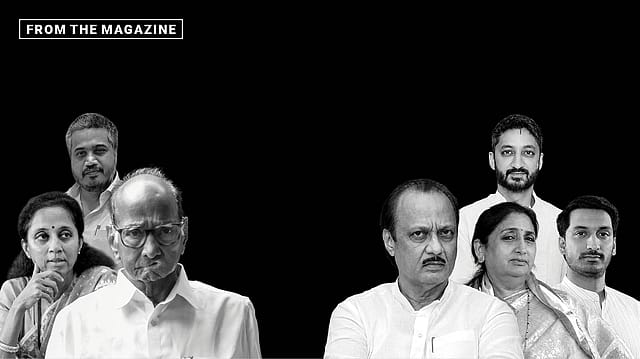
Instinctively seizing the moment, as only a savvy politician can, Sharad Pawar stood in a torrential downpour in Satara, the nerve centre of Maratha politics and, refusing an umbrella, continued to address an election rally attended by hundreds of cheering supporters, also soaked to the skin. In his trademark short-sleeved white shirt and trousers, Pawar said he stood before the people of Satara to admit he had made a mistake. “I feel if you have made a mistake, one should admit it,” he said. The choice of candidate for the recent 2019 Lok Sabha election had been wrong and now the right man had been selected. “This election is important. What you decide in Satara will send a message to all of Maharashtra,” he said, concluding a short speech.
Videos of a drenched Pawar calling on the faithful to support him went viral, tugging at the heartstrings of voters who had backed ‘Saheb’ over the years, and injected new life into the Nationalist Congress Party’s (NCP) claim to represent regional identity and a Maratha-led political order that had held sway in the state for long. The electoral cycle is such that state polls follow soon after the national election and, in recent years, the Lok Sabha results are seen to have an impact. In 2004, following the Vajpayee government’s shock defeat, the political climate in Maharashtra changed rapidly and a resurgent Shiv Sena-Bharatiya Janata Party (BJP) combine lost steam. The Congress-NCP alliance recouped and won two more terms, remaining in office from 1999 until 2014, when the Narendra Modi storm blew it out of power. In the 2019 Lok Sabha polls, the National Democratic Alliance (NDA) won 41 of 48 seats and NCP was staring down the barrel. Pawar’s dramatic act, seen as a heroic rallying of forces, helped stave off a rout and NCP won 54 seats in the Maharashtra Assembly.
Recently discharged from hospital following treatment for respiratory problems, Pawar, now in the autumn of his long career, faces yet another critical moment. Although the breakaway NCP majority faction that allied with BJP in July 2023 has been experiencing rough weather since the death of its leader Ajit Pawar in an air crash on January 28, with his widow, Deputy Chief Minister Sunetra Pawar, at odds with the old guard, discontent in the mother party is increasingly apparent. The 85-year-old veteran of several political battles is faced with the task of keeping the remaining flock—10 MLAs and eight Lok Sabha MPs—together, along with the grassroots leaders and local notables who have been the backbone of NCP’s political mobilisation. The ill-fated “merger” talks between the two factions came to a halt after the sudden death of Ajit Pawar, as Sunetra Pawar seems markedly uninterested in the proposal. Sharad Pawar’s daughter and political heir Supriya Sule, MP from Baramati, said there had been no discussion about a merger. While Sunetra and her elder son Parth have their hands full, there is a lack of chemistry between them and Sule. Meanwhile, restive MLAs and MPs in the Sharad Pawar camp, chafing at the party being reduced to a rump and unsure of their future, are looking for options. Their destination, political sources point out, might well be NDA. Such an outcome might not displease Pawar, who has on more than one occasion considered breaking bread with BJP, but the catch lies in reservations in the saffron camp over the Maratha strongman being part of NDA.

The reprieve in the 2019 Assembly election was followed by an unanticipated opportunity. The BJP-Sena alliance, despite having secured a majority, ran aground as Sena chief Uddhav Thackeray claimed the allies had agreed to a rotational chief ministership. BJP leaders denied any such understanding and were resolute about not conceding to what they saw as Thackeray’s unprincipled gunboat tactics. In the early hours of November 23, 2019, Ajit Pawar was sworn in as deputy chief minister and BJP’s Devendra Fadnavis as chief minister. BJP leaders said discussions with NCP had been completed in fine detail. Addressing party workers after he finally split with his uncle in 2023, Ajit Pawar provided a lengthy account of Pawar’s dalliances with BJP and subsequent U-turns. At the time, the MLAs who were part of Ajit Pawar’s enterprise were scattered, and their not being in one place helped the NCP grandee script another twist in the plot. The MLAs were summoned and informed there would be no alliance with BJP and, in a dramatic turn of events, the NCP boss struck a deal with Thackeray and Congress to form a Maha Vikas Aghadi (MVA) government five days later. Sharad Pawar had found in Thackeray a prop who would allow him power and influence not possible as part of NDA.
Pawar’s determination to install Sule as his successor eventually led to Ajit Pawar’s exit, along with leaders like Praful Patel, Sunil Tatkare and Dilip Walse Patil. The success of the revolt, despite NDA's setback in the 2024 Lok Sabha polls, has placed at a crossroads Sharad Pawar’s Maratha-centric politics and his socially charged hostility towards ‘Peshwai’ or ‘Brahminism’, which helped garner the support of non-forward communities. The Maratha community, by far the most influential caste group, whose leaders have been chief ministers and have dominated powerful cooperative networks, no longer sees NCP or any one party as its sole option. Although the community’s relations with BJP have been uneasy, a good number of leading Maratha political families have aligned with the party. The demand for Maratha reservation has not benefited Sharad Pawar either. Questions about his lack of action when he was in office are hard to answer, while BJP leaders have raised questions about his links with Maratha quota agitator Manoj Jarange Patil. BJP has meanwhile worked hard to deliver on the quota, despite difficulties in establishing social and educational backwardness—key criteria for Other Backward Classes (OBC) categorisation—by bringing Marathas under the ‘Kunbi’ umbrella, as the agrarian community is designated as backward. Kunbi caste certificates are the path to making Marathas eligible for OBC quota benefits.
Although Marathas are politically dominant and socially assertive, their upward mobility has sometimes led to unhappiness over a lack of footprint in cultural fields and a modest presence in elite conversations, spheres in which non-Maratha forward castes are disproportionately represented. Tensions between the numerically preponderant Marathas, who enjoy political and economic clout, and the cultural mainstream and white-collar social classes have been evident. The resentments obliquely reflect the anti-Brahmin politics that animated Sharad Pawar’s mobilisation. The divergence has sometimes been seen in the light of the philosophies and legacies of social activist Dinkarrao Javalkar and Congress leader Bal Gangadhar Tilak, though some commentators argue their differences were not as sharp or vituperative as is made out despite the ideological chasm separating them. Pawar’s disparaging references to the Peshwas—the Brahmins who led the Maratha confederacy during its rapid expansion in the 18th century—are seen as caste-coded messaging. While it is true that the later Peshwas did not cover themselves in glory, outstanding military leaders like Baji Rao I and Nanasaheb played a stellar role in what came to be known as the century of Maratha supremacy.
MLAs AND MPs IN THE SHARAD PAWAR CAMP, CHAFING AT NCP BEING REDUCED TO A RUMP AND UNSURE OF THEIR FUTURE, ARE LOOKING FOR OPTIONS. THEIR DESTINATION MIGHT WELL BE THE NATIONAL DEMOCRATIC ALLIANCE
The demand for the inclusion of Marathas in the OBC category has unsurprisingly failed to enthuse other backward classes, such as NCP leader Chhagan Bhujbal, who hails from the Mali community and was close to Sharad Pawar. Although not directly affected, Scheduled Castes (SC) are also sceptical about Marathas gaining access to reservation, in the light of past antagonism. NCP was formed as an act of rebellion against Sonia Gandhi, a foreign-born person, becoming leader of Congress. While many Congress rebels have faded into oblivion or returned in sackcloth, NCP held its own and even won two seats more than Congress in the 2004 Assembly election. At the time, reports suggested Sonia Gandhi was insistent on retaining the chief minister’s berth. Other accounts do not discount Pawar’s unease over Ajit Pawar being the claimant to the chief minister’s chair if NCP had indeed asserted its pole position. NCP’s mix of patronage, populism and courting of Muslim interests kept it in business. In the 1995 election, which he lost to the Sena-BJP—who formed a government for the first time in Maharashtra, unseating Congress—Pawar often presented himself as a pro-Muslim leader. “BJP has two targets of abuse, me and Muslims,” he would say.
The real challenge arose after the United Progressive Alliance (UPA) lost office and BJP, led by Modi, won a majority in Lok Sabha in 2014. Modi’s emergence and the momentum of BJP’s big win swept the Congress-NCP out of power in Maharashtra. The unusual post-poll circumstances led to a revival in 2019, but it proved short-lived. Incensed at what they saw as Thackeray’s betrayal, the BJP brass left no stone unturned in forming a government, and did so with the assistance of major defections from the Sena in 2022, further cemented by Ajit Pawar joining NDA. The short-lived MVA government was riven with controversies over allegations of corruption and incidents like the attempted extortion of Mukesh Ambani by placing an explosives-laden SUV outside his Mumbai residence. While MVA was seen to be a self-serving enterprise, BJP’s Hindutva appeal and advocacy of cultural nationalism struck deep roots. The appeasement politics of NCP and other MVA con stituents became too blatant while BJP successfully branded the parties as “anti-development”. Moreover, a party set up to oppose dynastic rule was seen to be mired in the same processes while BJP’s tent grew to accommodate OBCs and sections of Dalits, and it was no longer just a city-based, forward-class party.
The decimation of MVA within months of winning more seats than NDA in the 2024 Lok Sabha polls might, on the face of it, seem hard to explain. But once Modi was sworn in as prime minister for a third time, the momentum swung back towards BJP. The complacency and rough edges around the alliance with Ajit Pawar—BJP had often labelled NCP the “Nationalist Corrupt Party”—disappeared, and the flow of defections from Sharad Pawar’s camp resumed. Keen to regain the political perch it had lost, BJP accepted legislators whom its leaders had previously targeted for corruption and who became ministers in the Mahayuti (grand alliance) government. At the end of a bitterly fought state election, the results declared on November 23, 2024 saw BJP and its allies win a landslide that left Congress with 16 seats, the Uddhav Sena with 20 and NCP (Sharad Pawar) with 10 in a House of 288.
Sharad Pawar has rarely run out of options. In 1991, when he gave up his bid for the prime ministership in favour of PV Narasimha Rao, he became defence minister and later returned to Maharashtra as chief minister. When UPA formed a government in 2004, he “chose” the agriculture portfolio, though there is some truth in Congress’ reported discomfort in handing him a portfolio that would make him a member of the Cabinet Committee on Security. Modi visited Baramati in February 2015 and, amid much bonhomie, exchanged good-natured repartee with Pawar. In October this year, Pawar announced that Modi would be in Baramati on November 3 to inaugurate a four-tonne Buddha statue and attend an event at the family-run Vidya Pratishthan educational trust. The programme was put off following Pawar’s hospitalisation during which he received a call from Modi, who asked Pawar to take care of his health. Pawar’s eight Lok Sabha MPs are part of NDA’s calculation for the passage of the delimitation Bill. While his political acumen remains undimmed, the political landscape in Maharashtra has changed for good.