The End of an Aura
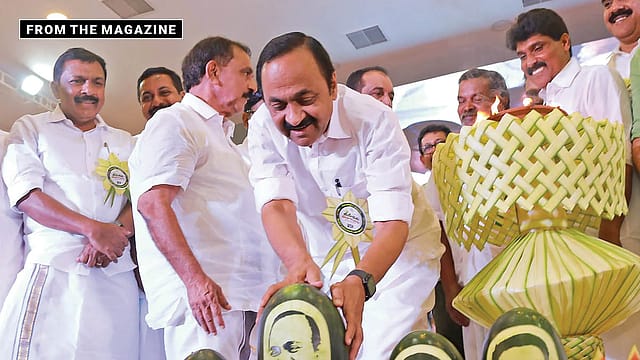
In mid-May, when the Congress high command in Delhi named VD Satheesan as the new chief ministerial choice for Kerala after days of dithering, involving internecine wranglings and one-upmanship against senior colleague KC Venugopal, who was Rahul Gandhi’s first choice for the coveted post, the regional media was bent on projecting any other decision as unfair, favouring Satheesan to the hilt, beaming sound bites of outrage and anguish at what was made to look like a betrayal of people’s faith and mandate—if he wasn’t handpicked for the job.
The media sentiment didn’t exactly reflect the opinions of the legislators in the newly constituted state Assembly following the polls which saw the Pinarayi Vijayan-led Left Democratic Front (LDF) government suffer a resounding drubbing, securing a mere 35 seats compared with the Congress-steered United Democratic Front’s (UDF) 102 in the 140-member state Assembly. Congress won 63 seats on its own, trouncing CPM and allies that had been in power for 10 straight years under Vijayan’s stewardship. CPM won only 26 seats, losing from strongholds considered unwinnable for opponents. In some such crucial seats, CPM rebels shifted loyalties to UDF that won, meaning the Left saw its own cadres turn against it.
Satheesan’s claim to glory in the polls, for which the results came out on May 4, was justified. After working at booth levels across the state, it was he, as Congress party leader and leader of the opposition (LoP) in the state Assembly, who, with meticulous planning, ensured the inclusion of names of new voters from Congress families, a practice once perfected by CPM to ensure that not a single vote from its sympathisers and loyal families went waste because their names weren’t on electoral rolls. That he didn’t have a majority in the Congress Legislative Party was an altogether different matter. Finally, following intrigue-filled days of parleys and lobbying, Satheesan had the last laugh, although according to parliamentary tradition, whoever had the majority of party MLAs on his side had the right to be chief minister. The Indian Union Muslim League (IUML), a formidable ally in UDF, threw its weight behind him, and the Gandhis, Rahul and Priyanka, both of whom had won from Kerala, from the Wayanad Lok Sabha seat, where IUML wields tremendous clout, didn’t want to antagonise that party. IUML has long played a key role in ensuring Congress victories in the Wayanad Lok Sabha seat, now represented by Priyanka Gandhi Vadra.

Rahul Gandhi had won from this seat in 2019, when he lost from the family pocket borough of Amethi to the Bharatiya Janata Party (BJP) contender Smriti Irani. In 2024, Gandhi Jr won from both Wayanad and Rae Bareli and vacated the former for his sister, who won handsomely in a bypoll, thanks to IUML support.
Now, as chief minister for six months, Satheesan, who as LoP was media savvy, good with quotable quotes, warm and quick on his feet, is no longer the darling of TV channels and their influential anchors who preside over debates with a sense of authority and superiority. While Satheesan was the perfect opposition leader the media was looking for, he is no longer so as chief minister. He was the most visible critic of the former Chief Minister Vijayan, going after the Left government over the gold smuggling controversy, AI camera allegations, governance failures and law and order.
But things changed after he was anointed chief minister. As someone who hurled charges against the previous ruling CPM, it was he who had to face questions about the use and misuse of state machinery, the chartering of choppers for private use and from people with dubious reputations, clandestine meetings with top executives of corporations and a raft of other charges. While in the opposition, Satheesan was loud and forceful in his pronouncements of alleged corruption against the ruling party of the time. Now it was his turn to face such queries, from both the current opposition and the media.
This shift in media behaviour did affect the chief minister, who, his party colleagues say, remembers slights against him and is vindictive. In the last week of September, the chief minister, who had been complaining about the newsrooms that had once glorified him, spoke about professional ethics in journalism. According to a report in The Hindu, Satheesan, while inaugurating the golden jubilee celebrations of the Thrissur Press Club, criticised what he described as the rise of unethical journalism in Kerala, warning mainstream media against compromising professional standards in the race for ratings and attention in the rapidly changing digital media landscape. He said some sections of the media had begun practising journalism “without professional courtesy or dignity” and cautioned established media organisations against following that path. He had earlier gone after social media users for allegedly posting an abusive comment. His party also took legal action against the managing director of Reporter Broadcasting Company, which runs Reporter TV, in connection with a controversial comment. The news desk of the TV channel was also raided.
For observers of Kerala media, though, there has not been much change in the levels of “ethics” from the time Satheesan was LoP to now. But the friction with the media has become somewhat routine, although a section of TV anchors keeps taking his party’s side in matters of broader political questions. In August in Kollam, Satheesan argued that news reporting in Kerala had sunk to an “unethical” level, accusing the media of making more and more errors and not issuing corrections. In an article, he also said media groups were out to discredit his government before it had completed even three months in office.
A Congress leader from his rival camp who is a regular at TV debates however says that Satheesan has no right to complain about the media, which had lapped him up when he was in the opposition. “He cultivated good relations with them, and his people are now spreading canards that rivals within the party are planting stories against him in the state media. It makes no sense because at the end of the day if the media reports poor governance and bad priorities and actions of the chief minister, he has only himself to blame for all that,” says this leader, who adds that insinuating that intra-party rivalry is the reason for bad press is an excuse to run away from responsibility for his own actions. The chief minister has been under sharp attack in August and September for visits to Kochi and Malappuram, respectively, for using a private chopper and a state-hired ambulance helicopter to visit his father-in-law. Satheesan, for his part, has justified his decisions, partly by snapping at anyone who raised questions. Ironically, as LoP, Satheesan had continuously attacked the LDF government for extravagance, citing the decision of the then Pinarayi Vijayan government in 2023 to lease a government helicopter at a fixed monthly rental of Rs 80 lakh.
In a role reversal, he was accused of “moral hypocrisy” by rivals publicly and by his own party men in private. In a public spat, UDF convener and Lok Sabha MP Adoor Prakash recently criticised what he said were unilateral decisions of the chief minister without consulting coalition partners, including in granting cabinet-rank status to two allies. Satheesan defended his actions, stating that they were in line with party policies. “He gets away through outbursts. He mimics righteous indignation whenever he comes under attack for lack of propriety. He has been attacking Pinarayi Vijayan for being authoritarian and taking unilateral decisions. Look at where he is now. He has become a carbon copy of Pinarayi or a wannabe Pinarayi,” a Congress leader from central Kerala told Open. Satheesan, for his part, has justified his actions, stating that none of his decisions has caused any deep crisis in his party.
Now, the most serious clash came over social media. Meta removed or restricted multiple news cards and posts critical of the chief minister and the UDF government. Reporter TV and the CPM-run Kairali TV said more than 20 of their updates had been taken down. The posts in question concerned the arrest of a Youth Congress activist on narcotics charges. Satheesan admitted he knew the man but denied any role in the takedowns. He argued that the idea that he could silence the media by getting 10 posts removed was absurd. Separately, the Satheesan government had gone back on the state Congress party’s stand on the PM SHRI scheme, prompting opponents to call it a “U-turn government.”
But then a section of CPM leaders Open spoke to say that Satheesan’s position is far from shaky and that it doesn’t depend on the favour of anyone in Delhi or in the media. “If you are someone who works at the grassroots level, you realise that his honeymoon is far from over. He still enjoys the people’s goodwill, whether or not he is popular among TV anchors,” one of them, from Thiruvananthapuram, said.
A senior government official says that as of now, the Satheesan dispensation is in a position to absorb a bad news cycle. But he adds, “This comfort may not last forever. His rivals within may not want to take over at this juncture because they are preoccupied with anti-Centre agitations in Delhi and with ensuring that the Congress improves nationally. In that sense, Satheesan is lucky.”
Luck, though, is a loan in politics, and the lender always comes calling.