The Double-Engine Pledge
UNDER THE Mahatma Gandhi National Rural Employment Guarantee Act (MGNREGA), now renamed the Viksit Bharat Guarantee for Rozgar and Ajeevika Mission (Gramin) or just G-RAM-G, Tamil Nadu in October 2025 accounted for 22 per cent of the total demand under the scheme. This was about 2.9 million people seeking work as compared to less than half that number in India’s most populous state of Uttar Pradesh. The Ministry of Rural Development record as of February 18, 2026 shows that Tamil Nadu issued 84.1 lakh job cards, of which 73.6 lakh are active, and the total number of active workers is 86.5 lakh. The state logged in 3,457.2 person days in 2021-22, 3,346.5 lakh in 2022-23, 4,100 lakh in 2023-34, 2,000 lakh in 2024-25 and 1,200 lakh so far in 2025-26. Strikingly, the state’s utilisation of the labour budget was 111 per cent, 104 per cent, 99.6 per cent, 153 per cent and 129.9 per cent for the same period detailed above.
A web search of Tamil Nadu’s record throws up glowing references to it being a “leading performer” in utilising the rural employment scheme and media reports routinely praise the state’s commitment to economic growth and equity. The figures mask an obvious question: How does Tamil Nadu’s status as one of India’s leading industrialised state, ranked by the NITI Aayog’s 2023-24 Sustainable Development Goals Index at No 3, square up with so many people seeking employment? The MGNREGA was after all conceived as a safety net to ensure households earned enough to sustain themselves. Does Tamil Nadu have high unemployment? According to NITI Aayog, “As of 2022-23, both annual unemployment rate at 4.3 per cent and the Female Labour Force Participation rate at 40.5 per cent in the State are above their respective national averages.” In 2024-25, the unemployment rate dropped to 3.5 per cent as the labour force participation breached 72 per cent. Reports point to higher unemployment among graduates and post-graduates but these individuals, at least a significant number, are not likely to enrol for the physical work of laying roads, digging ponds and sanitation projects. If they are, something is amiss.

The MissOil Strike
03 Apr 2026 - Vol 04 | Issue 65
The War on Energy Security
The truth of the seemingly conflicting data, according to observers familiar with the state, could lie in a well-organised system involving beneficiaries, contractors and local officials. It is not as if work does not get done and ghost works are recorded on paper. The labour rolls are ‘authorised’ and payments made and it is not uncommon for domestic help or workers to seek some days off to claim MGNREGA benefits. The G-RAM-G’s provisions that make it mandatory for a state like Tamil Nadu to foot 40 per cent of the budget, introduces a strong incentive to ensure accountability. An open-tap scheme like MGNREGA with no limits or quotas was an invitation to fiscal disaster and an encouragement to states to draw on the Central funds. The Modi government’s decision to radically restructure the scheme is a significant issue in the state elections in opposition-ruled states of Tamil Nadu, Kerala and West Bengal due in March-April. Kerala and Tamil Nadu Assemblies passed resolutions against the G-RAM-G Act and West Bengal criticised it too, though the latter is not receiving Central payments due to failure to produce utilisation certificates.
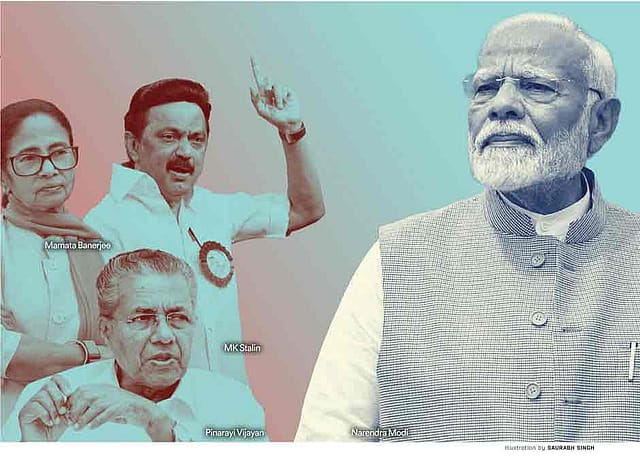
The politics over G-RAM-G is a part of a charged debate over regional autonomy and identity with Tamil Nadu Chief Minister MK Stalin calling for a rebalancing of powers between the states and the Centre. In an article penned for The Hindu, the chief minister argued that over-centralisation leads to one-size-fits-all policies dictated by the Centre and prevents states from implementing locally adaptive solutions. The constitutional formulation of a “strong Centre” was possibly relevant soon after Independence when India’s unity faced several challenges but with the passage of time, such fears ought to subside and the autonomy of the states be enlarged. Interestingly, Stalin argues that initial spells of single-party rule encouraged a ‘high-command’ culture that kowtowed to Delhi, an assertion that amounts to a swipe at ally Congress. The emergence of coalition governments and regional parties produced a more “federal” order, the chief minister says, drawing on the report of a committee on Union-state relations headed by former Supreme Court Judge Kurian Joseph.
The argument that coalition governments at the Centre enlarged regional representation and gave voice to parties wedded to state agendas can be a beguiling one. While the National Front (11 months) and United Front (under two years) governments were short-lived, the National Democratic Alliance (NDA) and the United Progressive Alliance regimes lasted longer. The crucial factor, however, was the size and clout of the largest component in the alliance. The National Front was a precarious creation dependent on both the Left and the Bharatiya Janata Party (BJP), while its central component, the Janata Dal, was far from stable. The second Vajpayee government (13 months) was kept on tenterhooks by the late All India Anna Dravida Munnetra Kazhagam (AIADMK) leader J Jayalalithaa and it was only the third edition, when BJP won 182 seats, did the coalition become immune from the whims of regional leaders. The two UPA governments (2004-14) were held together by a shared desire to keep BJP out of office even though some of the parties had been part of NDA previously. It helped that Congress won 145 and 206 seats in 2004 and 2009, respectively. The corruption, sloth and indecision of the UPA governments were an important factor that propelled Narendra Modi’s rise on the national scene as a viable and credible alternative. Barring certain geographies, BJP overwhelmed Congress and muscular regional parties like Samajwadi Party, Rashtriya Janata Dal and the Nationalist Congress Party, and won a Lok Sabha majority in 2014, and again in 2019.
Despite a setback in the 2024 Lok Sabha poll, BJP is back on track after winning important state elections and has become a larger factor than it ever was in the forthcoming Assembly polls where leaders and coalitions emphasise regional “models”—the Left in Kerala, the “Dravidian” in Tamil Nadu and “Trinamool” scheme under West Bengal Chief Minister Mamata Banerjee. To a varying degree, all three embody a certain exceptionalism that is at odds with BJP’s stress on nationalism and—despite diversity in custom and tradition—a shared cultural heritage. This has led to sharp differences on issues such as language where Stalin and Dravida Munnetra Kazhagam (DMK) made Tamil Nadu’s two-language policy a matter of identity. BJP leaders are not unaware of the pull of regional ideology and have sought to align the party with specifics of state scenarios. In Tamil Nadu, it is the junior partner of AIADMK and in West Bengal, it has promised to preserve the state’s cultural and religious balance by acting against illegal infiltrators. In Kerala, it is allying with smaller parties in a bid to increase its popular reach. Yet, the party does stand for a strong Centre that sees Sardar Patel as its inspiration.
While BJP is not shy of expressing its commitment to nationalism, the party has responded to criticism by pointing out that Congress has been a serial offender against state governments ruled by parties it differed with. BJP leaders say the Gujarat government under Modi was constantly in the crosshairs of UPA and that this has been a trend associated with Congress since the dismissal of the Kerala government in 1959. The saffron party is now looking to turn the heat on governments headed by regional parties accusing them of fostering corruption and inefficiency and being weak on matters of national security such as illegal immigration. In this context, it offers the “double-engine” government model where the state and Centre are aligned as one that will deliver governance efficiently. The three opposition-ruled states present a picture of varying levels of governance with Tamil Nadu seen as a better functioning example. The UPA coalitions were seriously hamstrung in acting against errant ministers from regional allies and even portfolios were allocated on the basis of power-sharing arrangements. BJP has demonstrated that a tally of 240 in Lok Sabha is sufficient if decisions are taken expeditiously belying expectations that it would be pegged back by its dependence on the Telugu Desam Party (TDP) and the Janata Dal (United). The passage of contentious legislation such as the Waqf (Amendment) Bill, 2025 offer a new political and social vision that would have been unthinkable in the days of previous coalitions.
The regional models in Tamil Nadu, Kerala and West Bengal may well survive the saffron surge but the debate is heated and the contending claims present voters with choices that have seldom been so polarising, emotive and intellectually challenging.