Thackeray Cousins Formally Reunite Ahead Of BMC Polls
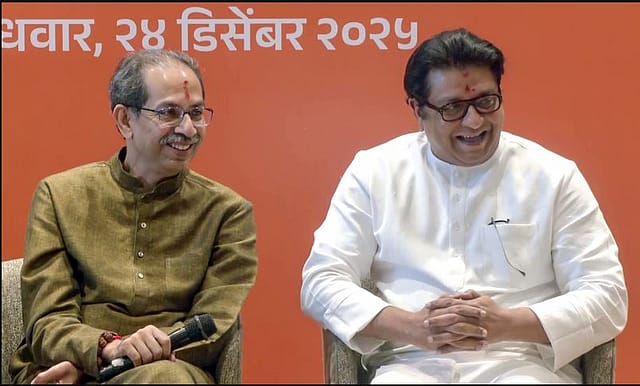
After months of speculation, the once embattled cousins Uddhav Thackeray and Raj Thackeray formally announced their electoral alliance for the upcoming Brihanmumbai Municipal Corporation (BMC) and other civic polls earlier today.
The day was filled as much with symbolism – to lay claim to Bal Thackeray’s legacy and underline the burying of old grudges – as an attempt to frame the upcoming municipal elections as the last stand to regain Marathi pride. It began with Uddhav driving to Raj’s house in Dadar, where the latter’s mother Kunda Thackeray would perform an aarti, followed by a visit, along with their respective families, to pay their respects to Bal Thackeray’s memorial at Shivaji Park, and then finally sitting together, along with Sanjay Raut, who has been pushing for this alliance, to announce their tie-up at a press conference. “I am advising all Marathi people. If you make a mistake now, you will be finished. If you get divided now, you will be completely destroyed… So don’t get divided, don’t split, don’t waste the Marathi pride,” Uddhav said. Seated beside him, his once embittered cousin Raj would describe their coming together as a kind of duty towards the state. “...Maharashtra is bigger than any dispute or fight and that is where we started coming together,” Raj said. “We are announcing the alliance… for which Maharashtra has been waiting for a long time.”
The tie-up between Shiv Sena (Uddhav Balasaheb Thackeray) and Raj Thackeray’s Maharashtra Navnirman Sena (MNS) marks a major realignment after years of bitter estrangement between the cousins. The alliance will span key municipal corporations including Mumbai and Nashik, with leaders indicating a broader understanding for other civic bodies going to polls in January.
Both the parties face an existential threat. Uddhav’s Sena has been in a free-fall ever since Eknath Shinde left the party with a large chunk of its leaders. Uddhav’s Sena seemed to have done fairly well during the general elections last year, but that proved to be a false dawn, with its core messaging of a betrayal by Shinde not enthusing voters enough to vote for it in the state elections a few months later. Raj’s MNS, with its old Sena-like playbook of rough and ready street politics, might have started with a bang when he first established the party back in 2006, but it has never been able to establish itself as a viable political entity and the many flip-flops of Raj has hurt its credibility. Strategists in both Uddhav’s and Raj’s parties hope that their coming together could rejuvenate old loyalists to vote for the party again and stop the fragmentation of the Marathi vote bank.

Iran After the Imam
06 Mar 2026 - Vol 04 | Issue 61
Dispatches from a Middle East on fire
At the press conference, the two framed their alliance clearly around a Marathi-first plank. Declaring that “the Mayor of Mumbai will be a Marathi,” Raj Thackeray underlined that the central guarantee of the new front is to restore political control of the city to “our people” and prevent what he described as outside forces from capturing the civic body. Uddhav Thackeray, for his part, cast the alliance as a defence of regional identity, saying, “We have come together to stay together and to foil attempts to divide Mumbai or isolate it from Maharashtra,” while pointedly appealing to the Marathi manoos to remain united. “Marathi people sacrificed and brought Mumbai into Maharashtra. It is natural to remember this today,” he continued. “I will not tell you the history after that. But when Maharashtra got Mumbai, outsiders started dancing on the shoulders of Mumbai’s Marathi people and Balasaheb Thackeray had to give birth to Shiv Sena for fair rights… today, once again, the intentions of… Delhi are to break Mumbai’s resilience.”
While this new alliance will bring its complications to the opposition, it also raises uneasy questions for allies. Uddhav’s Maha Vikas Aghadi (MVA) partner Congress, which is worried any proximity with an alliance that features MNS would alienate its North Indian and Muslim voter base, has so far signalled that it will contest the BMC elections alone. Interestingly, hatchets may be burried not just in the Thackeray households. Yesterday, a senior leader in Sharad Pawar’s NCP faction revealed that the party had reached an ‘in principle’ agreement with Ajit Pawar’s faction to contest the municipal elections in Pune together. By the evening, once a brouhaha broke out, Supriya Sule denied such an agreement had been reached and claimed the decision to include Ajit Pawar’s NCP into an alliance will only be taken after “consultations with everyone”. Meanwhile, conversations about Ajit Pawar holding phone being in touch with the Congress to stitch up an alliance have been doing the rounds for a few days now.
These moves exploring jumps from one alliance to another may raise questions about the future of these alliances. (For all one knows, these could just be ploys to extract better deals from their preexisting partners.) But they also reflect how high the stakes are this time. For some of these parties, a loss at these elections could well and truly signal their end.