Tamil Nadu: The Deepam Pitch
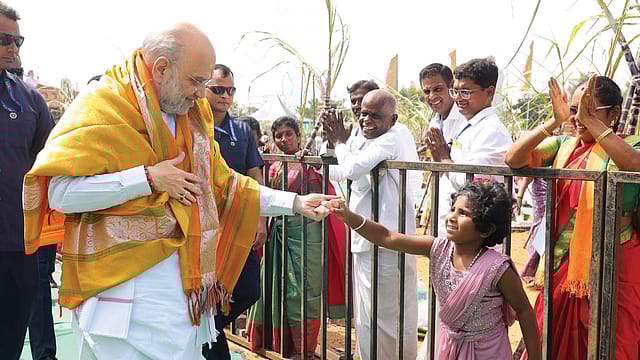
SANDALWOOD PASTE SMEARED on his forehead, clad in a white veshti (dhoti) and a saffron angavastram (stole), the Bharatiya Janata Party’s (BJP) newly anointed National Working President Nitin Nabin offered prayers at the Marudhamalai Murugan temple before attending to his other engagements on a two-day visit to Coimbatore. In his posts on X, he took on the ruling Dravida Munnetra Kazhagam (DMK), saying, “From the issue of lighting the lamp for Tamil god Murugan to crushing the beliefs of Hindus, Sanatana rituals are continued to be mocked. Corruption, family politics and pseudo religious politics are causing unceasing pain among people.” Equating it with Congress’ controversial stand on the Ram Setu in 2007, Nabin said DMK’s deriding of Sanatana beliefs will lead to its decline, starting from Coimbatore.
For BJP, Coimbatore, the second largest city in Tamil Nadu where Union Home Minister Amit Shah inaugurated the party’s district office in February 2025, has marked a watershed in its political odyssey in the state. In February 1998, after a series of bomb blasts, the first of which took place barely 100 metres from where then party president LK Advani was to address an election meeting in the run-up to Lok Sabha elections, killed 58 people, BJP won three seats making electoral inroads into the state for the first time. In the Coimbatore seat, where polling was postponed from February 22 to 28, BJP’s candidate and current Vice President CP Radhakrishnan won by a record 1,00,000 votes. J Jayalalithaa’s All India Dravida Munnetra Kazhagam (AIADMK) was in an alliance with BJP for the first time and defeated the ruling DMK, then led by M Karunanidhi. BJP, which had not won a single seat from the state in the previous four Lok Sabha Elections since 1984, notched up a vote share of 6.8 per cent. AIADMK won 18 seats, which lent support to the Atal Bihari Vajpayee government, though Jayalalithaa decided to withdraw support in under a year, forcing fresh elections in 1999.
Survival Instinct
22 May 2026 - Vol 04 | Issue 72
India navigates global economic turmoil with austerity and smart diplomacy
Much water has flown in Tamil Nadu politics and as DMK under Karunanidhi’s son and successor, Chief Minister MK Stalin, faces a litmus test, the party has responded fiercely to BJP’s attacks. Stalin has clashed with the Centre on issues of financial and legislative autonomy and while these draw on past precedent, the showdown over Hindutva and Sanatana issues is a new strand that belies the fact that BJP is a junior partner of AIADMK which does not emphasise such a strident ‘Hindu’ line. Stalin has taken on BJP over the National Education Policy (NEP) that advocates a three-language formula as “Hindutva” policy aimed at promoting Hindi and attacked BJP’s advocacy of Hindutva as “fake spirituality” and a political gimmick. Stalin has been careful not to run down Sanatana Dharma himself, but defended his son and minister Udhayanidhi’s remarks that the faith should be “eradicated”, saying the criticism was directed at discriminatory practices. The continuing BJP-DMK sniping makes it clear that the battle is well and truly joined.

In its current foray into Tamil Nadu’s political arena, BJP has rejuvenated its tie-up with AIADMK for the Assembly polls this year, after the two parties broke up in 2023. With both keen to challenge the ruling DMK, BJP wants to change the terms of engagement, reluctant to just play second fiddle to the Dravidian party. BJP leaders in Delhi say it is too early for seat-sharing talks for an election expected more than two months later, but there is speculation over the party’s demand for a larger share of seats and in government, if the National Democratic Alliance (NDA) comes to power, following meetings between Amit Shah and AIADMK leaders, including former Chief Minister Edappadi K Palaniswami, in the national capital. Apart from the seat calculations, the BJP brass has tried to persuade Palaniswami about the need to unify all anti-DMK forces, including former AIADMK leaders O Panneerselvam and TTV Dhinakaran.
BJP’s calculations to seek more seats as well as its articulation of Hindutva are apparently based on arithmetic—in the 2024 Lok Sabha results, AIADMK cornered a vote share of 20.4 per cent and BJP 11.2 per cent, an increase of 7.58 per cent from the previous election for the latter. While AIADMK, which had snapped ties with BJP in September 2023 citing comments “belittling” its former stalwarts, lost all 34 seats it contested, BJP also did not win any of the 23 seats it had put up candidates for. BJP had contested 20 of the 234 seats in the 2021 Assembly polls after its vote share in the 2019 Lok Sabha elections was 3.58 per cent, down by 1.98 per cent from the previous election. Although its vote share more than doubled in the last Lok Sabha polls, BJP sees the benefits of reviving its alliance with AIADMK, apprehending limits to its hopes of expansion if it fought on its own. AIADMK, which had contested 179 seats in 2021, would like to reach the majority mark of 118 on its own and dispense with any power-sharing.
About a decade after identifying “catchment areas” in Tamil Nadu, BJP is trying to carve out a space for itself in the state, so far dominated by Dravidian politics, which has its origins in the quest for social equality, opposing Brahmin dominance, standing up for rationalism, and pitching itself against Hindu nationalism. BJP’s latest plank is the controversy over lighting the lamp on the sacred Thiruparankundram hill near Madurai, an issue which has brought it to loggerheads with DMK. Dubbing the ruling party anti-Hindu, in a bid to consolidate the Hindu vote, BJP is hoping to cash in on an ideological war with the Dravidian party, with AIADMK, another Dravidian party, by its side. Although AIADMK had been opposed to the lighting of the lamp at the deepathoon (stone pillar), favouring the traditional temple location, during its late supremo Jayalithaa’s tenure, Palaniswami is now backing BJP’s stand which, observers say, may have some resonance among Brahmins and upper castes.
In 2023, however, even for Palaniswami it had been difficult to digest Annamalai’s attack on DMK founder CN Annadurai and Justice Party chief PT Rajan, both atheists, during the Sanatana Dharma controversy triggered by Udhayanidhi Stalin’s remarks. AIADMK walked out of its alliance with BJP, which then replaced Annamalai with Nainar Nagendran, realising that it required a formidable alliance to fight DMK which has swept the 2019 and 2024 Lok Sabha elections and the 2021 Assembly polls. It was after the debacle in the 2024 Lok Sabha polls that AIADMK renewed its alliance with BJP.
With the BJP training its guns on DMK and Stalin retaliating, the perception war is that of a BJP versus DMK show, more than a DMK versus AIADMK battle. However, on the ground, BJP, seen as a Hindi-belt, Hindi-centric party alien to Dravidian politics, needs AIADMK in the state. At the end of the day, AIADMK is a Dravidian party though it may have lost minority votes because of its association with BJP whose core Hindutva ideology juxtaposes Dravidian tenets. Stalin, in his Pongal message to the people of the state on the eve of the four-day celebrations of the harvest festival, projected its Dravidian model, saying it was a cultural expression, irrespective of caste, religion, social status or gender. He used the epistle to attack BJP, accusing the Modi government of discriminating against the state.
According to a veteran politician from Tamil Nadu, neither power sharing nor temple politics works in the state. Even if every individual in Tamil Nadu is religious, it may not reflect on the vote, said the leader. On the question of power sharing, he said people want a stable government and have rejected pre-poll power sharing in the past. After the collapse of the Charan Singh government at the Centre in 1979, when fresh parliamentary elections were held in 1980, the Congress-DMK alliance won 37 of the 39 seats in the state. Nudged by DMK, which said MG Ramachandran’s AIADMK government in Tamil Nadu had lost the confidence of the people, the Centre dismissed it. Congress and DMK, after much mulling, agreed on fighting an equal number of seats for the Assembly elections held just four months later. Though Karunanidhi was declared chief ministerial candidate, there were concerns about the repercussions in case DMK got fewer seats than Congress. The electorate rejected the alliance, which managed to win just 69 of the 234 seats, and AIADMK returned to power.
The experiment left a bitter taste about a national party seeking a stake in power in Tamil Nadu where the two Dravidian parties have alternately held pole position since 1972, when AIADMK was formed by breaking from DMK, with national parties allying with either. After the 1980 experience, Congress followed a formula of one-third seats for itself and two-thirds for the regional party in Assembly elections and the reverse in Lok Sabha polls till 1996, when GK Moopanar formed the Tamil Maanila Congress (Moopanar).
This time, however, the state’s political chess board has more players—actor-turned-politician Vijay’s Tamilaga Vettri Kazhagam (TVK), which has resonance among the youth, fishermen and minorities, and Naam Tamilar Katchi (NTK) coordinator S Seeman, a filmmaker-turned-politician who advocates Tamil nationalism and attacks even Dravidian parties. Opposition leader Rahul Gandhi’s post on X, backing Vijay in the controversy over release of his film Jana Nayagan, has raised questions about the strategy of Congress which has been an ally of DMK. “The I&B Ministry’s attempt to block Jana Nayagan is an attack on Tamil culture” Gandhi wrote. Meanwhile, amid the feud within the Ramadoss family, there is speculation that S Ramadoss, founder of the Pattali Makkal Katchi (PMK) which has influence in northern Tamil Nadu’s Vanniyar belt, may lean towards the DMK-led alliance while his son Anbumani has joined NDA.
With still some time left for parties to indulge in brinkmanship, the script is yet to be fine tuned in the making of Tamil Nadu’s next blockbuster.