Tamil Nadu Assembly Elections 2026: Vijay - A Star is Reborn
VIJAY IS SEATED in plain sight, in the front passenger seat of his campaign car, a large white recreational vehicle (RV), framed with a massive, tint-free windscreen for best visibility. But it is nearly impossible to see him, sometimes even from a few feet away. For, every square inch of the RV’s glass front is covered in handprints, a fresh supply of palms seamlessly thickening the coat over and over again so that the windscreen seems fogged over; even though it is the stroke of noon in the peak of Chennai’s summer.
The motorcade for this Tamilaga Vettri Kazhagam (TVK) roadshow in north Chennai in early April, helmed by the party’s founder himself, the superstar actor-turned-politician Vijay, is a slender one by itself: a cop car in the front, followed by a media van and rounded up by Vijay’s RV. But because of the size of the crowd surrounding Vijay’s vehicle on foot, the convoy has the feel of something far larger and monstrous, crawling towards the first stop of today’s multi-halt rally, Perambur. The significance of making this locality his first port of call is not lost on anyone. This is where the actor grew up. Therefore, the constituency of Perambur has also been chosen as one of the two seats he will personally contest from (Trichy East being the other) in the upcoming Tamil Nadu Assembly elections.
To witness Vijay’s splash into politics, or simply to catch a fleeting glimpse of his face, thousands upon thousands of fans and supporters have surrounded the moving vehicles, so much so that four bodyguards—two on each side of the van—hang perilously on the outside, pressing up against the many entry points into the RV with their bodies. Flowers are thrown onto the windscreen, only for them to be wiped away by more hands, so selfies can be clicked, the crowd closest to the big wheels uncaring about the ever-present danger of being run over. Close or far, all hands in this swell are raised, each palm holding a smartphone with lenses trained at a blurry image of Vijay.
This very tangible mania hasn’t just halted traffic on the road to Perambur but has cast a far wider web of gridlocks. When the procession passes under a flyover, the bridge itself comes to a standstill, with drivers and passengers alike leaning over the railing, all across the arch’s different vantages. Then, as the trail of chaos leads to the bus stand in Perambur, cars lie abandoned on the other side of the road even as hooting fans packed on a low divider cheer violently as the TVK motorcade passes them.
Like this, the procession approaches the bus stand, where the thousands once surrounding the RV melt into the waiting crowd of a few thousand more, most of them dressed in white and draped in scarves of red and yellow—TVK’s party colours. Only once the police have successfully isolated Vijay’s vehicle does the superstar emerge through the sunroof, armed with a microphone in hand, and the blast of noise has a seismic effect on those present.
“Can you hear me?” Vijay asks, smiling. It is a pertinent question, for the roar below him is deafening. Vijay grins and waits for the noise to dissipate. On realising it won’t, he continues, in Tamil: “I was wondering where to begin my campaign. The answer was obvious: I should start with a locality I love.”
The applause is heavy, but Vijay knows better than to pause.
“All of Tamil Nadu I love, and I can start my campaign anywhere in this state. Having said that, what can be more auspicious than kicking off from my veetu vaasal (in front of my house)? What can be more auspicious than being here, the place where my mother raised me and made me who I am?”
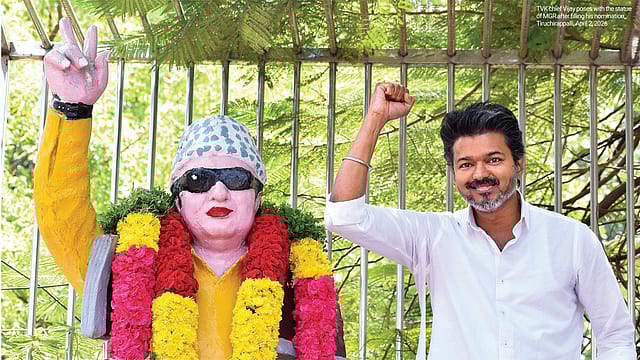
In unison, the crowd chants “Vee-jay! Vee-jay!” and I can see a few tears on the delirious faces close to where the media is cordoned off. At the same time, a veteran vernacular journalist standing next to me says: “I have witnessed this kind of craze in Tamil Nadu politics only once before this—when MGR converted his fandom to votes in 1977. If Vijay can do the same, it will be an even greater feat of success, because unlike MGR in 1977, Vijay has not been rooted in politics.”

The story of Vijay’s TVK does not begin with a party office or a manifesto but with something far more organic, and far more Tamil Nadu: the rasigar mandrams that have, for decades, doubled up as both sites of devotion and quiet mobilisation. What TVK represents is not so much the creation of a political structure as the formal acknowledgement of one that already existed in plain sight. The same men who once gathered to celebrate releases, paste posters through the night and organise welfare drives in their star’s name now find themselves doing much the same, only with a ballot in mind. As KV Damodaran, TVK’s district general secretary (south Chennai) had put it, the shift required little reinvention—the offices remained, the hierarchies held, only the purpose changed.
It is a model with deep roots in the state’s political imagination. The journey from screen to street, from mass mania to mandate, is one Tamil Nadu has seen before, most notably in the rise of MG Ramachandran, who understood early that devotion, if organised, could be converted into power. But where MGR’s politics was forged within the Dravidian movement, absorbing its language and its ideological certainties before breaking away, Vijay’s arrives less burdened by doctrine. His politics, as it has revealed itself so far, is not ideological as much as tonal—anti-corruption, pro-welfare, a promise of clean up governance—articulated in the same moral register that has long defined his screen persona.
In Perambur, he gives a taste of it immediately.
“I am here to save your Perambur, our Perambur and our Tamil Nadu from the terrible state it has fallen into, a place where our sisters and mothers are afraid for their safety,” he says. “What is the sole reason for women fearing for their safety in this state? I don’t need to tell you that the reason is Di-mu-ka.”
Di-mu-ka, or the phonetic abbreviation for Dravida Munnetra Kazhagam (DMK), the incumbent party in government, headed by Chief Minister MK Stalin.
“Stalin Sir thaan kaaranam (Stalin Sir is the reason).”
The fact that Vijay has suffixed the respectful ‘sir’ to his political rival causes both an enormous chuckle and a real sense of appreciation. The tone is a cunning ploy, a shift in voice audible well before the formal launch of TVK in 2024. Vijay’s public life had begun to blur more insistently with his politics, his films carrying sharper edges, less subtext and more signal. In The Greatest of All Time (2024), the messaging was no longer buried; it sat closer to the surface, addressing power, corruption and the idea of leadership with increasing directness.
The unreleased ‘Jana Nayagan’—which translates as ‘hero of the people’—only sharpened that trajectory, its stalled release this January becoming part of the larger narrative of a star edging into politics and the resistance that often accompanies that crossing. By then, Vijay’s fan clubs had already begun to take on a different shape, their welfare activities more visible, their coordination tighter, their sense of purpose shifting almost imperceptibly.
“What has Stalin Sir done over the last five years that the situation is so pathetic?” says Vijay, almost yelling into the mic. The otherwise soft features of his handsome face are now twisted in an angry frown. “There is no rice to eat or water to drink in people’s houses. How can we live like this?”
He pauses and there is something close to silence.
“Stalin Sir doesn’t care about people. You are not important to him. None of us are. Stalin Sir only cares about his family and dynasty politics. That’s all. That is why, I, Vijay, your Vijay, formed a political party to set things right.”
Ever since TVK was announced, Vijay has been careful how he frames his leap from reel to real. He casts himself as an outsider to Tamil Nadu’s entrenched political duopoly, keeping a studied distance from both DMK and AIADMK, even as he borrows, consciously or otherwise, from the traditions they have come to represent. The pitch is one of disruption, but delivered without overt aggression, as though aware that in a state where cinema and politics have long mirrored each other, performance itself must be calibrated.
That calibration can be seen real-time here in Perambur, for Vijay has replaced the scowl with a million-dollar, movie-poster smile. “It is now time to be confident in the fact that change is coming. It really is. So, on the morning of April 23, wake up, get ready, keep your voter ID in your hand and go to the first booth near your house. Once you are there, please place your vote in front of the whistle symbol. Because voting for anyone in TVK is akin to voting for me.”
As he says this, he points at a sticker on the top of the windscreen. There is the party sign, a yellow whistle, with the words ‘Namathu Vettri Chinnam Whistle’ (Whistle Is Our Winning Symbol)’ pasted below. He folds his hands one last time and swiftly lowers himself below the sunroof, the length of his appearance no longer than 10 minutes. The gathering swiftly dissipates, one section following the RV on foot even as others mount revving motorcycles in twos and threes, all of them headed towards the next stop of Villivakkam, located to the west of Perambur railway station.
But Vijay doesn’t reach Villivakkam. Somewhere along the choked arteries of urban villages between Perambur and the next halt, the procession gives way to its own excess—the crowds swelling beyond control, the police presence thinning against the surge. Word, in the form of messages on WhatsApp groups and then as news bulletins, trickles through: the rally has been called off. Vijay has turned back in the face of insufficient protection.
And just like that, the leviathan stalls. What had gathered in devotion begins to scatter in fragments—on foot and on bikes, into side streets—leaving behind the faint afterimage of a movement still learning how to contain the mania that powers it.