Tamil Nadu Assembly Elections 2026: The Last Bastion
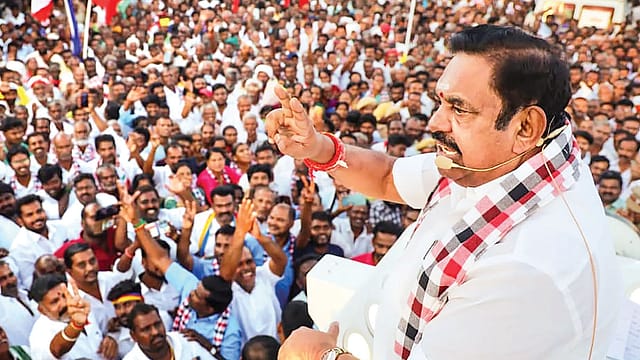
THE THOPPUR HILLS, a long undulating stretch of the Eastern Ghats in northern Tamil Nadu, lay at the edge of Dharmapuri’s hill country, just before the land opens out into Salem’s plains. A convoy of vehicles winds up these hills to pull up at the Chandranallur Mariamman temple. Sowmiya Anbumani, the AIADMK front’s candidate from Dharmapuri, swiftly delivers a speech centred on welfare, jobs and local issues. She refers to AIADMK President Edappadi K Palaniswami’s (EPS) promise of a one-time transfer of ₹10,000 to families. The party’s manifesto also includes refrigerators and three free LPG cylinders for all ration-card holding families.
“There is little job creation here despite the fact that the district ranks high in education,” she tells Open. “DMK had promised to reserve 75 per cent of jobs for locals who had given their land for industrial projects but this has not been implemented.” One of the most visible faces of Anbumani Ramadoss’ Pattali Makkal Katchi (PMK), Sowmiya is contesting from what is arguably the party’s safest seat in the Vanniyar heartland of northern Tamil Nadu. “I had lost the seat in the Lok Sabha election and I wanted to win from our home ground this time,” she says. Dharmapuri was one of the five seats PMK had won in the 2021 elections, with roughly 4 per cent of the total vote share. PMK is contesting 18 seats as part of the AIADMK-led NDA alliance. Some of these, like Dharmapuri, where Sowmiya is facing DMDK’s V Elangovan, have become prestige battles as PMK’s authority within its own core region now needs reaffirmation.
“The Vanniyar belt is not slipping away from PMK, but it is not a guaranteed reservoir of votes that can be delivered wholesale to an alliance partner,” says political analyst Raveendran Doraiswamy.
In neighbouring Palacode, where AIADMK’s KP Anbalagan is seeking a sixth consecutive term, DMK has fielded former MP S Senthil Kumar. As he campaigns in Erasikuttai, a village where water scarcity and landlessness are non-negotiable issues, he calls out Anbalagan for “failing an entire generation by neglecting basic necessities”.
“Palacode has remained poor and dry despite our proximity to Bengaluru,” says 65-year-old P Palaniamma, shelling tamarind on her front porch as her grandchildren listen to Kumar’s speech. “Women, in particular, have a reason to vote DMK because of the welfare schemes.”
In 2021, northern Tamil Nadu, including Chennai, Thiruvallur, Kanchipuram, and the surrounding arc moved almost decisively to the DMK-led alliance, which won a clear majority of seats in the region, leaving AIADMK with only a marginal presence in the urban-industrial north. The alliance with PMK, and even the late-stage Vanniyar reservation announcement, did little to reverse that tide. And yet, even in that defeat, western Tamil Nadu, the Kongu belt, held. The AIADMK-led front won close to two-thirds of constituencies in the region. This explains everything about EPS’ current political position. He is not merely a leader of AIADMK; he is the custodian of its last intact geography. If PMK can deliver Dharmapuri, Krishnagiri and Villupuram, the belt where caste arithmetic remains decisive, this region could be AIADMK’s bridge back into northern Tamil Nadu. Without that, AIADMK risks becoming a territorially concentrated party and not a statewide challenger. PMK, which sits at the hinge of that transition, is itself a split entity today, with S Ramadoss and his son going their separate ways.

“Slowly and wittingly, AIADMK and PMK are being cannibalised by BJP in the northern and western districts. With the late Vijayakanth’s party Desiya Murpokku Dravida Kazhagam (DMDK) also leaving the AIADMK alliance, Dalit and other community votes will transfer to the DMK alliance,” says D Ravikumar, Viduthalai Chiruthaigal Katchi (VCK) leader and MP, whose party is contesting six seats, including two in the general category as part of the DMK front.
The BJP impact is in fact visible on the ground. Where traditional AIADMK voters once rejected the national party, they are now more willing to acknowledge its leadership. In Rasankottai, a village in the Kaveripattinam block of Krishnagiri district, 60-year-old P Kuppamma credits the Union government for the Jal Jeevan Mission scheme, and for NEET. Chopping tomatoes for breakfast next to her 1.5 acre coconut and banana grove, she says one of her grandsons narrowly missed clearing NEET. “Despite decades of Dravidian rule, and despite being landowners, we could not educate our children. I hope at least my grandchildren are able to graduate and make a good living in the city,” she says.
This is Bargur in Krishnagiri district, a seat that carries the legacy of having elected, and later voted out, J Jayalalithaa. Its history is shaped less by loyalty than by the political mood. People here credit DMK’s incumbent MLA D Mathiazhagan with building a community centre, undertaking temple renovation and other local works and recommending unemployed youth for jobs at the Ola Electric factory in neighbouring Pochampalli and other industries that have come up in the district. He is pitted against AIADMK candidate EC Govinddarasan in a direct contest that could be complicated by the arrival of actor Vijay’s Tamilaga Vettri Kazhagam (TVK).
On paper, the DMK government has made a distinctly gendered pitch with its cash transfers, subsidised transport and targeted welfare that moves through women as both recipients and intermediaries of household stability. And yet, there is, on the street, a counter-narrative around substance abuse, women’s safety and corruption. If TVK represents a certain aspirational reset, then Seeman’s Naam Tamilar Katchi (NTK) remains something else entirely, his politics drawing from a deeper reservoir of grievance that neither welfare nor charisma has fully displaced. “Vijay and I are worlds apart. I don’t view him as a competitor,” Seeman says, speaking to Open. “His politics is based on glamour; mine is based on values. He wants to continue the freebie culture perpetuated by DMK and AIADMK, promising ₹2,500 a month to women where they have promised ₹2,000, and offering education loans of up to ₹20 lakh instead of saying the government will provide free world-class education for all. He says he is against BJP because of Hindutva but he himself is contesting from constituencies where he has hopes of bagging Christian votes.”
Still, wherever one speaks to voters, TVK enters the conversation unprompted. In Periyanaickenpalayam, Coimbatore district, the TVK office, a single small room next to a grocery store at a busy crossroads, is swarming with party men, fans and reporters. They are here to meet KA Sengottaiyan, part of AIADMK’s old guard in the Kongu belt whose estrangement from the party exposes the centralised authority under EPS. Chief coordinator of the administrative committee of TVK and de facto in-charge of the Kongu belt, he says this region that EPS has taken for granted is where the party’s internal contradictions are surfacing most sharply. Speaking to Open after canvassing for the TVK candidate in Mettupalayam, N Sunil Anand, he points out that both DMK and AIADMK stand divided and therefore weaker in Coimbatore and other Kongu districts. “EPS has to beg BJP for support. We have fielded fresh, clean candidates. The candidate is not important, the leader is everything,” he says. Sengottaiyan is contesting for the fifth consecutive time from Gobichettipalayam in Tiruppur district.
DMK’s lieutenant from Karur, minister and five-term MLA V Senthil Balaji, who was released from prison in 2024 on bail in an alleged cash-for-jobs scam, is contesting from Coimbatore South, a BJP-AIADMK bastion, in a bid to expand the party’s footprint across 35 seats in the Kongu region, which includes Coimbatore, Tiruppur, Namakkal, Salem, and Erode. He campaigns flamboyantly, surrounded by big crowds and introduced by able orators, even as BJP’s Vanathi Srinivasan, who is contesting from Coimbatore North this time, is unwell and unable to hit the road. “We will win most of the 10 seats in Coimbatore. Although we had a bad show here in 2021, we lost many seats by narrow margins. This time, our track record and our door-to-door campaigning will turn the tide,” says Balaji, who is contesting against AIADMK veteran Amman K Arjunan.
The battle for Kongu is being fought equally fiercely by AIADMK leader SP Velumani, a product of the region’s older political architecture, from his three-time constituency of Thondamuthur. Velumani is an everyday presence in his constituency, which may vote him back despite agricultural distress and the degradation of the Noyyal river.
In Avinashi, an agrarian reserved seat on the edge of Tiruppur’s textile sprawl, DMK is attempting something it has not managed in decades. V Gokilamani, a 28-year-old government doctor and the party’s youngest entrant, is positioned as a local first-generation political face shaped as much by public health work as by party work. A recent court ruling overturning the expulsion of a Dalit cook from a local school—the high school that Gokilamani attended—and holding those responsible to account has returned questions of caste and social justice to the centre of Avinashi’s politics. Set against her is BJP minister L Murugan, whose national stature turns the contest into a proxy for DMK’s rebellion against the Centre.
The Kongu belt is still AIADMK’s strongest ground, where holding on is no longer enough and losing even a little may mean losing the argument altogether. Because what is at stake is not just seats but the very premise on which AIADMK still claims to be a contender for power.