Tamil Nadu Assembly Elections 2026: Succession Rites
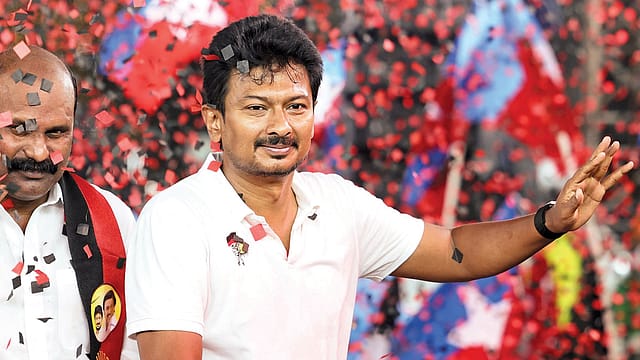
THE EVENING’S FIRST darisanam begins with the sound of temple bells echoing through Koil Street at Mylapore. But at this April dusk in Chennai, these pleasant sounds are drowned out by a man singing into a microphone on a crowded stage, a carpeted platform packed with dignitaries from DMK, all of them in eager wait for the arrival of Udhayanidhi Stalin. But the roadshow helmed by Udhayanidhi, the incumbent deputy chief minister of Tamil Nadu, is late. So, the welcome party, as well as the small crowd—made up largely of DMK and Congress workers—are entertained by the singer and his assistant on the keyboard.
With the aid of massive amplifiers, the song carries easily to the eponymous koil, or temple, on one side of the street and even to the far reaches of the BR Ambedkar Bridge on the other. “All over beauty… karuppu kannadi… Kalaignar personality,” the singer croons, the largely English lyrics delighting and amusing the onlookers in equal measure. The song is about Kalaignar, the honorific title given to M Karunanidhi, Udhayanidhi’s grandfather and the longest-serving chief minister of Tamil Nadu. But just as the singer enters a chorus about the karuppu kannadi—Karunanidhi’s signature dark glasses—the song stops abruptly. For, a DMK dignitary has snatched the mic to make an announcement about a misplaced mobile phone he found under his chair.
A young lady, wearing an embarrassed look, emerges from the gathering and claims the phone. The dignitary hands it over and is visibly pleased with himself. “Parunga (Look),” says the DMK man, “we immediately returned a lost phone. Such is the honesty of our party, DMK. If this were any other party, they would have stolen it because they are all thieves.” The spectators clap and whistle. Happy with the response, the dignitary continues. “This is the beauty of our kootam (crowd), Di-mu-ka (DMK) kootam. Our greatness lies in the values taught by our leaders, values that have passed down from generation to generation, from Karunanidhi to his son and our thalaivar, Chief Minister MK Stalin, and now to his son, Udhayanidhi, who will be gracing us with his presence shortly.”
Having spun lineage into a virtue, the dignitary receives a resounding roar in response, a sound that only swells with the sudden and immediate arrival of Udhayanidhi’s motorcade, the deputy chief minister having climbed through the sunroof of his campaign car, a jet-black recreational vehicle (RV). Standing beside him is Mylapore’s incumbent MLA, Dha. Velu. Together, they fold their hands at an audience that has fast filled all of Koil Street, the temples and shops now empty after having poured out into the barricaded lane.
Someone from the gathering offers Udhayanidhi a sword. He draws the weapon from its sheath and poses for the cameras. Another, a woman, hands him an infant, barely a few weeks old, and asks the leader to name him. “Udhaya Suriyan,” says Udhayanidhi, without missing a beat, having named the child after the ‘rising sun’ symbol for his party. Baby returned to his mother’s bosom, Udhayanidhi addresses the masses. “I came here to Mylapore to ask you all to vote for the Udhaya Suriyan symbol. But after seeing you all, I can see that you have already made up your mind to give us victory. I think our victory and DMK 2.0 is guaranteed, don’t you?”
In many ways, Udhayanidhi is the very representation of DMK 2.0, attempting to carve out a name from within a family that has long defined the party. In Tamil Nadu, politics is usually learned the long way—through years of waiting, of being seen and tested. Udhayanidhi Stalin has attempted something far more compressed: a political life fast-forwarded into the present, where inheritance is not concealed but carried out into the open, tested in full public view.
His formal entry came as recently as 2019 when he took charge of DMK’s youth wing, the same launchpad his father, MK Stalin, had once occupied for decades before inching his way up through the party’s dense hierarchy. What has followed since has been a climb so steep it almost resists the usual route of ascent—an MLA seat from Chepauk-Triplicane in 2021, a cabinet berth soon after, and by 2024, the office of deputy chief minister. Five years, where others have taken 30.
Some 10 minutes into his speech, Udhayanidhi is forced to stop by a section of the crowd to his left. In one voice they let him know that he could not be heard, perhaps due to a faulty mic. “You didn’t hear anything I had to say thus far, is it?” he jokes, before summing up everything he had to say in one line. “So far, I spoke about what we did for the last five years, followed by what we will do over the next five years. That’s all.” The audience is pleasantly surprised by his wit and delivery and the smile on Udhayanidhi’s face reveals that his training in cinema wasn’t for nothing.

A producer first and then a main lead in his own productions, Udhayanidhi learnt early the rhythms of performance—the pause, the punchline and, of course, the instinct to read a crowd. But the cinema he came from did not give him the mythic aura that once powered MG Ramachandran (MGR) or Jayalalithaa; or even his own grandfather for that matter, whose scripts made him one of the most famous off-screen personalities in the Tamil film industry. Instead, it offered his party a face people already knew, which DMK could then circulate, amplify, and steep into everyday contact.
His first outing as a producer, Kuruvi (2008), carried Vijay in the lead—an early collaboration from another life that now sits, almost neatly, on the opposite side of the political divide. But tonight on Koil Street, superstar Vijay’s Tamilaga Vettri Kazhagam (TVK), a new party that has turned this state’s entrenched political duopoly into a triopoly for the upcoming Assembly elections, slips under Udhayanidhi’s radar, barely warranting a mention. Rather, he takes on his old foes from AIADMK. Especially its general secretary and leader, Edappadi K Palaniswami (EPS).
“Who is our No 1 in DMK? It is Thalaivar (Stalin) without a doubt. But who is the No 1 in AIADMK? No, it is not EPS but Narendra Modi. For every little thing, Edappadi goes running to Delhi to seek permission,” Udhayanidhi says, drawing enormous laughter. “It is true. It is also true that since Jayalalithaa died in 2016 and Edappadi became the head of their party, all bad things that happened in Tamil Nadu happened on his watch. He immediately brought in NEET, in cahoots with BJP. When BJP brought in these bad schemes into our state, AIADMK stood with them. None of this had happened when we were in power. In fact, Thalaivar has assured us that whatever happens, we will not let Hindi become a language in our government schools. You also know that the opposition will allow it to happen.”
Just as he says this, a geriatric lady standing in the crush in front of me cracks her knuckles on her temples and grins. She shouts to be heard by her daughter and says: “I will vote for Di-mu-ka till the day I die because they put Tamil Nadu first. Even this third-generation leader is a man of principle. Look how well he has exposed all that is wrong with AIADMK in a few sentences.”
In a state where political memory is long and hierarchies are usually hardened over time, Udhayanidhi’s manicured path to heir-apparent seems almost planned. For his critics, it is the clearest expression of dynastic power, the distance between debut and deputy chief minister accelerated by surname. But within DMK it is framed as something else entirely: a leader who has been placed early before the people and has held his ground here and there, who has drawn and engaged crowds, all the while learning to speak in the language that the road demands.
Udhayanidhi continues, pedal to metal. “This election, then, is about Tamil Nadu versus New Delhi. We now know that the captain of Tamil Nadu is our thalaivar and the captain of Delhi is Modi,” he says. “Let me also tell you, if you did not know earlier, that Delhi wants to control Tamil Nadu from far away. Who is the remote control? That’s right, Edappadi Palaniswami. I say that let’s show Delhi that we will never be remote controlled. With DMK and with your support, Tamil Nadu will always remain ‘out of control’.” The words “out of control”, signifying freedom more than chaos, are spoken in English.
It is in this layering—of lineage and labour— that Udhayanidhi’s politics truly identifies itself. He does not deny where he comes from; rather, he leans into it, repeatedly, invoking it as familiarity rather than entitlement. His succession, therefore, is rehearsed, night after night, until it begins to settle into place.
“To you all assembled here in Mylapore, I don’t really have to say it, because I know you will do what is right on April 23,” he says, before pausing for a chuckle, then continues, “But because I have to, I will say it again. As your brother, son of Thalaivar, grandson of Kalaignar, I ask you to please vote for our chinnam (symbol), Udhaya Suriyan, and help us win this election by a landslide.”
Udhayanidhi waves and presses his palms together, lowering himself into the vehicle even as the crowd waves back, through a thicket of raised flags and hands. The street begins to loosen at the edges, a few groups peeling away to retrieve their parked scooters, inching them carefully through the barricades. The newly named baby, Udhaya Suriyan, and his mother attract plenty of attention from the locals of Mylapore. But despite the buzz around Koil Street, the sound of temple bells easily seeps through the ambient noise, calling the faithful for the last darisanam of the evening. n